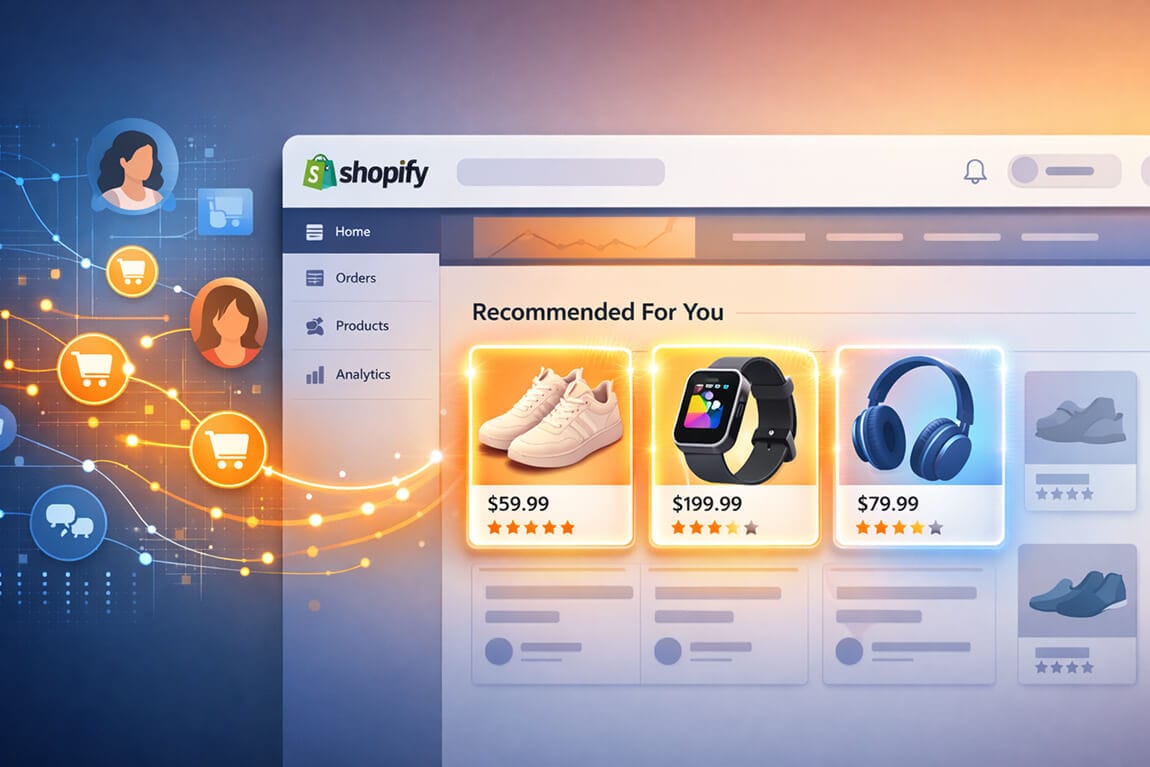
How Product Recommendation Algorithms Actually Work (And Why Your Store Needs One Yesterday)
The behind-the-scenes math that turns browsers into buyers, explained for merchants who'd rather sell products than study data science.
She had 1,200 SKUs and a 1.4% conversion rate.
That's where Sarah was when she emailed us. She runs a Shopify store selling home decor. Candles, vases, throws, wall art. Beautiful products. Solid traffic. But visitors were bouncing after viewing one or two products, like they'd walked into a gorgeous store and couldn't find the section they wanted.
Her "You May Also Like" section? It was showing random products. A customer looking at a minimalist ceramic vase was being recommended a rustic wooden picture frame and a scented candle shaped like a cactus.
That's not a recommendation. That's a coin flip.
Here's what most Shopify merchants don't realize: the difference between a store that converts at 1.4% and one that converts at 3.2% often comes down to one thing. How well you recommend products.
Not whether you recommend them. How.
And that "how" is powered by something called a product recommendation algorithm. Let me break down how these actually work, without the computer science PhD, and more importantly, what this means for your revenue.
What Is a Product Recommendation Algorithm, Really?
Strip away the jargon. A product recommendation algorithm is a set of rules that decides which products to show to which customers, and when.
That's it.
When you see "Customers Who Bought This Also Bought" on Amazon, that's an algorithm at work. When Netflix suggests a show you end up binging for three days, that's the same idea applied to content.
For ecommerce, product recommendation algorithms analyze signals like what a customer is browsing, what they've purchased before, what similar shoppers have bought, and what products share common attributes. Then they surface the products most likely to get a click, an add-to-cart, and a purchase.
Here's the important part: Product recommendations account for up to 31% of ecommerce revenue, according to research by Barilliance. That's nearly a third of your sales driven by the algorithm behind the "you might also like" section.
And yet, most Shopify stores either use no recommendation engine at all, or they rely on Shopify's default related products feature, which is about as smart as organizing your closet by the color of the hangers.
The 4 Types of Product Recommendation Algorithms (Simplified)
Stay with me here. I'm going to explain the four main types of recommendation algorithms in a way that actually makes sense for someone running a store, not a lab.
1. Collaborative Filtering: "People Like You Also Liked This"
This is the most popular recommendation algorithm on the internet. Amazon popularized it decades ago, and it still powers a huge chunk of online product discovery.
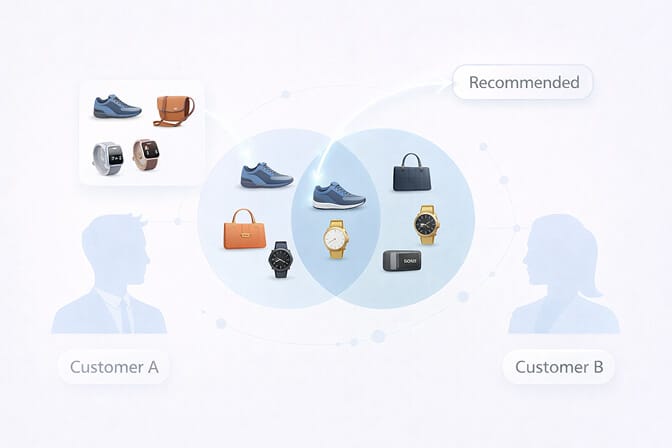
The idea is simple: if Customer A and Customer B have similar shopping behavior (they bought the same three products), then products that Customer A bought but Customer B hasn't seen yet are good recommendations for Customer B.
Think of it like this. You're at a dinner party. Your friend who has the exact same taste in restaurants as you says, "You need to try this new Thai place." You trust that recommendation because their preferences mirror yours.
Collaborative filtering works the same way, just at scale. It doesn't care why you like a product. It only cares that people with similar patterns tend to like similar things.
The catch? It struggles with new stores and new products. If you don't have enough customer data yet, the algorithm doesn't have enough patterns to work with. This is called the "cold start problem," and it's the reason brand new Shopify stores can't rely on this approach alone.
2. Content-Based Filtering: "This Product Is Similar to What You Already Like"
Instead of looking at what other customers do, content-based filtering looks at the products themselves.
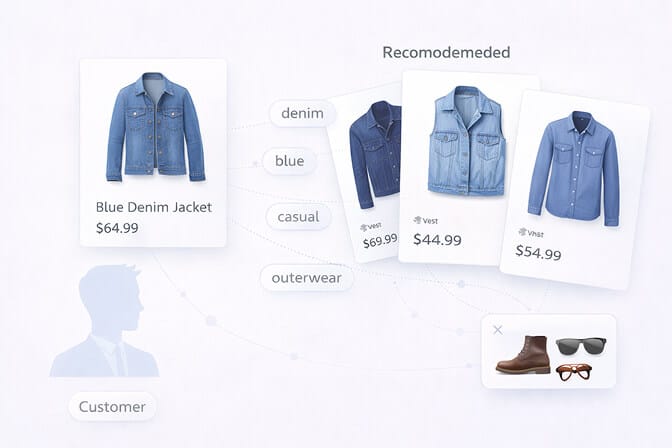
It analyzes product attributes like category, color, material, price range, brand, and tags. Then it recommends products that share characteristics with items a customer has already viewed or purchased.
Example: A customer browses three different blue denim jackets on your store. A content-based algorithm knows to show them more denim jackets, maybe in different washes or fits. Not leather boots. Not sunglasses. More of what they clearly want.
This approach is excellent for stores with rich product data. If your Shopify products are well-tagged with attributes, a content-based engine can make strong recommendations even without a massive customer base.
The downside? It can create a "filter bubble." If someone only gets shown products similar to what they've already seen, they never discover something new. The customer who came for a denim jacket might also love the vintage leather belt on your site, but a pure content-based system might never show it to them.
3. Hybrid Filtering: The Best of Both Worlds
This is where things get interesting.
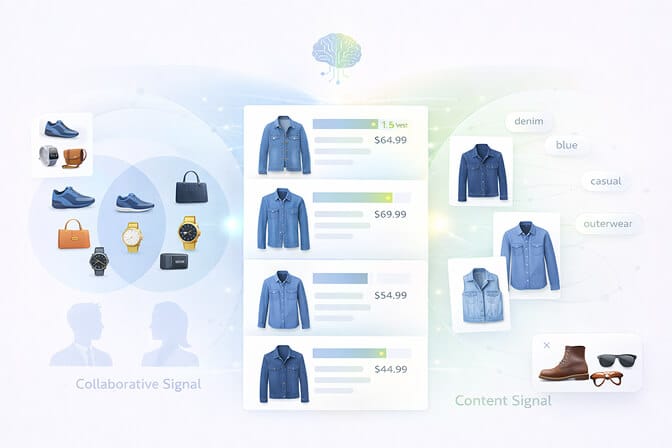
Most modern recommendation engines don't use just one approach. They blend collaborative filtering and content-based filtering into a hybrid system.
The collaborative side says, "Shoppers similar to you also bought this leather belt." The content-based side says, "Based on the denim products you've been browsing, here are more denim items." The hybrid engine combines both signals and ranks the results by what's most likely to drive a purchase.
This is what Amazon, Netflix, and Spotify all use. And it's increasingly what smart Shopify apps are adopting too.
The hybrid approach solves the cold start problem (content-based filtering kicks in when you don't have enough user data) and avoids the filter bubble (collaborative filtering introduces variety). It's the approach that consistently drives the highest conversion rates across ecommerce.
Key takeaway: If your recommendation system only uses one method, it's leaving money on the table. The best systems blend multiple algorithms to cover each other's blind spots.
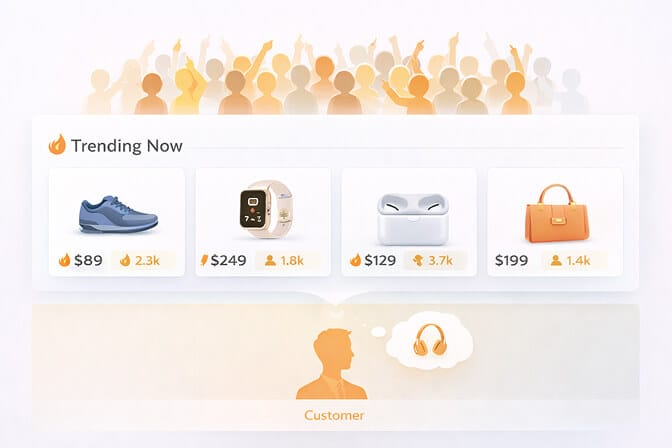
4. Popularity-Based Recommendations: "Here's What's Trending"
This is the simplest algorithm, and the one most Shopify stores accidentally default to.
Popularity-based recommendations show your best sellers, trending items, or most-viewed products to everyone. No personalization. No analysis of individual behavior. Just "here's what's hot."
Is it useful? Absolutely. Especially for new visitors with no browsing history. Showing your best sellers to first-time visitors is a proven conversion tactic.
Is it enough? Not even close.
Popularity-based recommendations treat every customer the same. A 22-year-old shopping for trendy earrings and a 55-year-old shopping for reading glasses both see the same "Best Sellers" section. That's a missed opportunity for personalization that directly impacts your revenue.
And This Is the Part That Costs You Money
Here's where most Shopify store owners get it wrong.
They install a recommendation app, turn on the default settings, and forget about it. Or worse, they manually curate "related products" for their top 20 items and ignore the other 980.
The truth? A product recommendation algorithm is only as good as the data it works with and the intelligence behind it.
If your search and discovery tools don't understand what your customers actually mean when they type a query, if your product data is messy, if your filters don't help narrow things down, then even the best recommendation algorithm is building on a shaky foundation.
This is why AI-powered search and discovery matters so much. When your search engine actually understands shopping intent, processes natural language queries, and tracks what customers are looking for, it feeds better data into your recommendation engine. Better data means better recommendations. Better recommendations mean more revenue.
It's a loop. And most stores break it at the search step.
Where Product Recommendations Actually Go on Your Store
Algorithms are great. But placement matters just as much.
Here are the spots where product recommendation algorithms drive the most revenue on Shopify stores:
Product pages. This is the classic "You Might Also Like" or "Frequently Bought Together" placement. When a customer is already looking at a product, showing complementary or similar items is a natural extension of their shopping intent.
Cart and checkout pages. "Customers who bought this also added..." is incredibly effective here. The customer has already committed to a purchase. The friction to adding one more item is low. This is where upsell and cross-sell recommendations shine, and it directly helps reduce cart abandonment.
Homepage. For returning visitors, showing personalized picks based on their browsing history creates an immediate sense of relevance. For new visitors, trending and popular products work well as a starting point.
Search results pages. This one is underrated. When a customer searches for something and your search results show relevant products alongside smart recommendations, the entire experience feels curated rather than random.
Email campaigns. Post-purchase recommendation emails, abandoned cart reminders with personalized suggestions, and re-engagement emails with "new arrivals you'll love" all drive repeat revenue. If you need help with this, check out our guide on email marketing best practices.
The stores that win aren't just using recommendations in one spot. They're threading them through the entire customer journey.
The Metrics That Actually Matter
You've implemented a recommendation algorithm. It's live. Now what?
Here's what to track:
Click-through rate on recommendations. Are customers actually clicking on the products you're suggesting? If not, the algorithm's relevance is off.
Recommendation-attributed revenue. What percentage of your total sales can be traced back to a recommended product? The industry average sits around 10 to 31%, depending on implementation quality. If you're below 10%, there's significant room to improve.
Average order value (AOV). A well-tuned recommendation engine should increase your AOV. If customers are adding recommended products to their cart, your average transaction size goes up.
Conversion rate for recommendation clicks. Of the people who click a recommended product, how many actually buy? This tells you whether the algorithm is suggesting products that look interesting but don't convert, versus products that genuinely match purchase intent.
These are just a few of the KPIs your Shopify store needs to track. If you're not tracking these metrics, you're guessing. And guessing doesn't scale.
Want to see what your customers are actually searching for and how much revenue your current setup is leaving behind? Install Sparq.ai and check your search analytics. The data is often surprising.
Why Most "Related Products" Sections Fail
I was watching a session replay of a customer on a client's store. She searched for "birthday gift for mom." The search returned a few candles and a mug. Fine. But the "Related Products" section below the search results? It showed a yoga mat, a phone case, and a dog leash.
The algorithm had no idea what the customer wanted. It was pattern-matching on product tags, and those tags were a mess.
This is the dirty secret of product recommendations. The algorithm is only as smart as your product data. If your tags are inconsistent, your descriptions are thin, and your categories are disorganized, the algorithm will reflect that chaos right back at your customers.
Here's how to fix it:
Clean your product data. Consistent tags, complete descriptions, accurate categorizations. It's boring work. It's also the single biggest lever you can pull to improve recommendation quality.
Use AI-powered search that understands intent. When your search engine can interpret "birthday gift for mom" as a gifting occasion rather than a literal keyword match, it feeds better context to your recommendation system. Tools like Sparq.ai handle this out of the box because they're built to understand shopping language, not just match strings.
Monitor and iterate. Check your search analytics regularly. What are customers searching for? What's returning zero results? Where are they dropping off? These signals tell you exactly where your recommendations are failing and how to fix them.
The Quiet Advantage Nobody Talks About
Here's what I want to leave you with.
Product recommendation algorithms aren't just about showing "similar products." They're about building a store that understands its customers.
When a first-time visitor lands on your homepage and immediately sees products that feel curated for them, that's trust. When a returning customer gets an email with picks that match their taste, that's loyalty. When a shopper adds two extra items to their cart because the suggestions felt natural and helpful, that's revenue.
None of that happens by accident. It happens because an algorithm, somewhere behind the scenes, is quietly doing the work of your best salesperson. Analyzing patterns. Connecting dots. Presenting the right product at the right moment.
You don't need a data science team to benefit from this. You need a well-built tool that handles the complexity for you.
The stores that figure this out early? They're the ones that grow. Not because they spend more on ads. Not because they have better products. But because every customer who walks through their digital door feels like the store was built just for them.
And honestly, isn't that the whole point?
Frequently Asked Questions
What is a product recommendation algorithm in ecommerce?
A product recommendation algorithm is a set of rules and machine learning models that analyze customer behavior, product attributes, and purchase patterns to suggest relevant products to shoppers. It powers features like "You Might Also Like," "Frequently Bought Together," and personalized homepage sections. The goal is to surface products a customer is most likely to buy, increasing both conversion rates and average order value.
How does collaborative filtering compare to content-based filtering?
Collaborative filtering recommends products based on what similar customers have purchased or browsed, while content-based filtering recommends products based on shared product attributes (like category, color, or price). Collaborative filtering is better at introducing customers to new products, but it needs substantial user data. Content-based filtering works with less data but can create a "filter bubble." Most effective systems use a hybrid of both approaches.
How do I add a product recommendation algorithm to my Shopify store?
The fastest route is installing a third-party app from the Shopify App Store that includes AI-powered recommendations. Tools like Sparq.ai combine search, filtering, and product discovery with smart recommendation logic that works out of the box. Setup takes minutes, requires no coding, and the algorithm improves automatically as it collects data from your store's traffic.
Do product recommendation algorithms actually increase sales?
Yes, significantly. Research by Barilliance shows product recommendations drive up to 31% of ecommerce revenue. McKinsey found that personalization, including recommendations, can produce a 10 to 15% increase in conversion rates. The impact depends on algorithm quality, product data accuracy, and placement strategy, but even basic implementations tend to lift average order value and reduce bounce rates.
Will a recommendation engine slow down my Shopify store?
Not if you're using a well-optimized tool. Modern recommendation apps process data on external servers and deliver results in milliseconds, so there's no impact on your store's page load speed. The key is choosing a solution built specifically for Shopify, like Sparq.ai, which is designed to integrate with your store's infrastructure without adding performance overhead.