Why 70% of Beauty Shoppers Abandon Your Store (The Fix Takes 10 Minutes)
The hidden reason your skincare and cosmetics store has traffic but no sales - and what successful beauty brands do differently
She had 47,000 visitors last month.
A Shopify beauty store owner - let's call her Maya - sat staring at her analytics dashboard at 11pm, trying to figure out where the money went. Traffic was up 34% from her influencer campaign. Her products had glowing reviews. Her site looked gorgeous.
But her conversion rate? 1.2%.
For every hundred people walking through her digital doors, barely one was buying.
What the hell is happening?
Maya did what most of us do. She blamed the ads. Changed her homepage banner. Rewrote product descriptions. Added more trust badges.
Nothing moved.
Then she installed a session recording tool. And within twenty minutes of watching real shoppers navigate her store, she found the leak.
It wasn't her products. It wasn't her pricing. It wasn't even her brand.
It was her search box.
The Part Nobody Talks About in Beauty Ecommerce
Here's a stat that should make every cosmetics brand owner uncomfortable:
The average beauty ecommerce conversion rate hovers between 2.2% and 3.3%, according to Salesforce research. That means roughly 97 out of 100 visitors leave without buying anything.
And when you dig into why, the usual suspects appear: price sensitivity, decision fatigue, trust issues.
But there's a quieter killer. One that doesn't show up in your standard analytics.
Your shoppers can't find what they're looking for.
Not because you don't have it. You probably do. But because the path from "I need something for my oily skin" to "Add to Cart" is broken.
In Maya's case, customers were searching "vitamin C serum for acne scars." Her site returned 89 results. Eye creams. Body lotions. A vitamin E moisturizer. Somewhere on page three, the actual product they wanted.
Most visitors never made it that far.
The search box is the most ignored conversion lever in beauty ecommerce. And it's costing you more than you realize.
Why Beauty Stores Have a Unique Search Problem
Selling beauty products online isn't like selling socks or phone cases.
Your customers don't just want "moisturizer." They want moisturizer for combination skin, without fragrance, under $40, preferably with hyaluronic acid, and definitely cruelty-free.
That's not a product search. That's a diagnostic.
And here's where most Shopify stores fall apart:
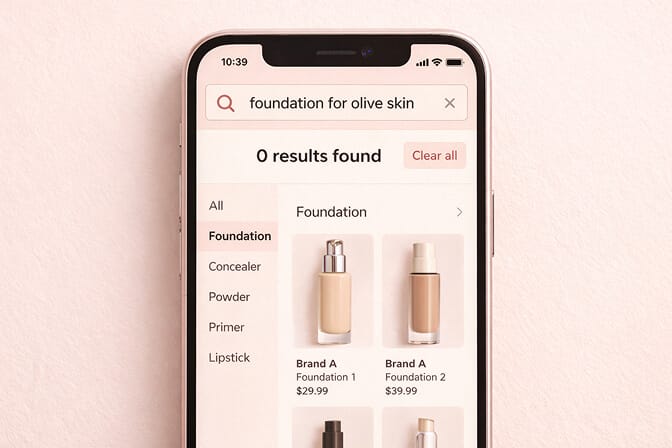
The variant problem. A single foundation might have 40 shades. A lipstick line might have 12 finishes across 25 colors. Your site search doesn't know the difference between "nude" the color family and "nude" the product name. So it shows everything. Chaos.
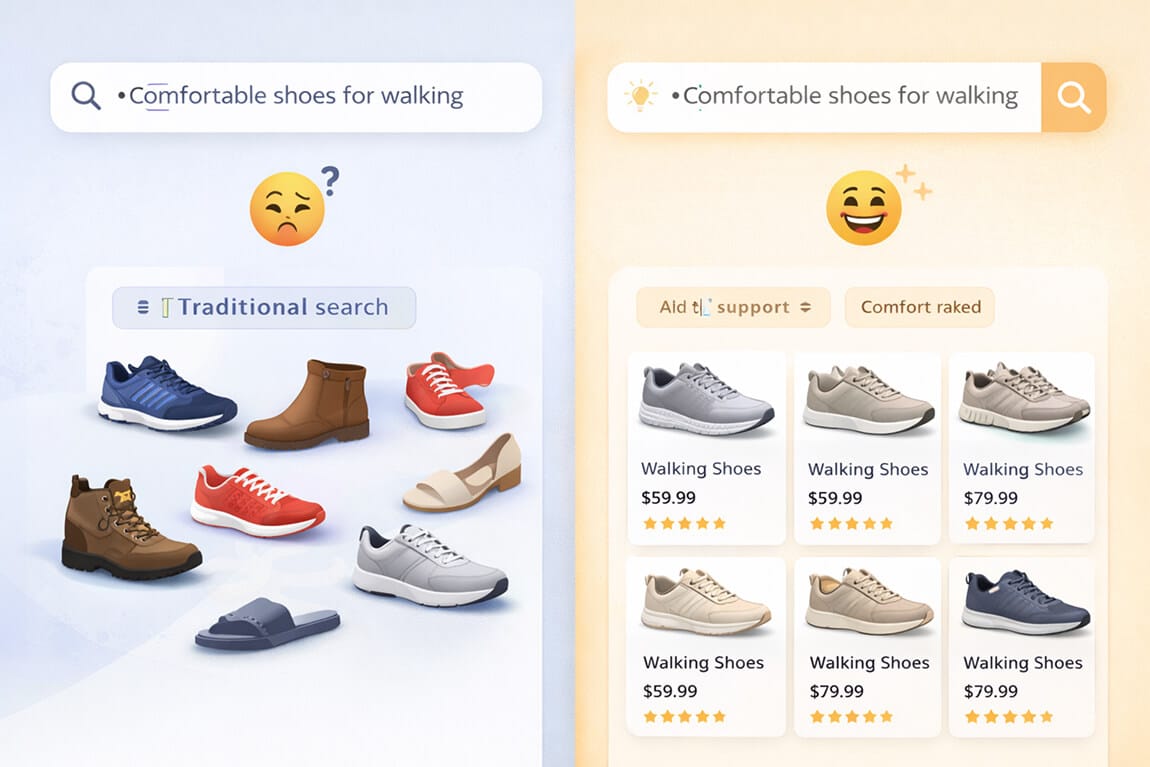
The language gap. Your product catalog says "hydrating facial cleanser." Your customer searches "face wash for dry skin." These are the same product. But your search engine doesn't know that.
The concern mismatch. Shoppers search by problem - acne, redness, fine lines. Your products are organized by category - serums, creams, masks. The two worlds don't connect.
This is where most beauty stores bleed money.
What Maya Found When She Fixed Her Search
Back to Maya's story.
After watching session recordings, she noticed a pattern. Visitors who used the search bar were actually her most motivated buyers. They knew what they wanted. They came ready to purchase.
But her search was actively pushing them away.
"Best selling moisturizer" returned nothing. "SPF for sensitive skin" showed her entire sunscreen category - 67 products - with no way to filter. "Gift set" showed a single discontinued product from 2022.
So Maya made a change. She replaced her default Shopify search with a tool that actually understood beauty shopping behavior.
Within two weeks:
- Her search-to-purchase conversion jumped from 1.8% to 4.1%
- Average order value increased by 18% (because related product recommendations actually made sense)
- Zero-result searches dropped from 23% to under 3%
The traffic didn't change. Her products didn't change. Her prices didn't change.
She just stopped losing the customers who were already trying to buy.
The Three Things Killing Your Beauty Store's Search (And How to Fix Them)
If you've never audited your site search, here's what to look for:
1. You're drowning shoppers in irrelevant results
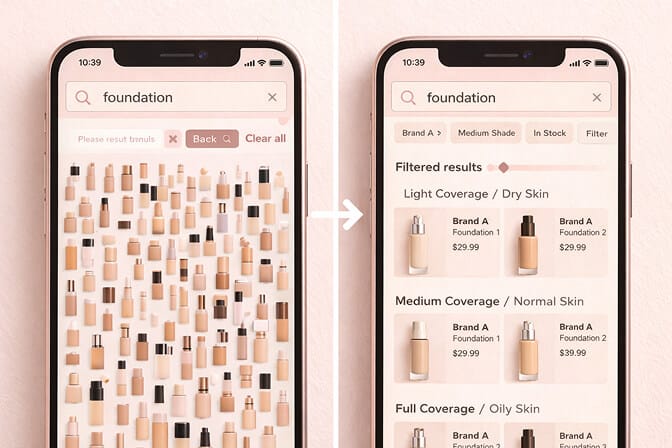
Beauty stores often have hundreds or thousands of SKUs. When someone searches "lipstick," they don't want to see all 347 options. They want the 12 that match their unstated criteria - their skin tone, their price range, their preferred finish.
The fix: Smart filtering that adapts to beauty-specific attributes. Not just price and brand, but skin type, concern, finish, ingredient preferences. Let shoppers narrow down before they get overwhelmed.
2. Your search doesn't speak customer language
Your inventory management system calls it "Anti-Aging Retinol Night Treatment Complex." Your customer types "wrinkle cream."
If your search only matches exact keywords, you're invisible to the people looking for you.
The fix: Synonym handling and natural language understanding. This isn't fancy AI buzzwords - it's recognizing that "moisturizer," "hydrating cream," "face lotion," and "daily moisture" should all return overlapping results.
3. You have no idea what customers are searching for
This one stings.
Most beauty store owners couldn't tell you the top 20 searches on their own site. They don't know which searches return zero results. They don't know which products get searched but never purchased (a sign of bad product pages or misaligned expectations).
The fix: Search analytics that show you the gap between what customers want and what you're showing them. This data is gold. It tells you what products to stock, what to feature, what to discontinue.
Here's Where Most Stores Get It Wrong
I talk to Shopify merchants every week who've tried to fix their search problem. Most make the same mistake.
They think better search means more results.
Wrong.
Better search means fewer, more relevant results. It means the customer types "red lipstick matte" and sees exactly six perfect options - not a wall of 200 products they have to scroll through.
The beauty industry has a paradox of choice problem. More options = more anxiety = more abandonment.
Your job isn't to show shoppers everything. Your job is to show them the right thing.
The best beauty stores don't make customers search harder. They make finding products feel effortless.
What Successful Beauty Brands Do Differently
Here's what I've noticed watching stores that convert at 4-5% instead of the industry average:
They treat search as a product, not a feature. It's not an afterthought buried in a corner. It's front and center, often with a prominent search bar and intelligent autocomplete that guides shoppers toward what they want.
They filter by concern, not just category. Instead of asking shoppers to navigate "Skincare > Serums > Anti-Aging," they let people filter by "Fine Lines" or "Dullness" across all product types.
They learn from search data. When they notice 50 people searching "gift set" every week with no purchases, they don't ignore it - they create a gift set page and redirect that search traffic.
They handle mistakes gracefully. Typos happen. "Mascarra" should still find mascara. "Foudation" should still find foundation. If your search treats typos as dead ends, you're losing easy sales.
This isn't about being perfect. It's about removing friction.
If you're wondering whether your own search is leaking revenue, there's a simple test. Go to your store right now. Search for your best-selling product - but use the words a customer would use, not the exact product name.
What shows up?
If it's anything other than that product at the top, you've found your leak.
The Bottom Line on Beauty Ecommerce Product Discovery
The beauty industry is projected to hit $750 billion globally by 2027. Ecommerce is eating a larger slice every year. The opportunity is massive.
But here's the thing nobody mentions in the "how to start a beauty brand" articles:
Traffic isn't the hard part anymore. Getting people to your store is solvable - run ads, partner with influencers, post on TikTok.
The hard part is what happens after they arrive.
And if your shoppers can't find what they need within 30 seconds, they're gone. Back to Sephora. Back to Amazon. Back to whoever makes discovery feel easy.
Maya's store is doing over $40K/month now. Not because she cracked some secret marketing code. Because she stopped fighting the customers who were already trying to give her money.
The search box wasn't the only thing she fixed. But it was the first.
Sometimes the biggest wins come from the most overlooked places.
Ready to stop losing customers who are already trying to buy? Sparq is AI-powered search and filtering built specifically for Shopify beauty stores. See what your customers are actually searching for, fix zero-result pages, and turn browsers into buyers. Install takes 10 minutes - no developer needed.
Frequently Asked Questions
1. What is beauty ecommerce product discovery?
Product discovery refers to how easily shoppers can find and explore products on your online beauty store. It includes site search functionality, filtering options, navigation structure, and recommendations. Poor product discovery is one of the leading causes of cart abandonment in cosmetics and skincare stores, as customers often leave when they can't quickly find products matching their specific needs like skin type, concerns, or preferences.
2. How does site search impact beauty store conversion rates?
Shoppers who use site search convert 2-3x higher than those who browse - but only if the search actually works. When beauty store search fails (wrong results, zero results, no filtering), those high-intent visitors leave. Improving search relevance and adding beauty-specific filters for skin type, concerns, and ingredients can lift overall store conversion rates by 20-50%.
3. Why is filtering so important for cosmetics and skincare stores?
Beauty products have uniquely complex attributes - shade ranges, skin types, ingredient preferences, concerns like acne or aging, finishes, formulations. Unlike simpler product categories, beauty shoppers need to narrow options quickly to avoid decision fatigue. Stores that let customers filter by concern (not just category) consistently outperform those with basic filtering.
4. What's the average conversion rate for beauty ecommerce stores?
According to Salesforce research, beauty ecommerce conversion rates typically range from 2.2% to 3.3%, with significant variation between cosmetics (2.3%), skincare (2.2%), and the broader health & beauty category (1.7-1.9%). Top-performing Shopify beauty stores achieve 4-5% conversion rates by optimizing product discovery, search, and the overall shopping experience.
5. Does Sparq work with all Shopify themes and beauty products?
Yes. Sparq integrates with any Shopify theme and works for all beauty categories - skincare, cosmetics, haircare, nail care, and wellness products. The AI understands natural language searches specific to beauty shopping (like "foundation for olive skin" or "moisturizer without fragrance") and automatically handles synonyms, typos, and concern-based queries that standard Shopify search misses.