
Natural Language Search for Ecommerce: Why Your Customers Stopped Speaking Robot (And Your Search Bar Didn't Get the Memo)
Your shoppers talk like humans now. Thanks to ChatGPT, they expect your store to understand them. Here's how natural language search closes the gap between what customers type and what they actually want.
She typed: "something cute to wear to my sister's outdoor wedding in June."
The search bar returned: 0 results.
Not "sundresses." Not "garden party outfits." Not even a polite suggestion.
Just... nothing.
I was watching this happen in real-time on a session replay. A shopper with clear purchase intent, credit card probably already in hand, bouncing off a store because the search couldn't understand a perfectly reasonable human request.
This was two years ago. And honestly? It still happens on most ecommerce stores today.
Here's the uncomfortable truth: your customers have been trained by ChatGPT, Google, and Alexa to speak naturally. They ask questions. They describe problems. They search the way they'd talk to a friend.
But most ecommerce search bars are still stuck in 2015, waiting for exact keyword matches like obedient robots.
That gap is costing you sales. Let's talk about how to fix it.
What Natural Language Search Actually Means (Without the Jargon)
Natural language search is exactly what it sounds like: search that understands human language.
Instead of forcing customers to guess which keywords might be in your product titles, natural language search interprets intent. It reads between the lines. It gets context.
When someone searches "gift for a coffee-obsessed dad who has everything," a natural language search engine doesn't throw up its hands. It thinks: coffee + gift + dad + hard to shop for and returns curated options - premium beans, unique brewing gadgets, maybe a subscription box.
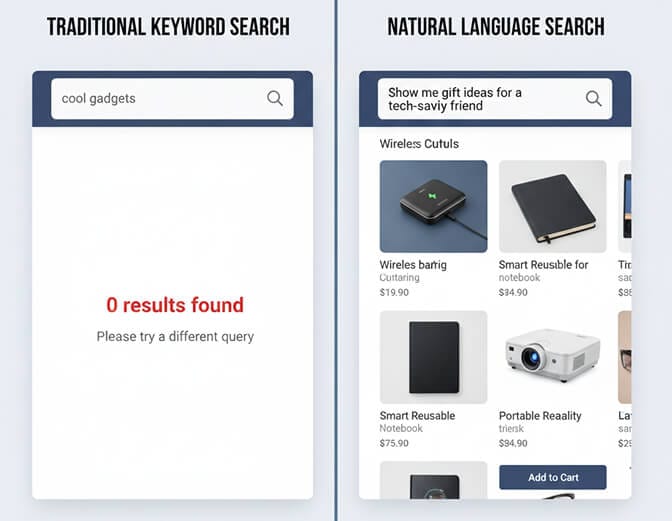
The technology behind this is called NLP - Natural Language Processing. It's the same AI that powers ChatGPT, voice assistants, and Google's increasingly conversational search results.
And here's the part that matters for your bottom line: site search users are 6.4x more likely to convert than browsers. When those high-intent shoppers can't find what they're looking for, you don't just lose a sale. You lose a customer who was ready to buy.
The ChatGPT Effect: Why Shopper Expectations Changed Overnight
Stay with me here, because this shift happened faster than most merchants realize.
Before 2023, shoppers had been trained to search like robots. We'd learned to strip our thoughts down to keywords: "black dress size 8" or "running shoes men." We adapted to the machine.
Then ChatGPT happened.
Suddenly, everyone experienced what it felt like to have a conversation with a computer that actually understood them. You could ask messy, complicated questions and get thoughtful answers.
That experience reset expectations across the board.
Now when a shopper types "lightweight jacket for unpredictable spring weather" and gets zero results, they don't blame themselves for searching wrong. They blame your store for not understanding.
The standard changed. Most ecommerce search didn't.
According to recent data, AI-driven traffic to Shopify stores has increased sevenfold since January 2024, with orders from AI-assisted searches up elevenfold. Shoppers are learning to expect conversational interfaces everywhere - including your product catalog.
Here's Where Most Stores Bleed Money
Let me paint you a picture of what's probably happening in your store right now.
A customer searches "moisturizer for sensitive skin that won't break me out."
Your traditional search sees: moisturizer... sensitive... skin... break... out.
It returns every moisturizer with "sensitive" in the description. Maybe some acne products because of "break out." Perhaps nothing at all because there's no exact phrase match.
The customer sees irrelevant results or - worse - an empty page.
They leave.
And here's the part that costs you money: you'll never know why. Your analytics will show a bounce. A session that went nowhere. But you won't see the perfectly reasonable query that your search couldn't handle.
This happens hundreds or thousands of times per month on most stores. Each one is a missed conversion hiding in plain sight.
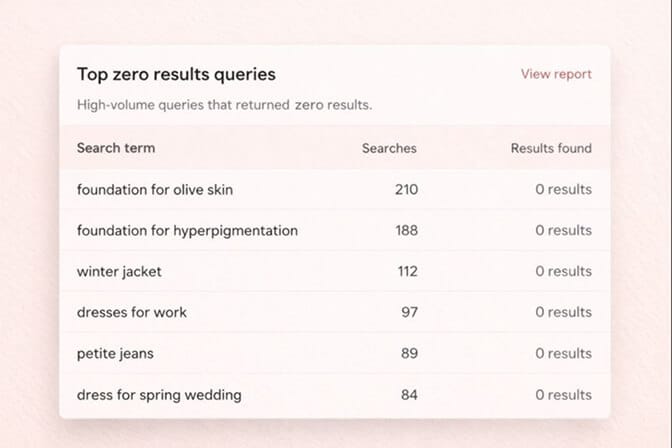
When we talk to merchants about implementing smarter search and filtering, this is usually the "aha" moment. They had no idea how many customers were searching, failing, and leaving - all because the search bar couldn't understand natural language.
What Natural Language Search Gets Right
So what's different about AI-powered search that understands natural language?
It interprets intent, not just keywords.
When someone searches "cozy throw blanket for movie nights," natural language search understands the vibe they're going for. Soft textures. Comfortable size. Maybe something in warm colors. It doesn't need the product title to contain the exact phrase "movie nights."
It handles synonyms automatically.
Your customer says "sneakers." Your product data says "athletic shoes." Traditional search shrugs. Natural language search connects the dots.
It forgives typos and misspellings.
"Cashmeer sweater" should still find cashmere sweaters. "Jogging pants" should return joggers. These seem obvious, but you'd be shocked how many stores return zero results for common misspellings.
It understands modifiers and context.
"Red dress under $100 for a summer wedding" contains multiple signals: color preference, budget constraint, occasion, seasonality. Natural language search parses all of it and filters accordingly.
It learns from behavior.
When shoppers consistently click on certain products after specific searches, the system gets smarter. It's not static rules - it's intelligence that improves over time.
The Real-World Impact (With Actual Numbers)
I know what you're thinking: this sounds great in theory, but does it actually move the needle?
Let me share what we've seen.
One home goods brand implemented AI-powered search with natural language understanding and saw their search-driven conversion rate jump 23% within the first month. Not because they got more traffic - but because the traffic they already had could finally find what they wanted.
A beauty retailer reduced their "zero results" rate by 67% after switching from basic keyword matching to semantic search. Those weren't new customers. Those were existing visitors who'd been failing silently.
Another merchant in the supplement space saw an 11% conversion rate from AI-assisted search interactions - compared to their site average of 2.8%. Same products. Same prices. Just better discovery.
"The gap between how customers search and how most stores handle search is the biggest hidden conversion leak in ecommerce today."
This isn't about adding a shiny new feature. It's about removing friction that's been costing you money all along.
"But My Store Has Good Search" - Does It Though?
Here's a quick diagnostic. Pull up your store right now and try these searches:
- A conversational query: "gift for someone who loves cooking"
- A problem-based search: "something for lower back pain"
- A misspelled product: purposely typo a popular item
- A synonym test: search a word your customers might use that isn't in your product titles
How'd it go?
If you saw zero results, irrelevant products, or results that clearly missed the point - that's what your customers experience every day.
Most merchants haven't tested their own search this way. They assume it works because they've never watched it fail.

The brutal reality: Shopify's native search is basic. It's designed for exact matches. No synonym handling. No typo tolerance. No natural language understanding. For a store with a dozen products, that might be fine. For anything larger, it's leaving money on the table.
Making the Switch: What to Actually Look For
If you're evaluating search solutions - and after reading this, I hope you are - here's what matters:
Natural language processing is non-negotiable. This is the foundation. Without it, you're just getting a fancier keyword matcher.
Typo tolerance and fuzzy matching. Your customers will misspell things. Your search should handle it gracefully.
Synonym handling. Either automatic or easy to configure. You know your products; you know what customers call them.
Search analytics. You can't improve what you can't measure. You need to see what people are searching, what's returning zero results, and where they're bouncing.
Speed. Results should appear as shoppers type. Any delay feels broken in 2025.
Easy setup. You're running a store, not managing an engineering project. If implementation requires a developer and three weeks, keep looking.
If you're tired of customers searching and leaving empty-handed, Sparq handles all of this - and you can set it up in about 10 minutes. Free to try, no developer needed.
The Bigger Picture: Where Ecommerce Search Is Heading
Here's what's coming, and it's coming fast.
Shopify just launched "Agentic Storefronts" - a way for merchants to connect their product catalogs directly to ChatGPT, Perplexity, and Microsoft Copilot. Shoppers will increasingly discover products through AI conversations, not Google searches.
Voice commerce is growing. Visual search is maturing. The common thread? All of it assumes natural language understanding as the baseline.
Stores that still rely on exact-match keyword search aren't just behind - they're building on a foundation that's becoming obsolete.
The merchants who invest in natural language search now won't just see better conversions today. They'll be ready for how shopping works tomorrow.
The Part Nobody Tells You
I'll be honest with you: implementing better search won't fix a bad product catalog or broken checkout flow.
But if you have products people want, and traffic coming to your store, and you're still seeing high bounce rates from search pages - this is probably your problem.
The gap between how customers naturally express what they want and how your search interprets those queries is where conversions go to die.
Natural language search closes that gap.
Your customers stopped speaking robot a long time ago. Maybe it's time your store learned to listen.
Want to see what your customers are actually searching for - and how often they're leaving empty-handed? Install Sparq and check your search analytics. What you find might surprise you.
Frequently Asked Questions
1. What is natural language search in ecommerce?
Natural language search allows customers to search using conversational phrases instead of rigid keywords. Instead of typing "blue dress size 8," shoppers can search "something blue and flowy for a beach vacation" and get relevant results. The technology uses AI and natural language processing to understand intent, context, and meaning - not just exact word matches.
2. How does natural language search compare to traditional keyword search?
Traditional keyword search only returns results when product titles or descriptions contain the exact words a customer types. Natural language search understands synonyms, handles typos, interprets context, and identifies what the shopper actually wants. For example, a search for "sneakers" will find products labeled "athletic shoes" - something keyword search would miss entirely.
3. Does AI search actually increase conversion rates?
Yes. Site search users are already 6.4x more likely to convert than browsers. When you improve search relevance with AI, those high-intent shoppers find what they need faster. Merchants typically see 15-30% improvement in search-driven conversions after implementing natural language search, primarily because "zero results" pages drop dramatically.
4. Will adding AI search slow down my Shopify store?
No. Modern AI search solutions like Sparq are built for speed - results appear instantly as customers type. The search processing happens on external servers, not your store, so there's no impact on page load times. If anything, faster, more accurate search reduces the time customers spend hunting for products.
5. Is natural language search worth it for smaller Shopify stores?
It depends on your catalog size and traffic. If you have fewer than 50 products, basic search might be sufficient. But once you're past a few hundred SKUs, or if you're getting consistent search traffic, the ROI becomes clear. The real question isn't store size - it's how many customers are searching, failing to find results, and leaving without you knowing.