7 Federated Search Examples That Show Why Your Store Is Losing Sales
Your customers are searching. They're just not finding. Here's how the smartest ecommerce brands fixed that.
Last Tuesday, I watched a Shopify merchant lose $4,200.
Not from a refund. Not from a failed ad campaign. From search.
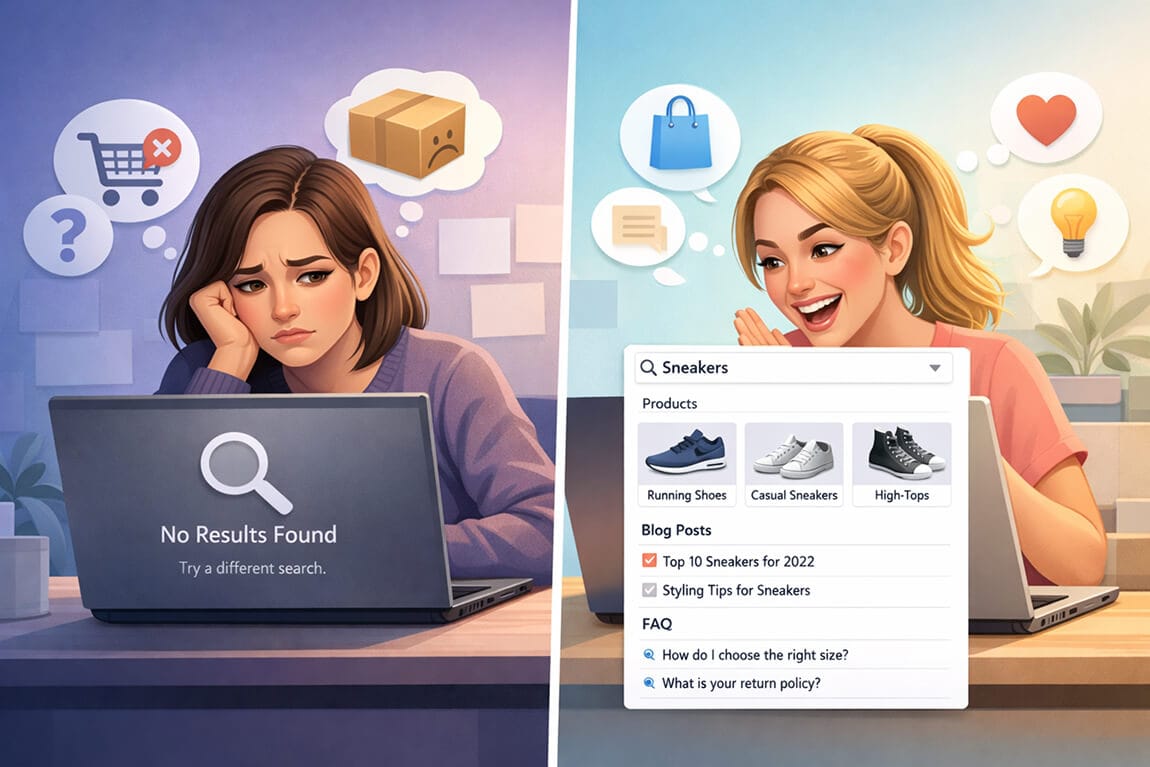
Her store sells handmade candles. About 800 SKUs across scented, unscented, seasonal, and gift sets. A customer typed "lavender candle for mom" into the search bar. The store's default search returned three random products, none of them lavender, none of them gift-ready.
The customer bounced. So did the next one. And the one after that.
Here's the thing most store owners miss: your search bar isn't just a feature. It's a salesperson. And if that salesperson can only look in one aisle at a time, you're bleeding revenue every single day.
That's where federated search comes in. Not the Wikipedia definition. The real-world, "this is how stores actually make more money" version.
Let me show you exactly what I mean with seven federated search examples that changed the way these businesses sell online.
But First, What Is Federated Search (in Plain English)?
Forget the technical jargon for a second.
Federated search is what happens when your search bar is smart enough to look in multiple places at once and bring everything back in one clean view.
Think about what happens when a customer searches "winter jacket" on your store. A basic search engine scans your product titles. Maybe your descriptions if you're lucky. That's it.
A federated search engine? It pulls results from your product catalog, your blog posts about winter styling, your FAQ about shipping times for seasonal items, your collection pages, and your customer reviews. All at the same time. All in one search result.
It's the difference between a store clerk who only knows one shelf and one who knows the entire store, the warehouse, and next week's shipment schedule.
The core idea: Federated search queries multiple data sources simultaneously and presents the results in a single, unified interface. For ecommerce, this means products, content, and support resources all appear together when a customer searches.
Now let's look at how real businesses actually use this.
Example 1: The Multi-Category Product Search
This is the most common federated search example, and the one most Shopify stores get wrong.
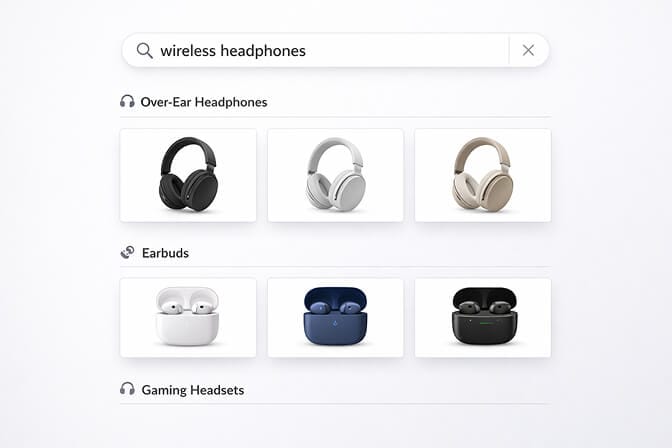
Imagine you sell electronics. A customer types "wireless headphones" into your search bar. Without federated search, they see results from whatever category the search engine defaults to. Maybe Bluetooth accessories. Maybe audio equipment. But not both.
With federated search, that single query pulls results from every product category simultaneously. The customer sees over-ear headphones, earbuds, gaming headsets, and wireless adapters, all ranked by relevance, all in one view.
Amazon does this at massive scale. When you search for anything on Amazon, you're hitting results across dozens of product categories, seller listings, and inventory databases. That's federated search working behind the scenes.
But you don't need to be Amazon to do this.
Even a Shopify store with 500+ SKUs spread across 15 collections benefits enormously from this approach. Instead of forcing customers to guess which collection holds their product, federated search removes that friction entirely.
Example 2: Products + Blog Content in One Search
Here's where most stores get it wrong.
You've spent months writing helpful blog content. Buying guides. How-to articles. Comparison posts. But when a customer types a query into your search bar, none of that content shows up. It's invisible.
Federated search fixes this by indexing your content alongside your products.
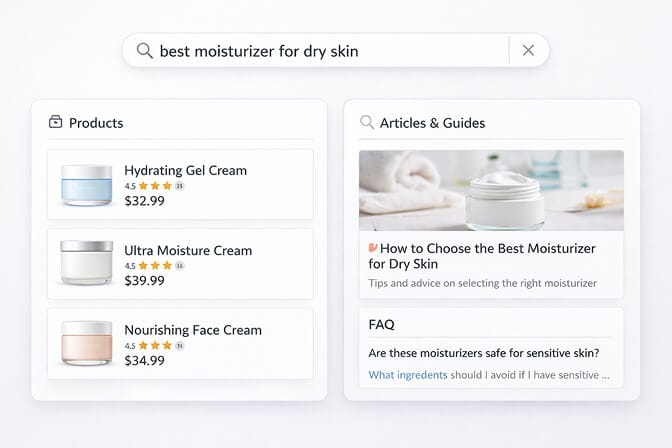
Picture a skincare brand. A customer searches "best moisturizer for dry skin." A federated search engine returns three things at once: your top-selling moisturizers for dry skin (products), your blog post titled "How to Choose a Moisturizer for Dry Skin" (content), and your FAQ about ingredient sensitivities (support).
That customer just went from "browsing" to "informed and ready to buy."
This is the approach that companies like AddSearch have championed, where results from your website and your blog appear in separate, clearly labeled sections within the same search dropdown. Your customer sees everything relevant in one glance.
For Shopify merchants, this is a huge missed opportunity. You're already creating the content. Federated search just makes sure your customers actually see it when it matters.
Example 3: Marketplace Search Across Multiple Sellers
If you run a multi-vendor marketplace, federated search isn't optional. It's survival.
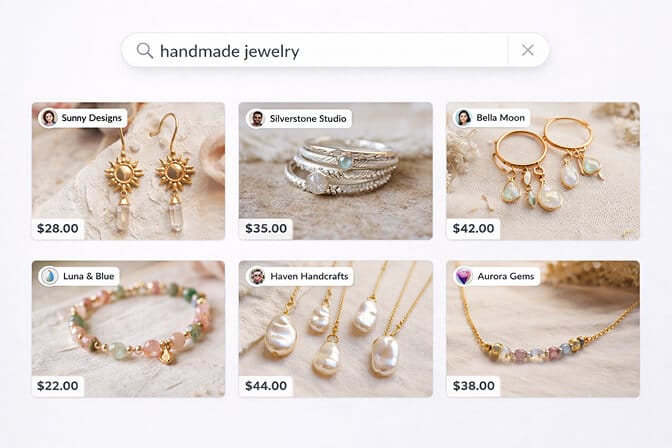
Think about what Etsy does. When someone searches "handmade jewelry," they see results from thousands of independent sellers in a single, unified view. The customer doesn't need to know which seller has what. The search handles it.
This same principle applies to any Shopify store that aggregates products from multiple suppliers or warehouses. Federated search pulls inventory data from each source, merges the results, and ranks them by relevance, price, ratings, or whatever signals matter most to your shoppers.
Without it? Your customers are stuck navigating a confusing maze of collections and sub-pages, never quite sure if they've seen everything available.
The takeaway: For marketplaces and multi-vendor stores, federated search turns fragmented inventory into a single, shoppable experience.
Example 4: Search That Includes Customer Reviews and UGC
This one's underrated.
Some of the best federated search implementations don't just pull from your product database and blog. They also surface user-generated content like reviews, Q&As, and community discussions.
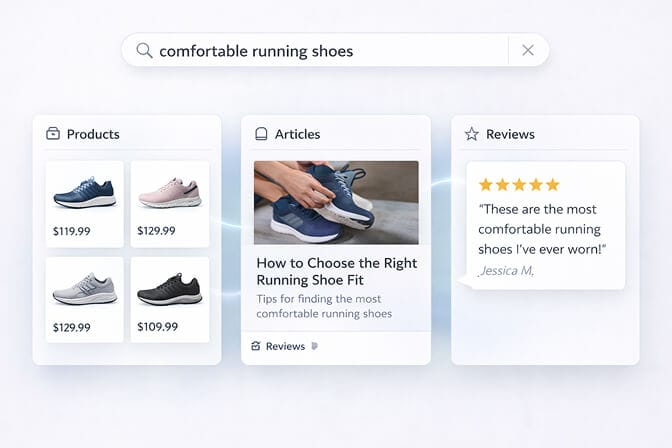
Imagine a customer searching "comfortable running shoes." They see your top-rated running shoes (products), a blog post about choosing the right fit (content), and a highlighted review from another customer saying "most comfortable shoes I've ever worn" (social proof).
That's three different data sources working together to push the customer toward a purchase.
The psychological impact is significant. When search results include real customer voices alongside products, trust goes up and hesitation goes down.
Example 5: Travel and Booking Aggregators
You've probably used federated search without even knowing it.
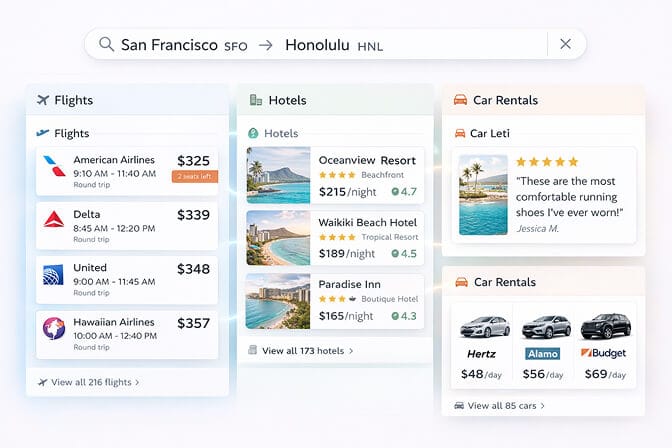
Kayak is one of the clearest federated search examples on the internet. Type in a destination, and it simultaneously queries airlines, hotels, car rental companies, and travel packages. Different databases. Different data formats. One unified result.
For ecommerce, the lesson is powerful: customers don't care where your data lives. They care about getting the right answer fast.
If you sell products that span different fulfillment methods (drop-shipped items, in-house inventory, digital downloads), federated search can unify all of that into a single search experience. The customer types a query and sees everything available, regardless of where it ships from or how it's stored.
This is especially relevant for Shopify merchants using multiple apps or fulfillment services. Your backend might be messy, but your search results don't have to be.
Example 6: Customer Support + Product Search Combined
Here's a federated search example that directly reduces your support ticket volume.
When a customer types "return policy" into your search bar, what happens? On most stores, they get zero results. Maybe a random product with "return" in the title. The customer gets frustrated, opens a support ticket, and your team spends five minutes answering a question that was already on your website.
Federated search solves this by including help articles, FAQs, and policy pages in your search index.
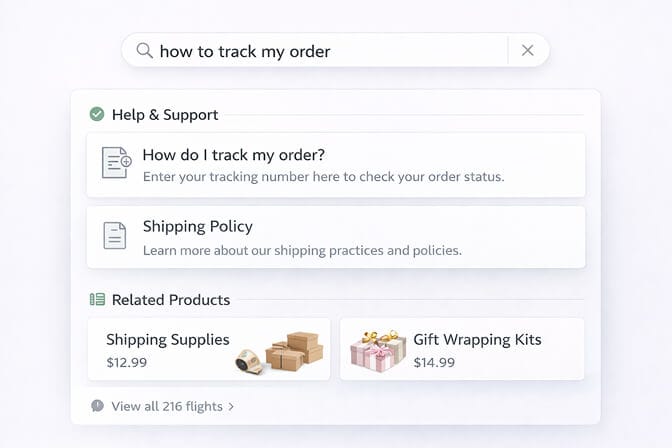
A customer searching "how to track my order" sees a link to your order tracking page, your FAQ about shipping times, and your blog post about delivery expectations. No support ticket needed.
This approach is already standard for SaaS companies. When you search on a platform like Slack, you're not just searching messages. You're searching users, shared files, channels, and integrations. That same multi-source approach works beautifully for ecommerce support content.
The result? Fewer support tickets. Faster resolution. Happier customers.
If you're tired of customers searching and leaving empty-handed, Sparq.ai's AI-powered search fixes that in about 10 minutes. It understands what your shoppers actually mean and pulls relevant results from across your entire store. Free to try.
Example 7: Dynamic Collection and Promotion Search
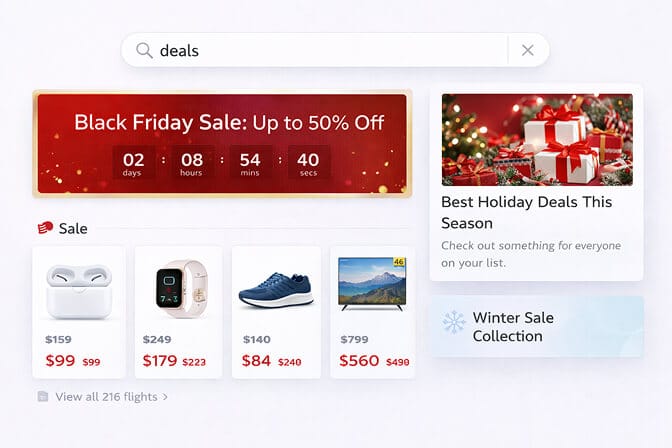
This is the one that separates good ecommerce search from great ecommerce search.
During Black Friday, a customer types "deals" into your search bar. A basic search might return a product called "Deal Maker Watch Case." Useless.
A federated search engine can surface active promotions, sale collections, and time-sensitive offers alongside products.
The customer searches "deals" and sees your Black Friday collection, your "50% off winter styles" promotion, individual sale products, and a blog post about your best holiday deals. Everything, all at once, all ranked by relevance and urgency.
This approach works for seasonal campaigns, new arrivals, limited editions, and any time-sensitive content that lives outside your standard product catalog.
For Shopify store owners, this means your search bar becomes a dynamic merchandising tool. Not just a product finder.
Why These Examples Matter for Your Store
Let me be blunt.
If your store's search only looks at product titles and descriptions, you're showing customers about 30% of what you actually have to offer. The other 70%? Blog posts, FAQs, collection pages, reviews, guides, promotions. All invisible.
Federated search makes your entire store searchable from one place.
And the conversion impact is real. Studies consistently show that customers who use site search convert at 2 to 3 times the rate of those who browse. When that search is federated, pulling from multiple sources and surfacing richer results, the gap gets even wider.
Here's what I'd want you to take away from these seven examples:
Your search bar should know your store as well as you do. Every blog post you've written. Every FAQ you've answered. Every collection you've built. Every review your customers have left. If your search can't find it, your customers won't either.
The good news? You don't need to be Amazon or Kayak to implement this. Modern AI-powered search tools have made federated search accessible to stores of every size.
Want to see what your customers are actually searching for and how much revenue your current search is leaving behind? Install Sparq and check your search analytics. It's eye-opening.
The Quiet Part Nobody Talks About
Here's what separates store owners who grow from those who plateau.
It's not always the big stuff. It's not the rebrand or the new product line or the influencer deal. Sometimes, it's the small infrastructure decisions. The ones customers never think about but always feel.
Federated search is one of those decisions.
Your customer doesn't know they're using a federated search engine. They just know that when they typed "gift for dad who likes coffee," they found exactly what they needed. A pour-over kit, a blog post about coffee gift ideas, and a collection page for Father's Day.
They don't know the technology. They just know your store gets them.
And that's the whole point.
Frequently Asked Questions
What is federated search in ecommerce?
Federated search in ecommerce is a search technique that queries multiple data sources, such as product catalogs, blog posts, FAQs, and customer reviews, all at once. Instead of searching one database at a time, it aggregates results from different content types and displays them in a single, unified search result. This gives customers a complete view of everything relevant to their query.
How does federated search compare to basic site search?
Basic site search typically scans only product titles and descriptions within a single database. Federated search is fundamentally different because it searches across multiple sources simultaneously, including blogs, help articles, collections, and reviews. The result is richer, more comprehensive search output that helps customers discover content they'd otherwise miss entirely.
How do I set up federated search on my Shopify store?
The fastest way is to use a third-party search app that supports federated search out of the box. Tools like Sparq are built specifically for Shopify and can be installed in minutes without any coding. They automatically index your products, collections, blog posts, and pages so customers get unified results from day one.
Does federated search increase conversion rates for online stores?
Yes. Customers who use site search already convert at 2 to 3 times the rate of non-search users. Federated search amplifies this by surfacing more relevant results from across your entire store, including buying guides, reviews, and related content that builds purchase confidence. Richer search results mean fewer dead ends and more completed purchases.
Will adding federated search slow down my Shopify store?
Not if you're using a well-built search solution. Modern search apps like Sparq.ai use pre-built indexes and AI ranking that deliver results in milliseconds. The search happens on external servers, not your Shopify store's infrastructure, so there's no impact on page load speed or overall store performance.