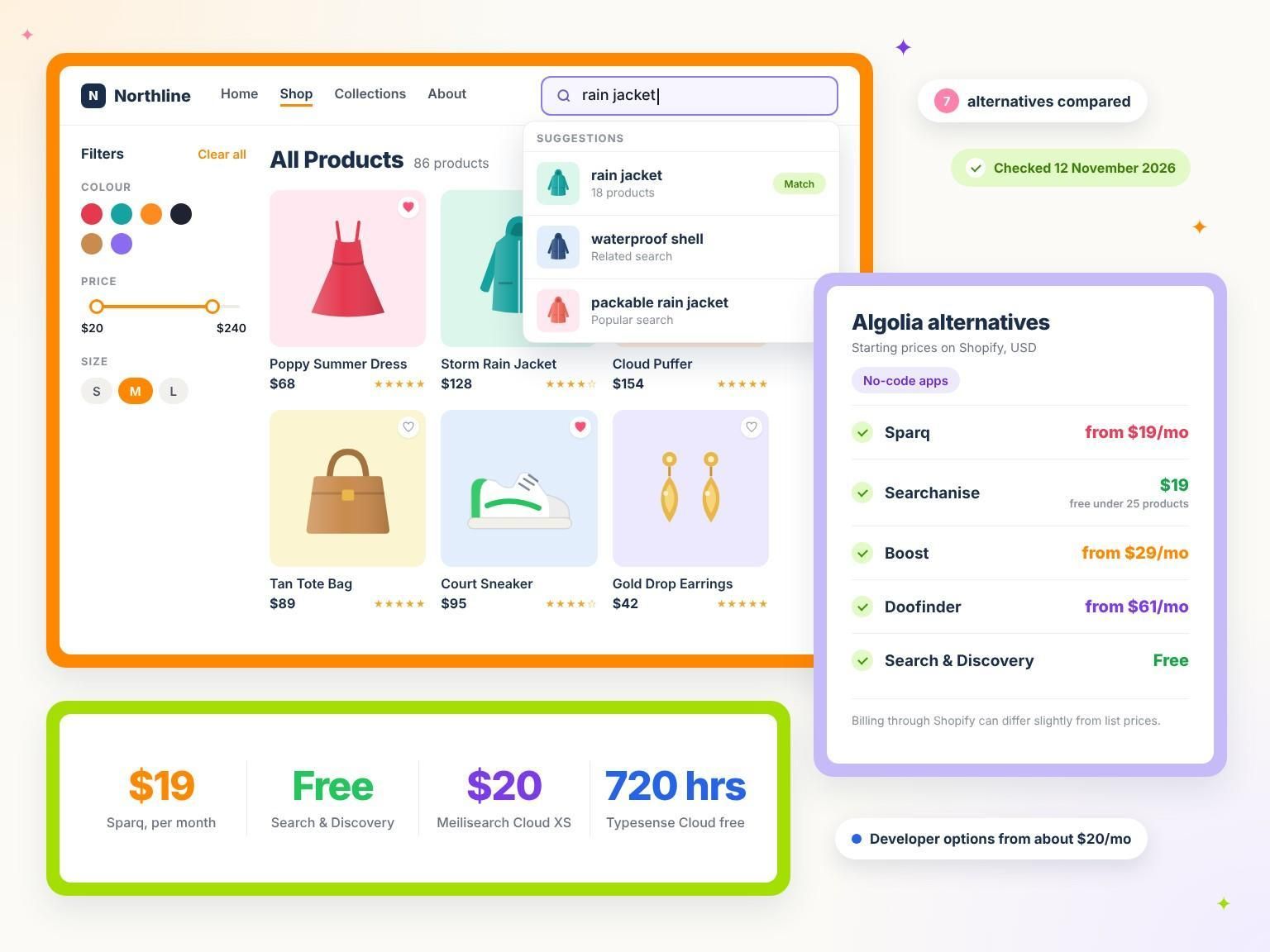
The short answer: The best free Shopify search app is Shopify Search & Discovery for basic filters and synonyms, with Searchanise (free up to 25 products) and Rapid Search (free up to 1,000 products) as free upgrades. The best paid apps are Sparq (from $19/month, AI search plus analytics), Searchanise (from $19/month), Boost (from $29/month, filters), Globo (from $14/month, filters) and Fast Simon (from $39.99/month). Algolia is free to start but suits stores with developers.
Free apps are fine for small catalogs. Once you have a few hundred products, or shoppers search with typos and natural language, a paid app usually pays for itself in recovered searches.
All prices are published USD list prices and ratings are from the Shopify App Store, checked November 2026. Many apps scale with catalog size, traffic or GMV, and prices billed through Shopify can differ slightly.
Free Shopify search apps
| App | Free plan limit | Rating | What you get free | First paid price |
|---|---|---|---|---|
| Shopify Search & Discovery | Free, no plan limits | 2.6 | Filters, synonyms, product boosts, basic recommendations | No paid plan |
| Searchanise Search & Filter | Up to 25 products | 4.7 | Instant search, filters, unlimited queries | $19/mo (up to 1,500 products) |
| Rapid Search | 1,000 products and 2,000 sessions/mo, with Rapid Search branding | 4.9 | Instant search and filters | From $14/mo (5,000 sessions) |
| Fast Simon | 100 sessions/mo | 4.8 | Instant search, filters | $39.99/mo (2,000 sessions) |
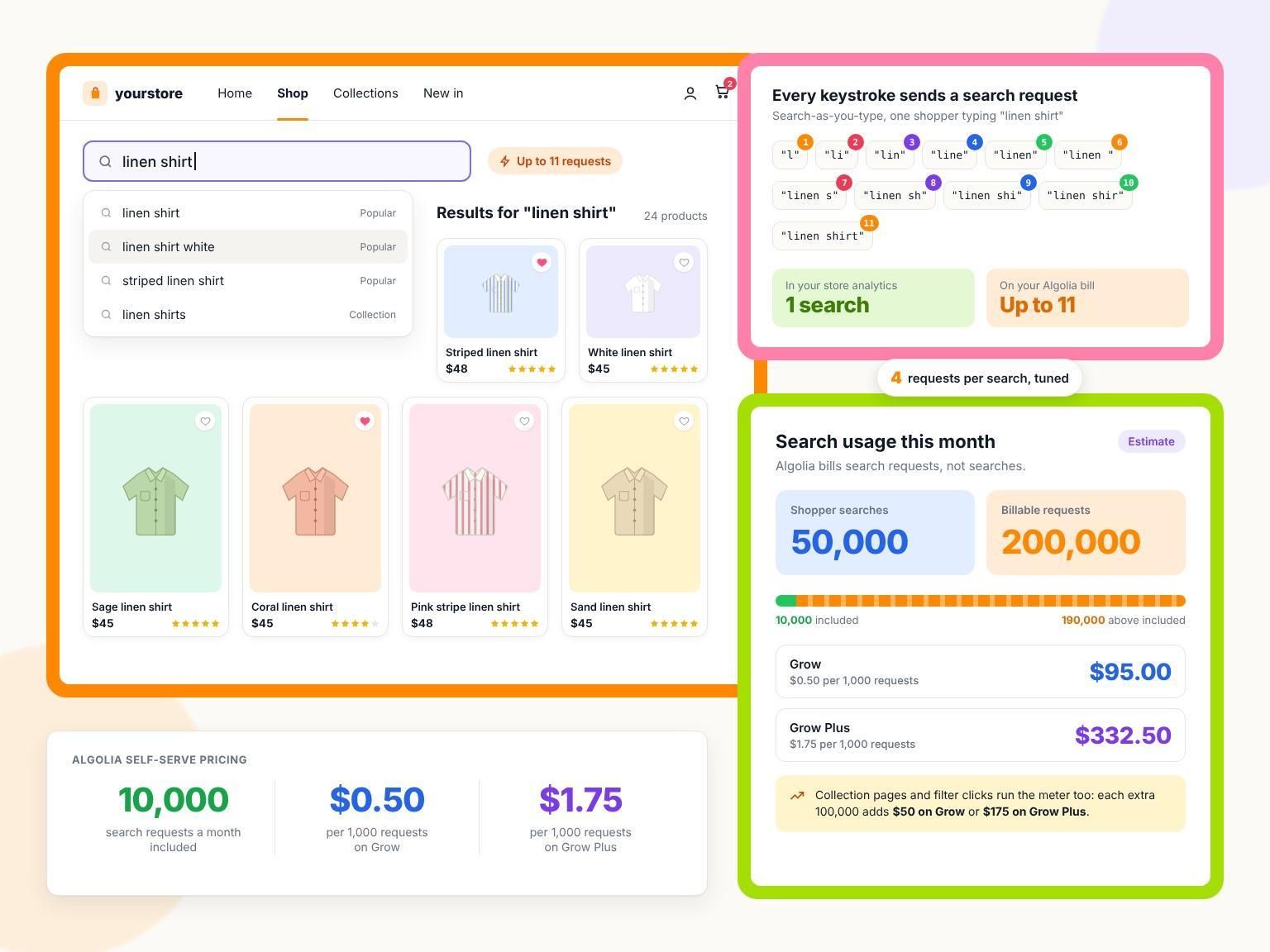
| Algolia AI Search & Discovery | 10,000 search requests and 50,000 records/mo | 3.7 | Core search, 5,000 recommendation requests | Grow: $0.50 per 1,000 requests after 10,000 |
The catch with free plans: most free tiers cap products or traffic at a level a growing store passes quickly, and some add branding. Shopify Search & Discovery has no limits, but it still uses keyword matching, so it doesn't handle intent ("gift for dad under 50") and gives limited zero-result reporting.
Paid Shopify search apps
| App | First paid plan | How price scales | Rating | Best at |
|---|---|---|---|---|
| Sparq | $19/mo (up to 2,500 products) | By products and traffic: $59/mo (7,500 products), $299/mo (50,000) | 4.8 | AI semantic search, typo tolerance, smart filters and zero-result analytics without a developer |
| Searchanise | $19/mo (up to 1,500 products) | By product count, up to $349/mo | 4.7 | Simple, reliable autocomplete |
| Boost AI Search & Filter | $29/mo (under $50K GMV) | By plan and store GMV | 4.7 | Collection filters and filter trees |
| Globo Smart Product Filter & Search | $14/mo (up to 500 products) | By product count and plan; Plus plans from $69/mo | 4.9 | Low-cost filters for small catalogs |
| Rapid Search | From $14/mo (5,000 sessions) | By monthly sessions | 4.9 | Budget instant search |
| Fast Simon | $39.99/mo (2,000 sessions) | By sessions, up to $299.99/mo for 30,000; enterprise by quote | 4.8 | Visual search and merchandising |
| Doofinder | $49/mo (10,000 requests) | By search requests: $149, $349/mo | 4.7 | Stores running several platforms |
| Algolia | Grow: $0.50 per 1,000 requests | Per request and record; Grow Plus $1.75 per 1,000; Elevate by quote | 3.7 | Custom builds with a dev team |
Comparing apps? See our side-by-side Sparq vs Searchanise and Sparq vs Globo comparisons for features, support and pricing.
The one pick for each kind of store
- New store, under 200 products, no budget: Shopify Search & Discovery.
- Small catalog, want a free upgrade: Rapid Search (up to 1,000 products) or Searchanise (up to 25).
- Filters are the main problem, small budget: Globo.
- Filters are the main problem, growing store: Boost.
- 200 to 50,000+ products, want AI search and analytics without a developer: Sparq.
- Selling on Shopify plus other platforms: Doofinder or Sparq (Sparq also supports WooCommerce, BigCommerce, Magento and PrestaShop).
- Enterprise with an engineering team: Algolia.
How to choose a Shopify search app
Test any app on your own catalog before you commit. Five things matter most:
- Typo tolerance. Search for "sneekers" or "bule dress." Do you still get results?
- Natural language. Try "warm jacket under 100." Does it understand price and intent?
- Zero-result analytics. Can you see what shoppers searched for and didn't find?
- Theme fit and mobile. Does the search and filter UI match your theme and work well on a phone?
- Pricing as you grow. Check what happens to the price when your catalog, traffic or GMV doubles.
For a deeper look at the top contenders side by side, read our best ecommerce search engine for Shopify comparison or Sparq vs Searchanise.
Why stores choose Sparq
Sparq is an AI search and filter app built for Shopify merchants who aren't engineers. It understands what shoppers mean, handles typos and synonyms automatically, and shows you every search that returned zero results so you can fix it. Setup takes about 10 minutes and our team helps for free.
Plans start at $19/month with a 14-day free trial. Calculate your price or install Sparq from the Shopify App Store.
Frequently Asked Questions
What is the best free search app for Shopify?
Shopify Search & Discovery is the best fully free option: it adds filters, synonyms and boosts with no plan limits. For better relevance on a small catalog, Rapid Search is free up to 1,000 products and Searchanise is free up to 25 products.
What is the best paid search app for Shopify?
For most stores without a developer, Sparq (from $19/month) offers the strongest combination of AI search, filters and analytics. Boost is a strong choice when filters are the main problem, and Algolia suits enterprise stores with engineering teams.
How much does a Shopify search app cost?
Most paid Shopify search apps start between $14 and $49 a month and scale with your product count, traffic or GMV. Enterprise plans from Algolia, Fast Simon and Doofinder are quote-based.
Is Shopify's built-in search good enough?
For very small catalogs, yes. Shopify's native search and the free Search & Discovery app use keyword matching, so they struggle with typos, natural-language queries and large catalogs, and they offer limited insight into failed searches.