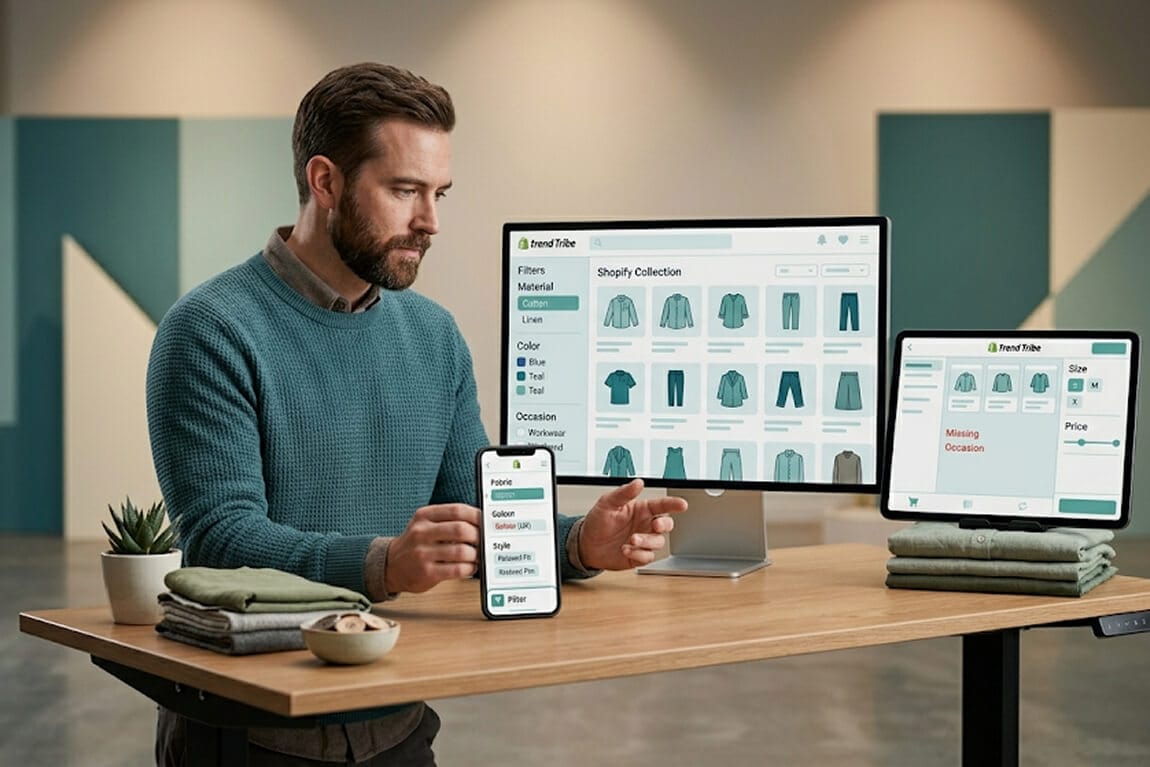
Generative On-Site Results Pages: Why Your Static Shopify PLP Is Becoming Obsolete in 2026
The traditional product listing page was built for browsing. But your customers don't browse anymore. They ask, they search, they expect the results to know who they are. Here's what's replacing the static PLP and what you need to do now.
She built her store the way everyone builds their store.
Collection pages organized by category. Women's tops. Women's bottoms. Dresses. Accessories. A filter sidebar on the left so customers could narrow things down once they landed somewhere.
It looked good. It worked fine. She launched, drove traffic, got sales.
Then she pulled up her session recordings.
The behavior was consistent and baffling. Customer after customer would land on a collection page, scroll for about eight seconds, and leave. Not bounce to checkout. Not engage with filters. Just leave. The filter sidebar sat largely untouched. The category pages showed hundreds of products and most customers looked at fewer than twelve before quitting.
She wasn't losing customers to competitors. She was losing them to decision fatigue.
The traditional product listing page, the static grid of everything in a category with a filter sidebar on the side, is a relic of how people shopped when the alternative was even worse. It predates search bars, let alone AI. And in 2026, as customers arrive with increasingly specific intent from increasingly specific traffic sources, the PLP is becoming the weakest link in the conversion chain. We covered the broader behavior shift in our piece on zero-click commerce for Shopify.
Here's what's replacing it.
What a "Generative Results Page" Actually Is
Let's define this specifically, because it gets vague quickly.
A generative on-site results page is a product discovery surface that's dynamically assembled in response to a specific customer context, rather than statically pre-built for a category. Instead of "all women's dresses, sorted by bestselling," it's "dresses that match what this customer is looking for, right now, based on what we know about them."
That context can come from multiple sources: the search query they just typed, the quiz they completed last week, the filters they've applied, the products they've viewed in this session, or explicitly stated preferences. The page assembles itself from those signals rather than displaying a pre-built collection. The signal collection mechanics are the same ones covered in our zero-party data filter strategy.
A static PLP is a museum. You walk in and everything is arranged the way the curator decided. A generative results page is a personal shopper. It asks what you're looking for and shows you that.
The shift is happening at multiple levels simultaneously: within on-site search (results that respond to natural language queries rather than keyword matches), within collection pages (dynamic sorting and surfacing based on behavioral signals), and within the broader product discovery experience (quiz-driven grids, preference-filtered starting states).
For Shopify merchants, this isn't a distant enterprise capability. It's already accessible. The question is whether your current setup is capturing it.
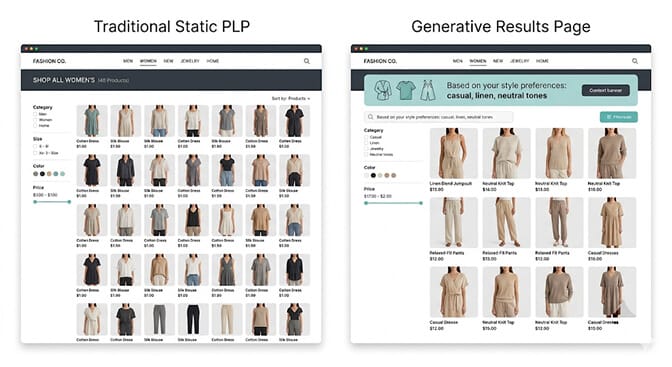
The Four Components of a Generative Results Experience
The transition from static PLP to dynamic results page isn't one product decision. It's four interconnected components, each of which can be improved independently, and each of which compounds the others when combined.
Component 1: Natural Language Search Results That Replace Keyword Matching
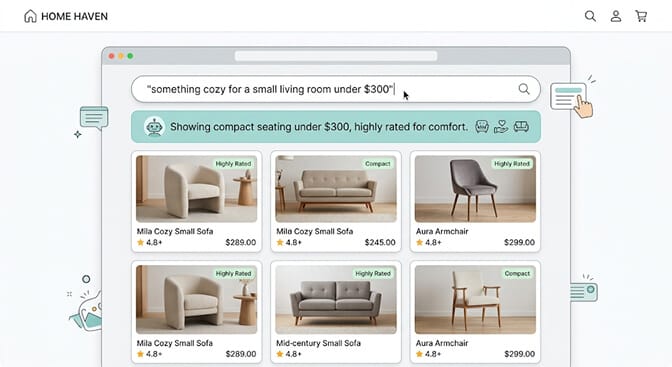
The most immediate shift from static to generative happens at the search results level.
Traditional keyword search matches words. A customer types "cozy small sofa" and gets results containing those exact words. "Compact loveseat" doesn't show up even if it's identical to what they want. "Armchair for small spaces" doesn't show up. The vocabulary mismatch sends the customer to a page that technically matches their words but doesn't match their intent. The deeper mechanics are in our piece on the best ecommerce search engines for Shopify.
Generative search results understand the meaning behind the query, not just the words. "Something cozy for a small living room under $300" parses as: compact size + comfort-focused + price limit + furniture category. The results surface products that match all four parameters regardless of whether those exact words appear in the product title. This is exactly what AI semantic search is built to do.
The practical impact for merchants: customers who use natural language queries (which is increasingly common as voice search habits bleed into text search, as we covered in multimodal search for Shopify) stop hitting zero-result or poor-result pages. They get surfaces that feel like the store understood them. Conversion rates on natural language search traffic are consistently higher than on keyword-matched results because the customer reaches the right product faster.
This is the first component of a generative results experience, and it's the one with the most immediate conversion impact. If your current search app does pure keyword matching, you're losing a growing slice of your search traffic to query types it can't handle.
Component 2: Context-Aware Collection Pages That Adapt to the Visitor
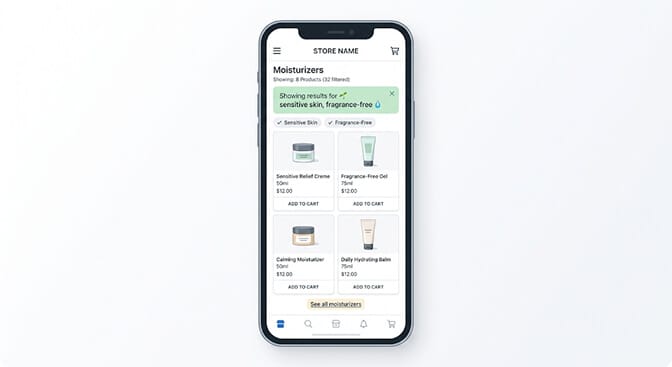
The traditional collection page shows everything. A "Moisturizers" collection shows all 32 moisturizers in whatever sort order you've configured. It's the same page for every visitor regardless of who they are or what they need.
A context-aware collection page adapts that starting state based on what you know about the visitor. A customer who completed your skin type quiz earlier sees the moisturizer collection already filtered to their skin type and sensitivities. A customer who previously searched for fragrance-free products sees those results surfaced first. A first-time visitor who arrived from a TikTok ad about anti-aging products sees that angle of the collection. The ranking layer that makes this happen is what we covered in personalized search for Shopify.
The key is that this doesn't require persistent login or cookies. Context can be gathered from session signals (what they've clicked, searched, or filtered in this session) as easily as from stored preference data. The page responds to available context rather than requiring a complete customer profile.
For most Shopify stores, this requires two things: a search and filter app that supports dynamic result ranking (not just static bestseller sort) and a way to feed session context signals into that ranking logic. Some advanced search apps handle this natively. Others require configuration. Pair it with AI merchandising and the storefront adapts at every scroll.
The conversion impact is significant. A collection page that shows twelve highly relevant products converts at a higher rate than one that shows 48 generic ones. Not because customers like fewer choices inherently, but because fewer relevant choices require less decision effort.
Component 3: Search-Driven Product Storytelling
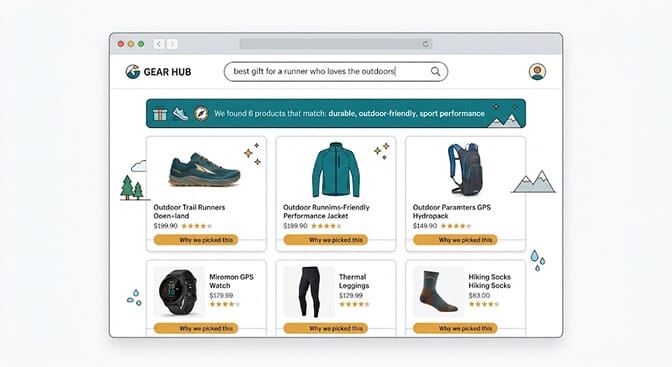
Here's the shift that most merchants don't anticipate.
When a customer types a natural language query, they're not asking for a list of products. They're asking for a recommendation. "Best running shoe for wide feet" is a request for guidance, not just a keyword search.
A generative results experience responds to that request with context, not just products. A brief summary of why these results match the query. Attribute callouts on individual products that explain why each one was surfaced. Comparison signals that help the customer distinguish between similar options. This is exactly the dynamic our piece on agentic search for Shopify covers from the AI-agent side.
This doesn't require you to write personalized content for every query. It requires a search system that can surface product attributes in a results-page context and organize them around the query's intent.
The practical implementation for Shopify: product metafields that capture the attributes most relevant to your specific catalog (outdoor durability, width options, arch support type), combined with a search app that surfaces those attributes contextually when relevant queries arrive. The "storytelling" element is the attributes speaking for themselves in the right context. The underlying catalog work is the same we covered in search enrichment for Shopify.
If you want to see what intelligent contextual search results look like in practice, the Sparq features overview walks through intent-based product discovery for Shopify stores.
Component 4: Post-Search Filter Adaptation
Traditional filter sidebars show the same filter categories regardless of what the customer just searched. You search for "linen pants" and the sidebar still shows "Material" as a filter option, even though every result on the page is already linen by definition of the search. This is exactly the problem covered in dynamic facets vs static filters.
A generative results experience adapts the filter set to the current results. When the search has already narrowed by material, the material filter disappears or moves to a secondary position. When the results contain only one size range, the irrelevant size filters collapse. When the search context makes certain attributes obviously more decision-critical (fit type and length for pants rather than sleeve length), those filters move to the prominent position.
This requires a filter app that can read the current result set and adapt its display logic accordingly rather than showing the same static sidebar for every page state.
The conversion impact is cleaner than it sounds. Customers who see fewer, more relevant filter options use those filters more. Customers who see a full sidebar of potentially irrelevant options tend to ignore it. The adaptation makes the filter sidebar feel like a tool rather than an obstacle.
What Your Current PLP Architecture Is Costing You
Here's the thing about this shift. It's not coming eventually. It's happening now.
Traffic arriving at Shopify stores from AI-generated recommendations (ChatGPT shopping, Google AI Mode, Perplexity) showed higher engagement and lower bounce rates than comparable traffic from traditional search in 2026 data. These visitors arrived with more specific intent, having already been pre-qualified by an AI that told them your store had what they needed. Our piece on generative engine optimization for Shopify covers how to capture more of this referral traffic in the first place.
When they arrive, they're looking for confirmation of what the AI said. "Show me the product I was recommended." If they land on a static PLP with 48 products and have to figure out your filter sidebar to find the thing they came for, you've turned a high-intent visit into a treasure hunt.
The stores that convert this AI-referred traffic efficiently are the ones where search results and collection pages understand specific intent and surface the right product with minimal friction. Not because they have more traffic. Because their discovery surface is built for how customers search in 2026 rather than how they browsed in 2016. The predictive search customer story shows what this lift looks like in production.
The Practical Path: How to Move Toward Generative Results Without a Full Rebuild
This doesn't require a platform migration or a six-month development project. Here's the sequence that produces visible results within your current Shopify setup.
Step 1: Replace keyword search with intent-aware search. If your current search app does pure keyword matching, upgrade to one that handles natural language queries. This single change produces the most immediate impact on search conversion because it resolves the query type mismatch that's currently failing your most specific, highest-intent customers. The Shopify search relevance audit playbook is a good starting checklist.
Step 2: Add product metafields for your most decision-critical attributes. Generative results pages can only surface the attributes that exist in your product data. Audit your top-selling categories and identify the attributes customers most commonly use to compare products. Add those as metafields. They'll power both filter adaptation and AI-readable product context.
Step 3: Enable dynamic result ranking in your collection pages. Most advanced search apps can apply the same relevance ranking logic to collection pages that they apply to search results. Enable this and configure it to use session signals (recent searches, viewed products, applied filters) to reorder collection page results for individual visitors. AI recommendations is the layer that ranks the right next product.
Step 4: Implement adaptive filters. Configure your filter app to surface only the filter categories most relevant to the current result set. Remove or collapse filters that are redundant given the current search or collection context.
Each of these steps is achievable with your current Shopify setup and a capable search and filter app. None of them require custom development. Together, they move your PLP from a static category browser to something that responds to the specific person looking at it. If you want to size what the lift is worth on your specific revenue, plug your numbers into our ROI calculator.
When you're ready to see what your customers are currently searching for and where your discovery experience is failing them most, install Sparq from the Shopify App Store and check your search analytics. Free to try, no-code setup, and the queries that generate high traffic and low conversion are usually the exact places where a generative results experience would make the biggest difference.
The Takeaway
The merchant reviewing session recordings finally found her problem.
It wasn't her products. It wasn't her pricing. It wasn't her photography. It was that her collection pages were showing customers everything and letting them figure it out. In 2026, that's asking too much.
She added natural language search, configured her filters to adapt to search context, and set up basic preference-based result reranking on her collection pages. The whole project took two weeks.
Her session recordings three months later looked completely different. Customers who searched were finding products in their first or second result. Collection page visitors were engaging with filters they could actually use. Bounce rates dropped. Session length increased. Conversion climbed.
The products were the same. The customers were the same. The discovery surface finally matched how people actually look for things.
That's what the shift from static PLP to generative results experience is really about. Not technology for its own sake. Showing the right product to the right person faster, with less effort on their part. If you'd rather see what's possible before installing, the Sparq features overview, pricing, and option to book a demo walk through the full picture first.
Frequently Asked Questions
What is a generative on-site results page in ecommerce?
A generative on-site results page is a product discovery surface that's dynamically assembled based on a specific customer's context, rather than statically pre-built for a category. Instead of showing all products in a category in a fixed order, it surfaces the most relevant products for that particular visitor based on their search query, stated preferences, behavioral signals from the current session, or stored preference data. The page adapts to who's looking at it rather than presenting the same view to every visitor.
How is a generative results page different from a traditional Shopify PLP?
A traditional Shopify product listing page shows every product in a collection in a pre-configured sort order, with a static filter sidebar that's the same for every visitor. A generative results page adapts to the visitor's context: natural language search queries return results that match intent rather than keywords, collection pages reorder products based on session signals, filter options adapt to the current result set rather than showing every possible filter, and context-aware sorting surfaces the most relevant products first. The core difference is whether the page responds to the individual or presents the same view to everyone.
How do I start moving toward generative search results on my Shopify store?
Start with the highest-impact change: replacing keyword search with natural language intent-aware search. This resolves the query mismatch that fails your most specific, highest-intent customers immediately. Then add product metafields for your most decision-critical attributes, so the search system has attribute data to work with. Enable dynamic result ranking on collection pages if your search app supports it. Finally, configure adaptive filters that surface only the categories most relevant to the current result set. Each step is achievable without custom development using capable Shopify search and filter apps.
Do generative search results require customer accounts or login to personalize?
No. Meaningful personalization can be achieved from session signals alone, without any login or stored customer data. A customer who searches "fragrance-free moisturizer" in the current session provides enough context to surface relevant products and adapt filter options immediately. A customer who has applied specific filters earlier in the session provides signals that can reorder collection pages for the remainder of that visit. Stored preference data from quiz completions or previous sessions adds further personalization for returning customers, but it's not required for the baseline generative results experience.
Will switching to AI-powered search and dynamic PLPs slow down my Shopify store?
No, when implemented through a properly built Shopify app. Modern search apps that handle natural language queries and dynamic result ranking operate at the edge or API level, returning results quickly without impacting page load performance. The product grid itself loads the same way it always did; the AI ranking logic determines which products fill that grid before the page renders. A well-implemented search app should not add perceptible load time. If you notice performance degradation after installing a search app, that's a sign of poor implementation rather than an inherent tradeoff.