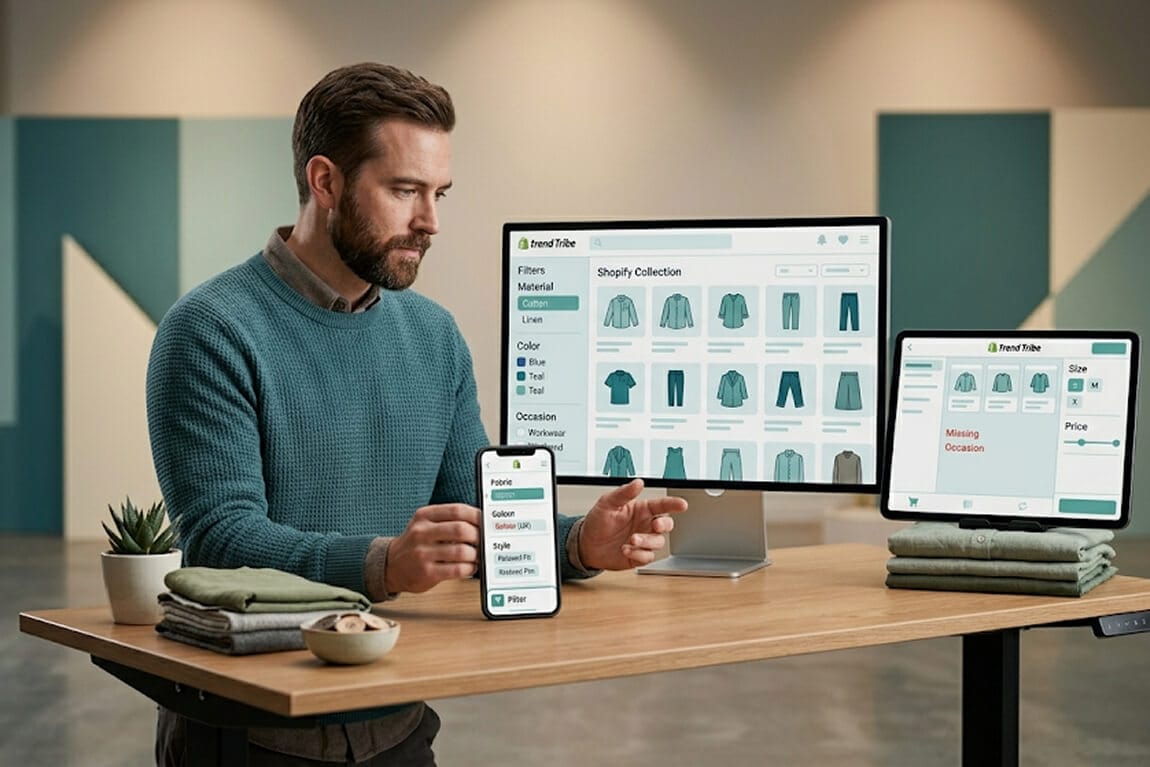
Agentic Search Is Here: How AI Agents Will Shop Your Store in 2026
Your next "customer" might not be human. Here's what your Shopify store needs to do this week to make sure they actually buy.
A Shopify merchant I know got five orders in four minutes last Tuesday. 2:47 AM. Same product, different sizes, same IP address.
Her first thought was fraud.
Her actual reality? An AI shopping agent had just placed orders on behalf of five different shoppers, all routed through a single conversational interface. The agent had been asked, "Find hiking boots for a family of five going to Yosemite next month," and quietly negotiated its way through her store while everyone slept.
She got lucky. Her catalog was structured well enough that the agent could find what it needed.
Most Shopify stores aren't.
Here's the weird part: agentic commerce isn't a 2027 problem. It's already running through your traffic logs. ChatGPT shopping. Perplexity. Claude with browsing. Operator. Anthropic's Computer Use. They're already querying ecommerce sites on behalf of real shoppers, making real decisions about what to recommend or quietly buy.
And if your store can't talk to them, you don't get the sale. You don't even get the consideration.
What "Agentic Search" Actually Means (Strip Out the Hype)
Let's be specific. Agentic search is when an autonomous AI agent queries your store on behalf of a user, instead of the user clicking around themselves.
The agent does three things humans usually do:
It interprets the shopper's vague request. ("a gift for my sister, she likes minimalism, under $80")
It translates that request into structured queries against your store. (category=home, style=minimal, price<=80)
It evaluates results, narrows them, and decides what to show, recommend, or buy.
You're no longer designing a storefront for a person scrolling with their thumb. You're designing for a program that's making decisions on a person's behalf, often with the person never seeing your homepage.
This is where most store owners get it wrong. They keep optimizing the visual storefront. The agent doesn't see the visual storefront. It sees data.
How AI Agents Actually Query Your Store (And Why Most Fail)
Stay with me here. This part matters.
When an AI agent visits your store, it has two paths.
Path 1: Structured data. The agent looks for schema.org product markup, sitemaps, JSON product feeds, and any machine-readable surface. If those exist and are clean, the agent gets answers in milliseconds.
Path 2: Page scraping. If structured data is missing, the agent reads HTML like a fast, slightly confused human. It has to guess at prices, parse product titles, infer categories from collection names, and try to navigate filters that were built for clicks, not API calls.
Path 2 is where most stores fail. Not because the agent can't do it. But because the agent will give up on ambiguous data faster than a human ever would.
A human shopper might tolerate vague product titles, missing sizes, and clunky filters. A human will scroll past it.
An agent will not. It moves to the next store.
And this is the part that costs you money. The agent won't email you to say it abandoned. You'll just see traffic that doesn't convert and never know why. Stores that already track this on the human side, through good search bar analytics, tend to spot the agent gap earliest. If you want to size the actual revenue at stake, run your numbers through our ROI calculator.
The Five Things Agents Actually Need (And What Your Store Is Probably Missing)
I'm going to give you a checklist. It's specific. Run through it on your own store this week.
1. Structured Product Data (Schema.org Product Markup)
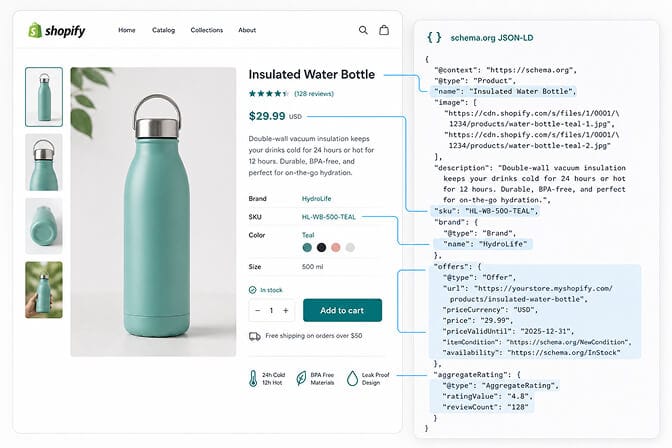
Every product on your store should expose schema.org Product markup with at minimum: name, sku, brand, price, availability, and image.
Most Shopify themes ship some version of this. Most ship it incompletely. Open any product page on your store, view source, and search for application/ld+json. If you don't see it, your products are partly invisible to agents.
If you do see it, check the fields. Missing availability? Missing priceValidUntil? Missing aggregateRating? Each gap is a place an agent will downrank you against a competitor with cleaner data.
2. Machine-Readable Filters (Faceted Navigation That Agents Can Query)
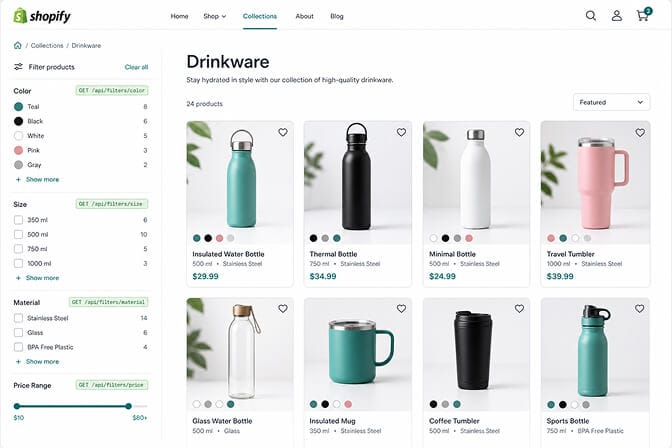
Filters built for click interaction don't work for agents. An agent that wants "size 10, waterproof, under $200" needs to query that as parameters, not navigate a menu.
This means your filter system needs:
URL-based filter state (so the agent can construct queries directly).
Predictable filter naming (color, size, material, not "attribute_pa_color_v2").
Real attribute data on every product (an agent can't filter by "waterproof" if you only mentioned it in the description).
Most Shopify stores fail at the third one. Their products live as titles and free-text descriptions. Agents need attributes. Structured, consistent, queryable attributes. The underlying ecommerce search algorithm work hinges on exactly this kind of data hygiene.
3. Rich Product Attributes (Beyond Title and Description)
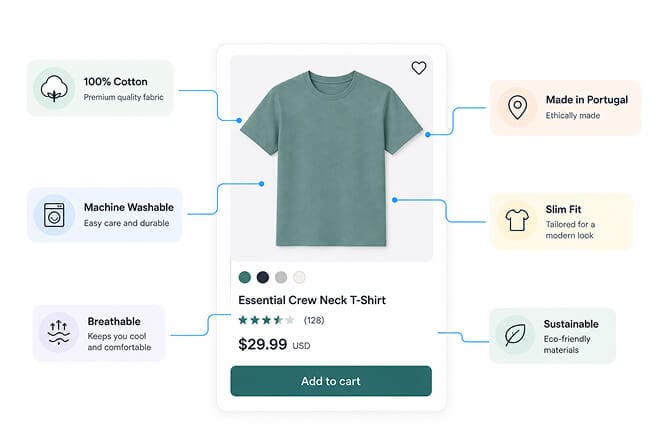
Your "Cozy Merino Wool Crewneck Sweater" needs to be queryable as: material=merino wool, style=crewneck, category=sweater, weight=mid, season=fall/winter.
If those attributes only exist as adjectives in your description, an agent has to do natural language inference to extract them. Some agents do that well. Most don't bother. They prefer stores where the data is already structured.
This is where search enrichment earns its keep. Tools that auto-extract attributes from your product data make your catalog agent-ready without a manual tagging marathon. We've written a full piece on how search enrichment actually works if you want to see what's happening under the hood, and AI merchandising is the layer that makes those enriched attributes actually rank.
4. Clean URL Patterns and Sitemaps
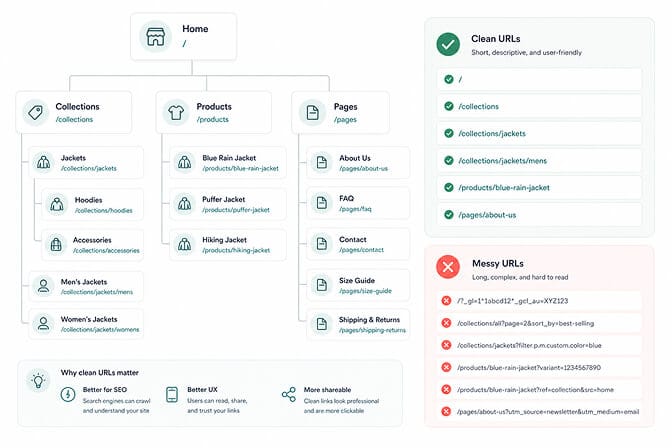
Agents traverse your site through links. If your URL structure is chaotic (/products/abc123-xyz789) or your sitemap is incomplete, the agent's understanding of your catalog is partial.
Run your sitemap through any sitemap validator. Make sure every collection and product is listed, with lastmod timestamps and proper changefreq hints. This isn't sexy work. It's the kind of plumbing that determines whether agents see your full catalog or 60% of it. The same plumbing supports good ecommerce site search architecture on the human side.
5. Conversational Query Tolerance (Natural Language Search)
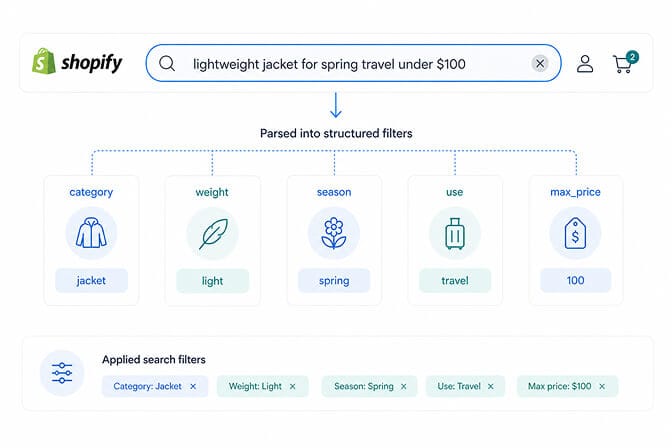
When an agent on behalf of a user queries your search bar, it won't always send neat keywords. Sometimes it sends the user's actual phrasing: "lightweight jacket for a spring trip under $100."
Shopify's default search will choke on that. It tries to match all those words against product titles. It returns nothing.
A search engine with AI semantic search parses that into structured filters: category=jacket, season=spring, use=travel, price<=100. Then it returns relevant products. The best ecommerce search engines for Shopify ship this as default behavior.
If you want to be agent-ready, your search has to be NLU-ready. There's no separating the two.
The stores that win in agentic commerce won't be the ones with the prettiest themes. They'll be the ones whose data, attributes, and search are clean enough for an agent to query in one pass.
If you're tired of customers (and now agents) searching and leaving empty-handed, Sparq fixes that in about 10 minutes. Free to try, no-code setup, and the search analytics alone will show you exactly which queries your store is failing on right now.
The Part Shopify Doesn't Tell You
Here's the inconvenient truth about Shopify out of the box.
Schema markup ships partial. Filter URLs are workable but not guaranteed across themes. Attribute data depends entirely on how you set up products. Native search is keyword-only. Sitemap is fine, but the rest of the agent-readiness stack is your responsibility.
This isn't Shopify being lazy. It's Shopify being a platform. The expectation is that apps and merchants close the gaps.
The gap, until recently, was small. A human shopper was forgiving. They'd squint at your store, scroll, and find what they wanted.
An agent won't squint. An agent will compare the structure of your data to the structure of three competitors and pick whichever is cleanest.
That's the real shift. Agentic commerce moves the competitive surface from visual design to data architecture. Beautiful storefronts still matter for humans. They no longer matter for agents.
A Quick Merchant Checklist
Before you close this tab, run through this:
Open one of your product pages. Right-click, view source, search for application/ld+json. Is Product schema present, with availability and price? If not, fix that first.
Open a collection page. Apply two filters. Look at the URL. Is the filter state in the URL? If not, agents can't bookmark or replay your filtered queries.
Pull up your top 20 products. Do all of them have consistent, structured attributes (material, color, size, use case) as actual product data, not just description text?
Search your own store for "lightweight summer jacket." Does it return jackets? Or does it return nothing because your products are tagged differently? If your store currently struggles with search relevance, this is where it shows up first.
Open your sitemap.xml. Are all your products and collections listed? Are timestamps current?
If you scored less than 4 out of 5, you have agent-readiness work to do.
What Comes Next (And Why You Don't Have a Year)
Agentic commerce is moving faster than any prior shift in ecommerce. Faster than mobile. Faster than social commerce. Faster than headless.
Why? Because agents don't need the consumer to change behavior. The consumer just types into ChatGPT. The agent does the rest. Adoption is invisible from the consumer side, which means it doesn't have the usual friction curve.
By late 2026, a meaningful share of ecommerce traffic will be agent-mediated. The merchants who prepared their data this year will collect those orders. The merchants who didn't will quietly stop showing up in agent results, the same way some sites quietly stopped showing up in voice search a few years back. We covered the broader shift in our piece on ecommerce search trends for 2026, and you can see how stores that already invested in predictive search are pulling ahead.
Your search bar, your filters, your attributes, your schema. They've always mattered for human conversion. Now they're table stakes for AI conversion too.
Want to see what your customers (and agents) are actually searching for? Install Sparq from the Shopify App Store and check your search analytics. The queries that return nothing are exactly the gaps an agent will punish you for. If you'd rather see what's possible before installing, the Sparq features overview and pricing walk through the full picture, or book a demo and we'll do an agent-readiness audit on your store live.
Frequently Asked Questions
What is agentic search in ecommerce?
Agentic search is when an autonomous AI agent queries an online store on a shopper's behalf, interprets vague requests, translates them into structured queries, and evaluates results before presenting or buying. Instead of the human browsing your storefront, the AI navigates the data layer of your store and makes purchase-relevant decisions.
How is agentic commerce different from regular ecommerce search?
Regular search assumes a human is reading and clicking. Agentic search assumes a program is parsing structured data and filters programmatically. That changes what your store needs to expose: clean schema markup, machine-readable filters, structured product attributes, and a search engine that handles natural language queries instead of keyword strings.
Do AI agents work with Shopify stores out of the box?
Partially. Shopify provides sitemaps and basic schema, but most themes ship incomplete product markup, attribute data depends on how you configure products, and the native search bar can't handle conversational queries. Stores that want to be fully agent-ready typically add an AI search and filtering layer plus tighten their schema and product attributes.
Will I lose sales if I ignore agentic commerce in 2026?
Likely yes, and you may not see it directly. Agents won't email you to say they skipped your store. They'll silently rank competitors higher because the competitor's data was cleaner, and your traffic will quietly stagnate. By the time you trace it, you've lost months of revenue to stores that prepared earlier.
How long does it take to make a Shopify store agent-ready?
The fastest path is one to two weeks: install an AI search and filtering app like Sparq, audit your schema markup, restructure product attributes for the top 50 SKUs, and verify your sitemap. The full cleanup (every SKU, every attribute, perfect schema) is a longer project, but the 80% improvement comes from the first focused sprint.