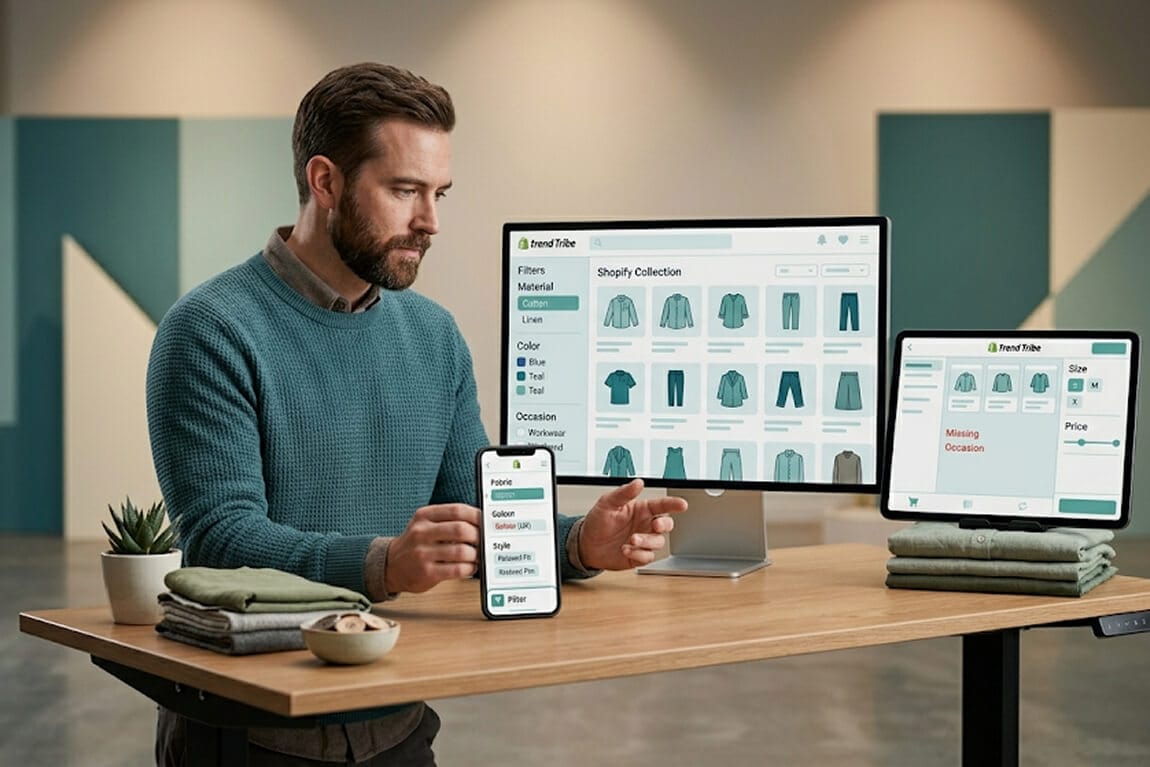
Your search bar knows less about your best customer than your worst intern. Here's how to fix that.
She'd been running her skincare store for three years. Decent traffic. Good reviews. Products people loved once they found them.
But Sarah kept seeing the same thing in her Shopify analytics: customers landing on her site, typing something into the search bar, and leaving. Not bouncing from a bad homepage. Not bailing on checkout.
Leaving after searching.
The search bar was the last thing they touched before they left her store forever.
Here's the weird part. Her products were great. Her catalog was organized. She even had a blog that drove thousands of organic visitors per month.
The problem wasn't her store. It was that her search treated every single visitor exactly the same way.
A first-time visitor searching "moisturizer" got the same results as a repeat customer who'd bought three serums and two SPFs in the last six months. A teenager looking for "cheap face wash" saw the same products as a 45-year-old searching for "anti-aging routine."
That's what most Shopify stores are doing right now. And it's costing them more money than they realize.
What Personalized Search Actually Means (and What It Doesn't)
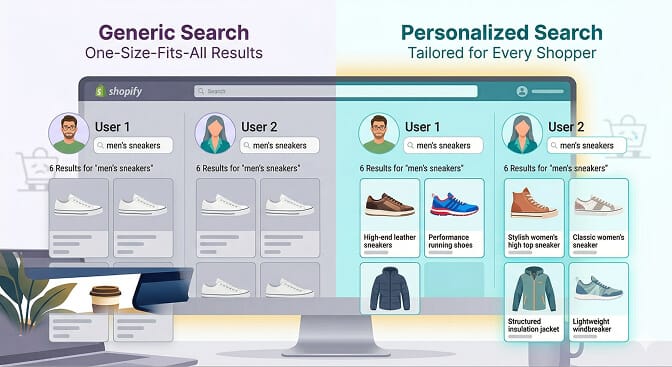
It means your search bar gets smarter over time.
When a customer searches your store, a personalized search engine considers what they've browsed before, what they've purchased, what similar customers tend to buy, and even how they phrase their queries. Then it serves results ranked by relevance to that specific person, not just keyword matches.
Think about it this way. When you walk into your favorite local shop, the owner doesn't hand you the same catalog every time. They say, "Hey, we just got something I think you'd love." That's personalization. That's what your search bar should be doing.
Shopify's default search can't do this. It matches keywords. That's it. No behavioral data. No purchase history. No intent signals. You could be their highest-spending repeat customer, and the search bar treats you like a stranger who wandered in from the street.
If you want to understand the technical foundations behind how ecommerce search actually works, we've broken that down in a separate deep dive.
Why Generic Search Is Bleeding You Dry
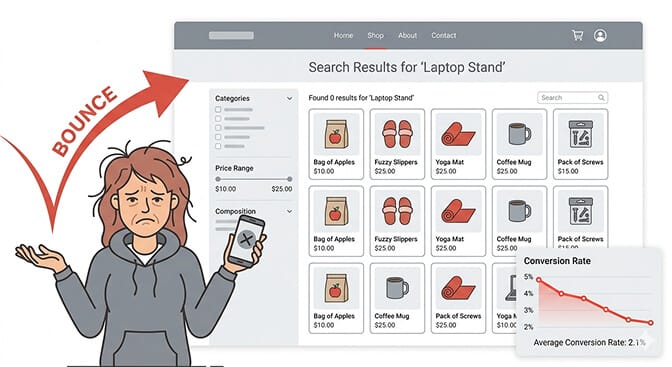
But here's the data that should make you uncomfortable: visitors who use site search convert 1.8x higher than those who don't. They already have intent. They're telling you exactly what they want. They're practically begging to buy.
And your generic search bar is fumbling the handoff.
When a returning customer searches "blue dress" and sees the same 200 results as everyone else, instead of seeing the blue dresses in their size, in the style they've bought before, at the price point they usually shop... that's friction.
And friction kills conversions.
This is where most store owners get it wrong. They blame the traffic source. They blame the product page. They blame the price. But the search results page is where the damage actually happens. We see this pattern over and over in stores dealing with high traffic but no sales.
If your search bar can't tell the difference between a first-time browser and your best customer, you're leaving money on the table every single day.
How AI-Powered Search Actually Learns
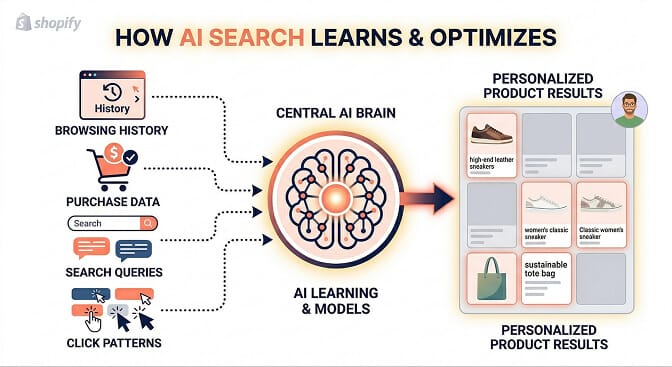
AI-powered personalized search works on three layers:
Layer 1: Behavioral Signals. The AI watches what customers do. Not in a creepy way. In a "hey, this person clicked on three different running shoes, so when they search 'sneakers' let's show them running shoes first" kind of way. It tracks clicks, add-to-carts, time spent on product pages, and purchase patterns.
Layer 2: Natural Language Understanding. This is where it gets interesting. Someone searching "gift for mom" isn't looking for products literally tagged "gift for mom." They want popular items in a mid-to-premium price range, maybe skincare, jewelry, or home goods. AI that understands shopping intent can translate vague, human queries into relevant results. The technology behind this is called semantic search, and it's completely changing how product discovery works.
Layer 3: Collaborative Filtering. This is the "customers like you also bought" logic applied to search. If shoppers with similar browsing patterns and purchase histories tend to buy a specific product after searching a certain term, the AI learns that connection and applies it to new visitors with matching behavior. It's the same product recommendation algorithm logic that powers Amazon, scaled down for Shopify stores.
The beautiful part? It happens automatically. No manual rules. No merchandising spreadsheets. The search engine gets smarter with every single interaction.
What This Looks Like in a Real Shopify Store
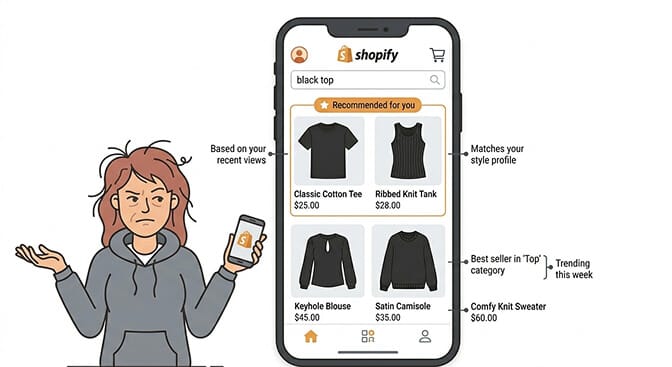
Imagine you run a fashion store with 800+ SKUs. A first-time visitor from Instagram searches "black top." Your AI search shows them your trending black tops, sorted by popularity and reviews. Good results. Broad, but smart.
Now that same visitor comes back two weeks later. They've browsed your silk camisoles, added a linen blazer to their cart, and purchased a pair of high-waisted trousers. They search "black top" again.
This time, the results are different. The AI prioritizes your silk and linen black tops in their size. It pushes casual cotton tees further down. Because it knows this person. Not their name. Not their address. But their shopping personality.
That's the difference between a search bar and a sales associate.
And this is the part that costs you money. Without this kind of intelligence, that returning customer sees the same 200 generic results, gets frustrated trying to find what they want, and bounces. They don't write you an angry email. They don't leave a bad review. They just quietly disappear, and you never know why.
Good search UX is the difference between a store that converts browsers and a store that watches them leave.
The Search Analytics Gold Mine Nobody Talks About
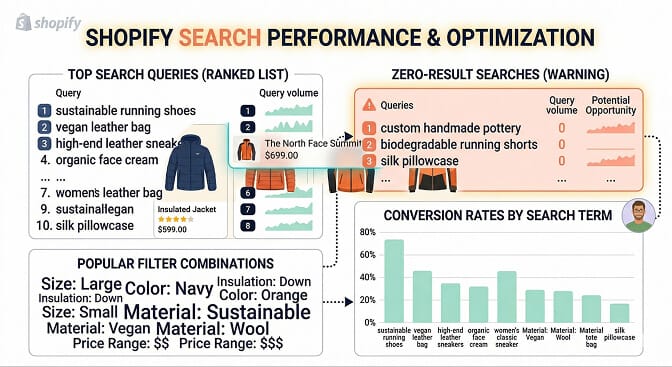
Most store owners have no idea what people are searching for. They don't know which searches return zero results. They don't know which search terms lead to purchases and which ones lead to exits.
This data is gold.
When you see that 50 people searched "vegan leather bag" last month and got zero results, that's a product opportunity. When you see that "red dress" converts at 8% but "red cocktail dress" converts at 22%, that's a merchandising insight. When you see that mobile searchers use completely different terms than desktop searchers, that's a UX revelation.
Search analytics turns your search bar into a customer research tool. It tells you what your audience wants in their own words, not through surveys or focus groups, but through real, in-the-moment purchase intent.
Understanding search abandonment patterns is one of the fastest ways to diagnose where your search experience is falling apart.
Why Shopify's Built-In Search Isn't Enough
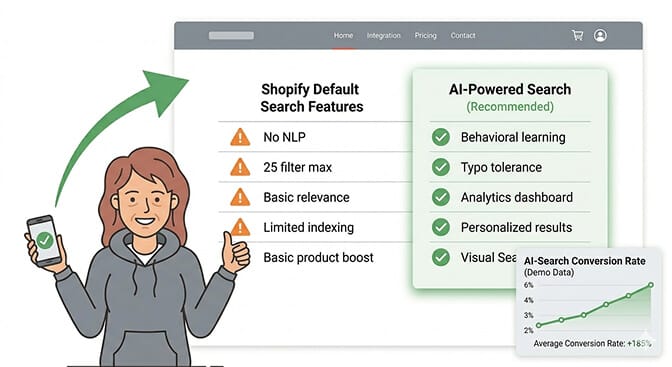
But Shopify's native search was built to be functional, not competitive. It does exact keyword matching. It doesn't understand synonyms. It can't handle typos gracefully. And it definitely can't personalize results based on individual behavior.
Shopify's own Search & Discovery app helps a bit. You can set up synonyms and pin certain products. But it still has hard limits. A maximum of 25 filters. No real AI. No behavioral learning. And as recent reviews on the app store suggest, it can be glitchy and slow to load.
For stores with under 50 products, that might be fine. But the moment you scale past a few hundred SKUs, generic keyword matching becomes a conversion killer. That's why so many merchants are exploring the broader world of ecommerce search engines built specifically for this problem.
What to Look for in a Personalized Search App
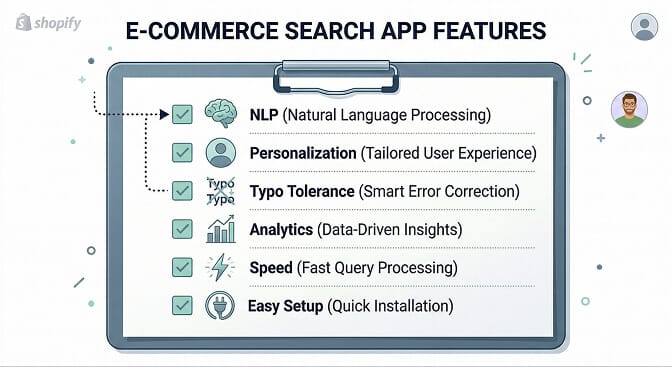
Natural language understanding. Can it handle "summer dress under $50" as a single query and return relevant, filtered results? Or does it choke on anything that isn't a product name?
Real personalization. Does it actually learn from individual behavior, or does it just show "popular products" and call it personalized? There's a massive difference.
Typo tolerance and synonyms. If someone types "sneekrs" instead of "sneakers," does your search still work? What about "sofa" vs "couch"? Good synonym management is essential for any serious store.
Search analytics. Can you see what people search for, what converts, and what returns zero results? Without this, you're flying blind.
Speed. Every millisecond matters. If your search takes more than 200ms to return results, you're losing impatient mobile shoppers.
Easy setup. If you need a developer to install and configure it, it's probably built for enterprise, not for growing Shopify stores. A great search bar app should work out of the box.
The Personalization Spectrum: Where Does Your Store Sit?
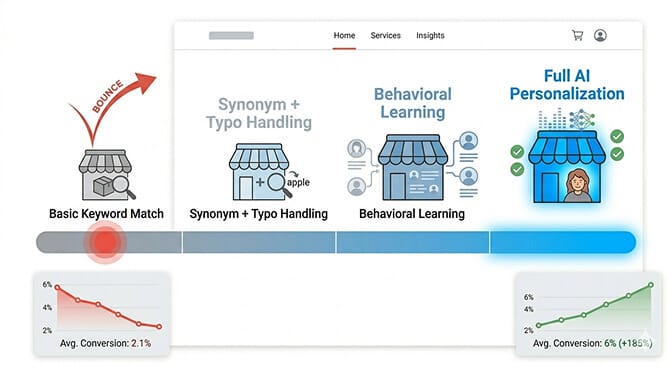
Level 1: Basic Keyword Matching. This is Shopify's default. Type "blue shirt," see anything tagged with "blue" and "shirt." No intelligence. No context.
Level 2: Smart Matching. Synonyms, typo correction, autocomplete. The search understands that "tee" and "t-shirt" are the same thing. It suggests products as you type. This alone can boost your ecommerce search conversions significantly.
Level 3: Behavioral Learning. The search starts paying attention to what individual customers do. Click patterns, browse history, and purchase data influence result rankings. Results feel relevant, not random.
Level 4: Full AI Personalization. Natural language processing. Real-time adaptation. Collaborative filtering. The search doesn't just find products. It predicts what each customer wants before they finish typing. This level of predictive search is where the real revenue gains happen.
Most Shopify stores are stuck at Level 1. The stores that are growing fastest? They've moved to Level 3 or 4.
But Won't This Slow Down My Store?
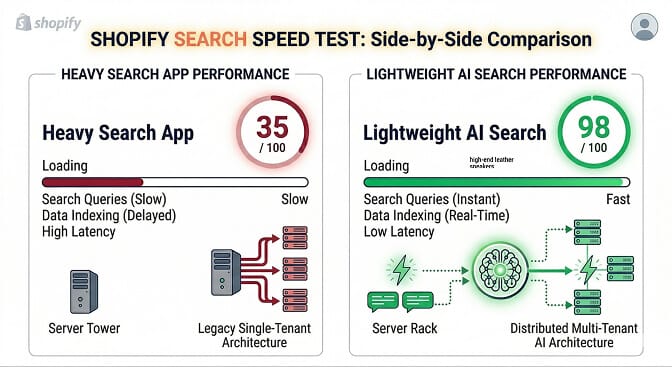
Bad search apps absolutely can slow down your site. If the app is making heavy server calls on every keystroke, rendering complex widgets, or loading unnecessary scripts, your page speed takes a hit. And we all know what happens when your store speed drops: conversions drop right along with it.
But modern AI search is built differently. The best tools use lightweight front-end scripts and process the heavy lifting on their own servers. Your Shopify store sends the query, the AI does its thing in the cloud, and results come back in under 100 milliseconds.
At Sparq, we obsess over this. Short version: your store stays fast.
The ROI Math That Makes This a No-Brainer
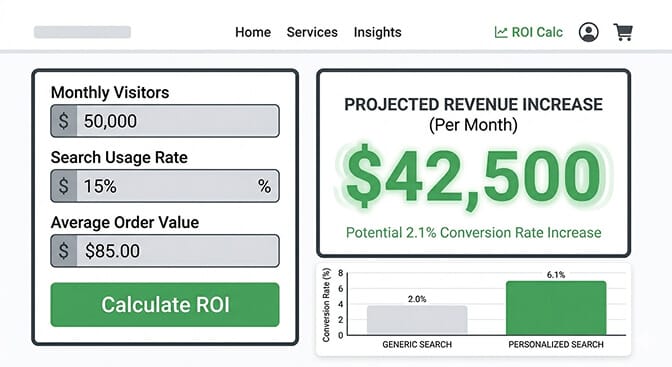
Say your store gets 10,000 visitors per month. About 15% of them use your search bar, which is typical. That's 1,500 search sessions.
With generic search, maybe 3% of those searchers convert. That's 45 orders.
With personalized AI search, conversion rates for searchers commonly jump to 5-7%. Let's be conservative and say 5%. That's 75 orders from the same traffic.
If your average order value is $80, that's an extra $2,400 per month. From the same visitors. With no extra ad spend.
Now imagine what happens when your store grows to 50,000 or 100,000 monthly visitors. The math scales. The ROI gets ridiculous.
Understanding the role of product discovery in ecommerce ROI makes it clear why search is one of the highest-leverage investments you can make.
If you're tired of customers searching and leaving empty-handed, Sparq fixes that in about 10 minutes. Free to try.
Getting Started Without Overwhelm
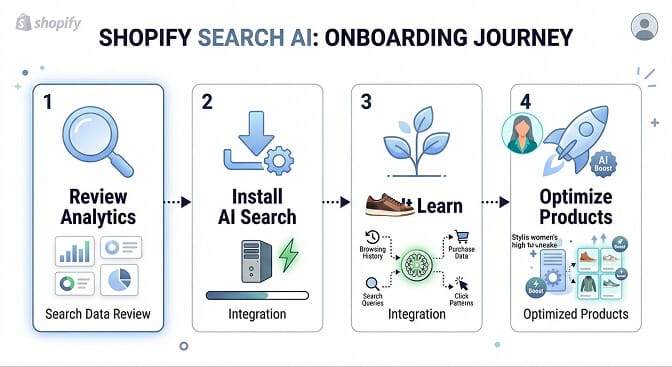
Here's the honest path:
Step 1: Look at your search analytics. What are people searching for? What's returning zero results? What terms convert? If you're not tracking this, you're missing your biggest optimization opportunity.
Step 2: Install a search app that does actual AI, not just keyword matching with extra steps. Make sure it handles natural language queries, typos, and synonyms out of the box.
Step 3: Let it learn. AI search gets better over time. The first week will be an improvement over default search. The first month will be noticeably better. By month three, your search is a sales machine.
Step 4: Use the analytics to inform your product strategy. Add products people are searching for. Improve descriptions for products that show up in search but don't convert. Kill dead inventory that nobody ever searches for.
That's it. No consultants required.
The Future Is Already Here
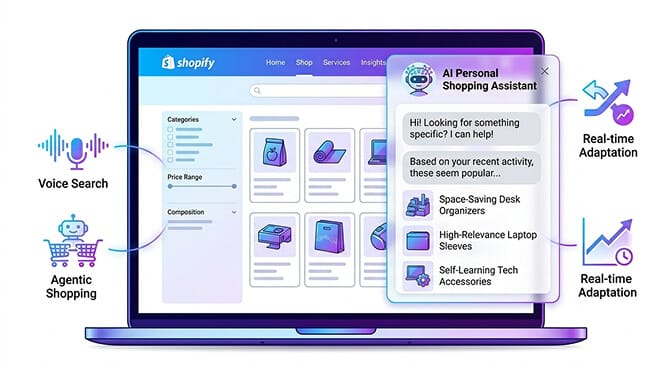
The stores that figure this out early won't just convert more. They'll build customer loyalty that's nearly impossible to compete with. Because once a customer experiences a store that gets them, going back to generic search feels like walking into a warehouse with no signs.
If you want to understand the broader shifts happening in ecommerce search trends for 2026, we've covered that extensively.
Your search bar is the most honest conversation you'll ever have with your customers. They're typing exactly what they want, in their own words, with money ready to spend.
The only question is whether your store is listening.
Want to see what your customers are actually searching for? Install Sparq and check your search analytics. It takes about 10 minutes. And what you find will probably surprise you.
Frequently Asked Questions
What is personalized search for Shopify?
Personalized search for Shopify is an AI-powered search feature that customizes product results for each individual visitor based on their browsing behavior, purchase history, and search patterns. Unlike Shopify's default keyword-matching search, personalized search learns what each customer prefers and surfaces the most relevant products first, increasing the likelihood of conversion.
How does AI search compare to Shopify's built-in Search & Discovery app?
Shopify's native Search & Discovery app provides basic functionality like manual synonyms, product pinning, and simple filters, but it's limited to 25 filters and doesn't offer behavioral personalization. AI-powered search apps like Sparq go further with natural language processing, automatic synonym detection, typo tolerance, real-time behavioral learning, and detailed search analytics that reveal what customers want.
Will an AI search app slow down my Shopify store?
A well-built AI search app should not slow down your store. Modern solutions process queries on external servers and return results in under 200 milliseconds. The front-end scripts are lightweight and designed to work within Shopify's performance standards. Always check whether the app has documentation on its performance impact before installing.
Does personalized search actually increase conversion rates?
Yes. Visitors who use site search already have higher purchase intent. Studies consistently show that search users convert at nearly double the rate of non-search users. When those results are personalized to individual preferences and behavior, conversion rates among searchers can improve by an additional 30-60%, depending on catalog size and traffic volume.
How long does it take to set up personalized search on Shopify?
Most AI search apps designed for Shopify can be installed and configured in under 15 minutes without any coding or developer support. The AI component begins learning from customer behavior immediately after installation, with noticeable improvements in result relevance within the first few weeks as the system accumulates behavioral data.