
Your customers are starting to ask ChatGPT and Google AI for product recommendations. Here's the data, schema, and on-site search work that decides whether your store gets named or skipped.
A Shopify merchant I work with did something dangerous last week.
She asked ChatGPT, "best minimalist leather backpacks for travel under $200."
She wasn't testing search rankings. She was looking for a gift.
The AI gave her five solid recommendations. Three brands she'd never heard of. Two she had.
Her own store, which sells exactly that kind of bag, wasn't in the answer.
She sat with that for a minute. Then she asked Perplexity the same question. Same answer. Same five brands. None of them hers.
Her catalog had the right products. Her descriptions were decent. Her domain authority was respectable.
But somewhere in the loop between her store, the AI engines, and her potential customer, her brand had become invisible.
That's the GEO gap. And it's about to define which Shopify stores grow and which ones quietly stagnate over the next 18 months.
What Generative Engine Optimization Actually Is
Stay with me here, because the acronym soup gets thick fast.
GEO (Generative Engine Optimization) and AEO (Answer Engine Optimization) describe the same thing: optimizing your store so that AI engines (ChatGPT, Perplexity, Claude, Google AI Overviews, Bing Copilot, etc.) confidently cite your products in their answers.
It's not SEO. SEO is about ranking on a results page. GEO is about being named in the answer itself.
The difference matters more than it sounds. When a customer Googles "best leather backpacks," they see a list of ten links and pick one. When the same customer asks ChatGPT, they see one synthesized answer with five brand names embedded. There's no second page. There's no "see more results."
If you're not in those five names, you're not in the consideration set. You're not in the comparison. You're not even in the customer's awareness.
Here's the weird part: most ecommerce brands trying to do GEO right now are writing more blog posts. That's not the play. The play is product data, schema, and on-site search structure.
SEO got you found in the SERP. GEO gets you named in the answer. They are not the same problem.
Why On-Site Search Is at the Center of GEO (And Most Merchants Miss This)
This is where most store owners get it wrong.
When ChatGPT or Perplexity decides which products to cite, they don't just read your homepage. They read your structured data, your product pages, and increasingly, the metadata your on-site search exposes about your catalog.
If your store's search engine surfaces clean attributes (material, size, use case, price band, occasion), AI engines can match those attributes against the user's query and cite you. If your search exposes only product titles and free-text descriptions, AI engines can't reliably match.
Same products. Different odds of being cited.
This is the part Shopify doesn't tell you. Default Shopify product data, with title and description as the main fields, is GEO-fragile. AI engines have to do natural language inference to figure out that your "Cozy Merino Wool Crewneck" is a "merino sweater for cold weather, mid-weight, classic style." Some engines do that inference well. Most prefer stores where the data is already structured. The same logic governs how agentic search decides whether to query your store at all.
We've covered the underlying catalog work in our deep dive on how search enrichment actually works. Same principle applies to GEO, with one extra layer: the data has to be exposed cleanly to external AI engines, not just your internal search.
Five Patterns That Make Your Shopify Store GEO-Ready
Here's the practical part. Five patterns. Each with a before/after example so you can see the actual difference. Each one matters whether you sell fashion, home goods, beauty, or anything in between.
Pattern 1: Complete Schema.org Product Markup
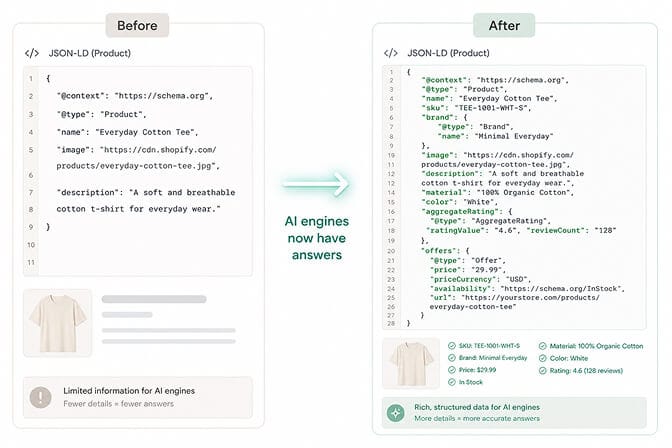
The first move is the most concrete. Every product page should expose a complete schema.org Product block in JSON-LD.
Before: A typical Shopify theme ships product schema with name, image, and description. Maybe price.
After: A GEO-ready product page exposes name, sku, brand, price, priceValidUntil, availability, aggregateRating, reviewCount, material, color, size, audience, and offers.
That extra metadata isn't decoration. It's the data AI engines parse first when deciding whether to cite a product. Stores with thin schema get skipped. Stores with complete schema become candidates.
Open one of your own product pages. Right-click, view source, search for application/ld+json. Count the fields. If you're under eight populated fields, you're GEO-fragile. If you've already done this audit for general Shopify search relevance, the same product data hygiene compounds here.
Pattern 2: Citation-Worthy Product Descriptions
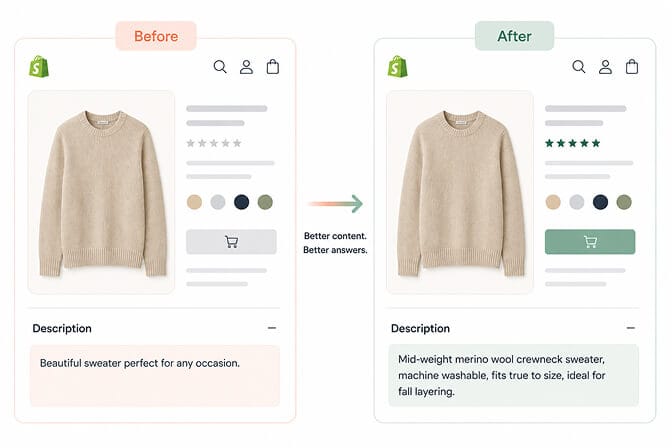
AI engines reward specificity. They cite products with descriptions that read like answers, not marketing copy.
Before: "This beautiful sweater is perfect for any occasion. Made with love and crafted to last."
After: "Mid-weight merino wool crewneck sweater, 250 GSM, machine washable, fits true to size, ideal for fall layering. Available in seven colors, sizes XS to XXL."
The second one is boring. AI engines love it. It contains attributes, specs, use cases, and audience information in plain prose. When a user asks "merino sweater for fall," that paragraph contains every signal the AI needs to cite you.
Marketing copy still has its place on the page. Just not in the slot the AI is reading.
Pattern 3: Answer-Shaped Category and FAQ Content
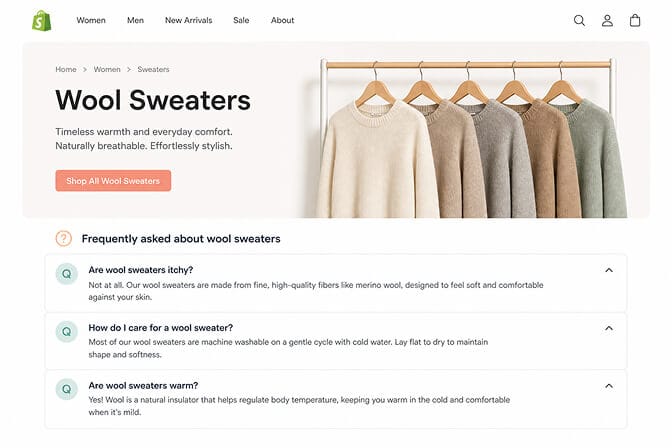
AI engines pull citations from content that's structured like a direct answer. Category pages and product collections are the highest-leverage real estate for this.
Before: A women's sweaters collection page with a hero image, a paragraph of brand voice, and a product grid.
After: The same page with a "frequently asked about wool sweaters" section: "How do I pick a wool sweater weight?" "What's the difference between merino and cashmere?" "Which sweaters work for office wear?" Each with a 50-word answer.
Two changes happen. First, your category page becomes citation-worthy because it answers questions AI engines see in user prompts. Second, your internal search engine can use that same content to enrich its own results, which boosts on-site relevance at the same time.
Pattern 4: Comparison-Friendly Attribute Structure
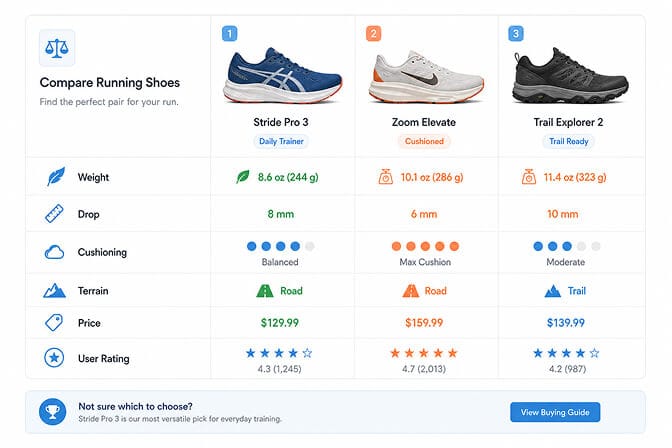
AI engines often answer comparison queries: "best running shoes for flat feet vs neutral arches," "wool vs cashmere sweater for winter."
To be cited in those answers, your products need to be comparable on consistent attributes. That means every running shoe in your catalog has weight, drop, cushioning level, and terrain tagged as structured data. Every sweater has weight, material, fit, and care tagged.
Before: Some products have material in the title, some have it in tags, some have it buried in the description. No two products are tagged the same way.
After: Every product in a category shares the same metafield structure with consistent values. AI engines can compare apples to apples and cite the right product for the right comparison query. Pair this with dynamic facets and the same structured attributes power your filter sidebar too.
Inconsistent attribute structure is the silent killer of GEO eligibility. Fix this once and the compounding return runs for years.
Pattern 5: On-Site Search That Mirrors AI Query Patterns
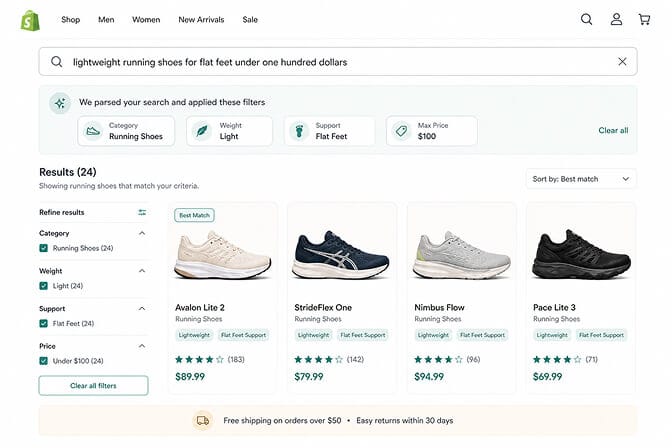
This is the pattern most merchants miss entirely. AI engines test stores by querying your on-site search with natural language phrases similar to what users ask. If your search returns relevant results, your store gets a citation-eligibility boost. If your search returns nothing or junk, you fall down the candidate list.
Before: A customer asks ChatGPT "lightweight running shoes for flat feet under $100." The AI tests your store with a similar query. Your default Shopify search returns "no results" because the words "lightweight" and "flat feet" don't appear in your product titles. The AI moves on.
After: The same query hits your AI semantic search, gets parsed into structured filters, and returns three perfectly matched products. The AI cites you. The best ecommerce search engines for Shopify treat this as default behavior.
This is why GEO and on-site search infrastructure can't be separated. The ability to be cited externally depends on the ability to answer queries internally.
If you're tired of being invisible to AI engines and want to see exactly which queries your store is failing right now, Sparq fixes most of this in about 10 minutes. Free to try, no-code setup, and the search analytics show you the gaps the moment they appear.
How to Test Whether You're Being Cited (And Why You Should Do This Monthly)
You don't need a special tool. You need 30 minutes and a willingness to ask AI engines about your category.
Pick five queries a real customer might use to find what you sell. "Best product type under $X." "Product type for use case." "Top category brands for audience." Run them in ChatGPT, Perplexity, Claude, Google AI Overviews, and Bing Copilot.
Note which brands get cited. Note where you appear (or don't). Note what attributes the AI used to make the recommendation.
If you're not cited, look at the brands that are. Read their product pages. View source. Check their schema. Read their descriptions. Compare structure to yours.
The pattern almost always shows up. Cited brands have richer schema, more specific descriptions, and on-site search that handles natural language queries. Uncited brands have thin schema, generic descriptions, and keyword-matching search. The mechanics are the same ones that govern any modern ecommerce search algorithm, just applied externally.
The fix isn't mysterious. It's the five patterns above, applied to your top 50 SKUs first. If you want to size what citation visibility is worth in revenue terms, run your numbers through our ROI calculator.
What's Next, and Why It's Already Happening
A meaningful share of ecommerce traffic is shifting from the SERP to the AI answer. Some research suggests Google AI Overviews now appear on a majority of commercial queries in core categories. Perplexity Pro is converting like a search engine for high-intent shoppers. ChatGPT shopping is being tested across major markets. We've covered the broader trend in our piece on ecommerce search trends for 2026.
The merchants who optimize for citation now will pick up that traffic as it shifts. The merchants who don't will see their old SEO traffic decline without an obvious replacement, and most of them will blame Google's algorithm instead of their own data structure. The same shift is reshaping voice and image queries, which we covered in our deep dive on multimodal search for ecommerce.
Your product schema, your on-site search, and your attribute consistency are the three levers that decide whether AI engines cite you or skip you. None of them require a developer. All of them compound. AI merchandising is the layer that turns those compounding signals into real ranking and citation lift.
Want to see exactly which queries your store fails today (the same queries AI engines are testing)? Install Sparq from the Shopify App Store and check your search analytics. The gaps you'll spot are the gaps to close first. If you want a guided walkthrough first, the Sparq features overview, pricing, and option to book a demo all give a clearer picture before installing.
Frequently Asked Questions
What is generative engine optimization in ecommerce?
Generative engine optimization (GEO) is the practice of structuring your store's product data, schema, and on-site search so AI engines like ChatGPT, Perplexity, and Google AI Overviews cite your products in their answers. Unlike SEO, which focuses on ranking on a search results page, GEO focuses on being named within the AI-generated answer itself.
How does GEO compare to SEO for Shopify stores?
SEO ranks your store on a results page where users still choose among ten links. GEO gets your products cited inside an AI answer where users see only the brands the AI names. Both depend on quality content and structured data, but GEO weights schema completeness, attribute consistency, and on-site search behavior more heavily than backlink profiles.
How do I get my Shopify products cited in ChatGPT or Google AI Overviews?
Start with complete schema.org Product markup on every product page (name, brand, price, availability, ratings, material, audience). Rewrite product descriptions with specific attributes instead of generic marketing copy. Add answer-shaped FAQ sections to category pages. Make sure your on-site search handles natural language queries, since AI engines test your store with conversational phrases.
Will I lose ecommerce traffic if I ignore GEO in 2026?
Most likely yes. AI Overviews and AI-mediated shopping are absorbing a meaningful share of high-intent commercial queries. Stores with thin schema and weak on-site search are being skipped silently in those answers. The decline shows up in your traffic logs without a clear cause, and recovery becomes harder once competitors have a citation lead.
Do GEO and on-site search optimization slow down my Shopify store?
No. Schema markup is text in your page source and adds negligible weight. Modern AI-powered search apps run on external infrastructure and respond in under 200 milliseconds. The performance impact is essentially zero, and the citation and conversion gains compound month over month.