Zero-Click Commerce: Why Your Shopify Results Page Is Dying (And What Replaces It)
Customers don't want a list of 200 products anymore. They want an answer. Here's how the smartest Shopify stores are rebuilding their search results page for the zero-click era.
A Shopify merchant pulled up her funnel report on a Tuesday morning and noticed something she couldn't explain.
Her search results page had a 71% exit rate.
Not bounce rate from the homepage. Not abandoned carts. Customers were searching, getting results, and leaving from the results page itself.
Her site search was working. The results were technically relevant. The page rendered fast. And the customers were still leaving.
She showed me the analytics. We dug in. The query that drove the exits more than any other was a four-word phrase: "best gift for mom."
Her search returned 132 products that contained the word "gift" or "mom" somewhere in the title or description. Some were great gifts. Some were random items with "mom" in the name. Some were clearance products from years ago.
A wall of choices. No answer.
The customer didn't want 132 options. She wanted three good ones with reasons.
Here's the weird part. This wasn't an isolated problem. This was the new behavior. And it's the same behavior that's killing Google search results pages, now playing out inside Shopify stores everywhere.
What Zero-Click Commerce Actually Means
Stay with me here, because the term gets misused.
Zero-click commerce is the shopper behavior pattern where customers expect answers, not results. They've been trained by ChatGPT, Perplexity, Google AI Overviews, and TikTok recommendation feeds to receive a synthesized, ranked, opinionated suggestion. Not a list of 200 things to scroll through.
When that same shopper lands on your traditional product listing page, with its 12-per-row grid and "showing 1 of 200 results" header, they feel the dissonance immediately. The page is asking them to do work the rest of the internet now does for them.
Most exit. Most don't search again. Most don't come back.
This is where most store owners get it wrong. They think the problem is their search algorithm. The problem is actually their results page format. The list itself is the dead end.
A wall of products is no longer a useful answer. It's the question you forgot to answer for the customer.
Why Traditional Results Pages Are Quietly Dying
Three forces are colliding to break the classic ecommerce results page.
First, attention spans on mobile keep dropping. The average shopper scrolls about 1.5 screens of search results before deciding whether to refine, exit, or buy. A 200-product results page is a hostile experience for that attention budget.
Second, AI tools have trained shoppers to expect one good answer with reasoning, not a comparison shopping exercise. The same dynamic is at the center of generative engine optimization, and now the expectation has spread to your own storefront.
Third, mobile commerce keeps growing as a share of total traffic, and the desktop results page metaphor (left sidebar filters, large grid, sort dropdown) just doesn't scale to a thumb.
The combined effect is what the data calls a zero-click commerce moment: the shopper landed on your search results, decided the page wasn't going to give them an answer, and left without clicking a single product.
This is the part that costs you money. The customer was high-intent. They searched. They reached your results page. And the format itself, not the products, told them to leave.
Five Patterns Replacing the Traditional Results Page
Here's the practical part. Five patterns that the smartest Shopify stores are using to evolve their search experience past the dying grid-and-sort layout.
Pattern 1: Conversational Search Interface (Chat-Style Discovery)
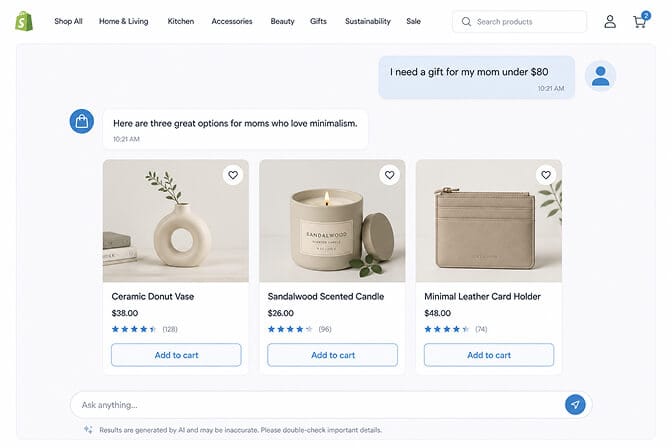
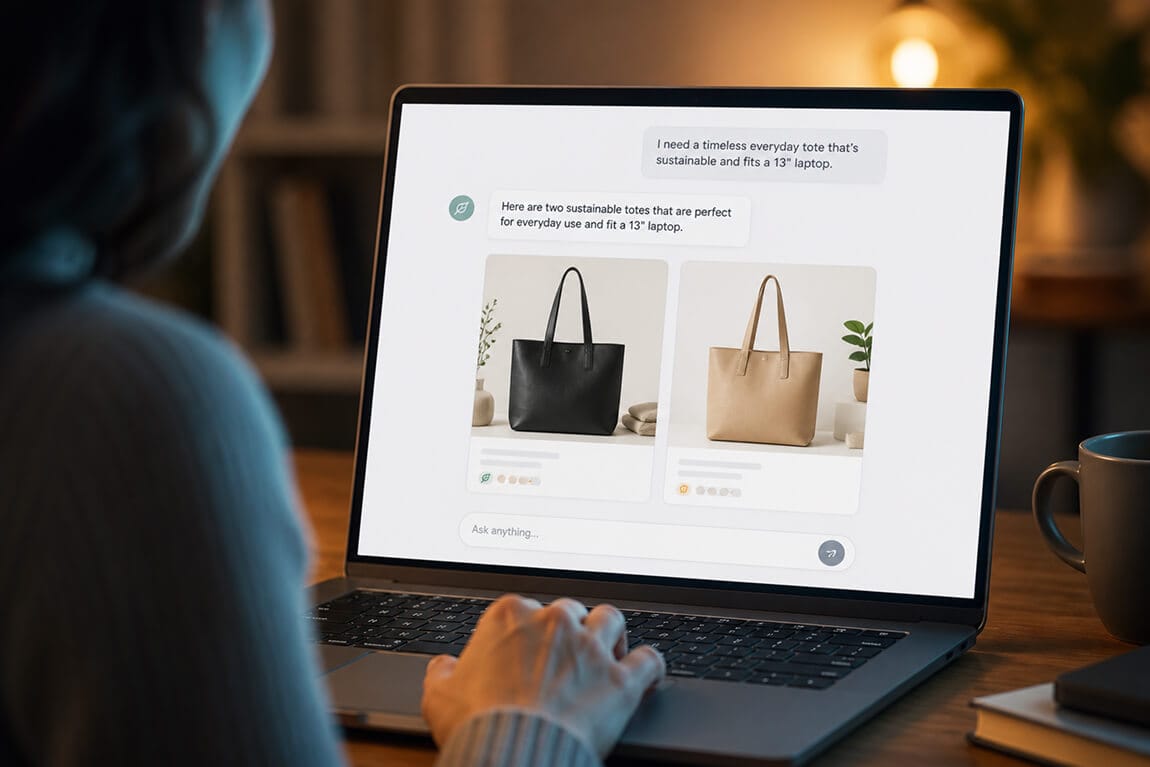
Replace your search bar with a conversational interface. Shoppers describe what they want in their own words. The store responds with a small narrative explanation and a curated handful of products, not a 200-item grid.
This isn't science fiction. Several Shopify search and discovery apps now ship this pattern out of the box. The shopper types or speaks their query. The system parses intent, narrows the catalog, and presents three to five top matches with short reasoning. Behind the scenes it's the same parsing layer that powers our AI semantic search.
The conversion lift comes from removing decision fatigue. A shopper presented with three good options buys at 2 to 3 times the rate of a shopper handed 200 options.
Pattern 2: Predictive Filters That Appear Before the Shopper Types
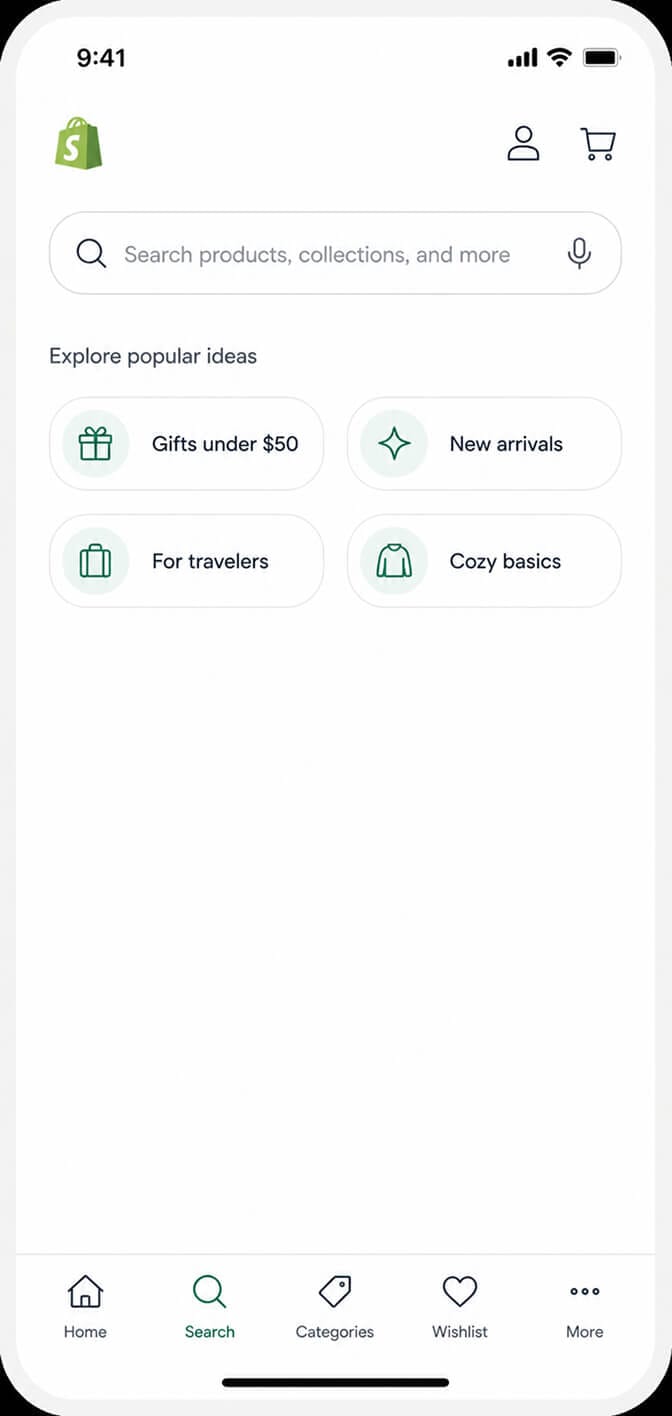
Predictive filters surface before the shopper types a single word. Based on the time of year, recent shopper behavior, trending queries, and the shopper's session context, the search bar offers smart starting points: "Gifts under $50," "New arrivals," "Trending in your size," "Cozy basics."
The shopper taps one and lands not on a 200-item grid but on a curated micro-collection. The predictive search customer story shows what this looks like in production.
This pattern works because it eliminates the cold-start problem. Instead of asking the shopper to articulate a query, you offer them an opinionated path. They take it more often than you'd guess. Pair it with dynamic facets and the predicted filter set adapts to the shopper's session signals too.
Pattern 3: Answer-First Results (One Top Match Plus Reasons)
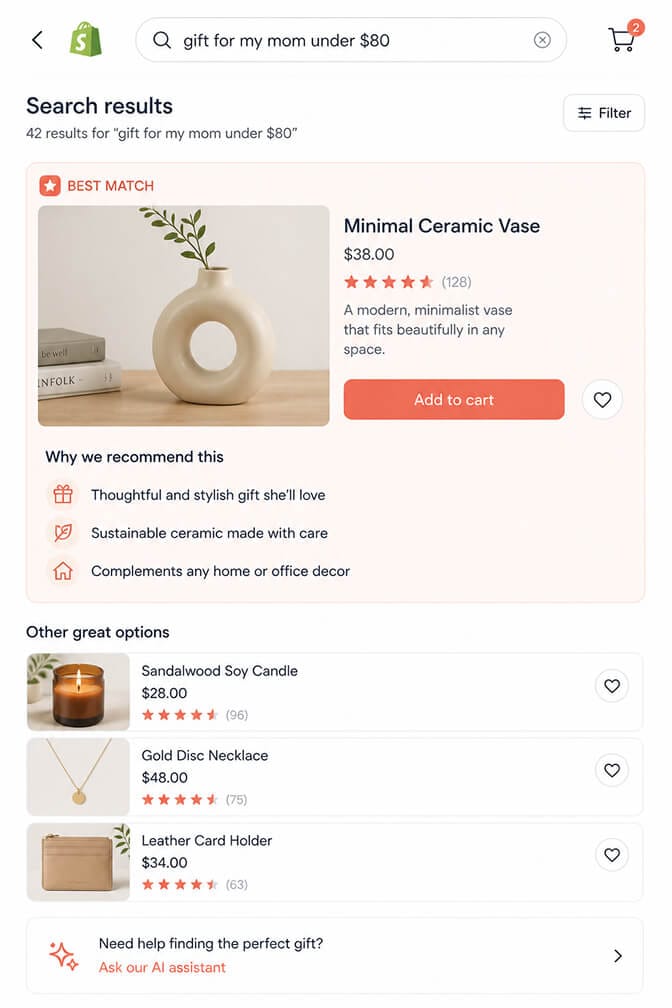
Instead of dumping 200 ranked products, show one "best match" at the top of the page with a short explanation: "Why we recommend this for your search." Below it, three to five strong alternatives. Below those, the broader result set for shoppers who want to keep browsing.
This format mirrors the way AI engines answer queries: confident answer first, supporting alternatives second, full options third.
The conversion math here is favorable. The shopper who clicks the top "best match" buys at materially higher rates than the shopper who scrolls through a generic grid.
You don't need a developer to ship this. AI-powered search and filter apps for Shopify can rank and label a top match automatically based on conversion behavior, query parsing, and inventory signals. The ranking layer is exactly what AI merchandising is built to do.
Pattern 4: Inline Comparison Cards
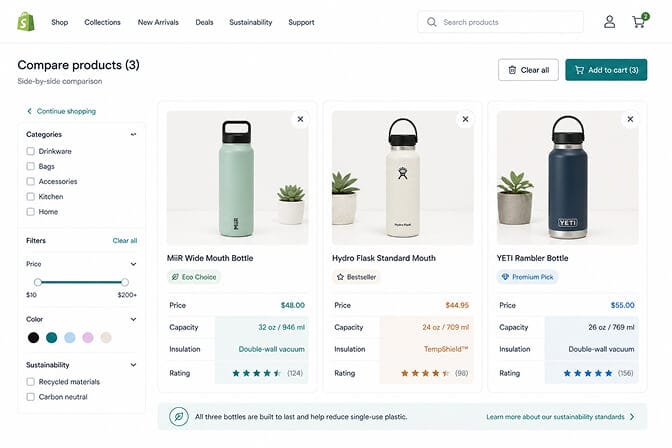
When a shopper's query implies comparison ("running shoes for flat feet vs neutral arches," "merino vs cashmere sweater"), don't return a single ranked list. Return inline comparison cards.
The cards display the top two or three products side by side with the differentiating attributes shown clearly: weight, drop, material, price, rating. The shopper can compare in one glance instead of opening five product pages in five tabs.
This pattern works in any category with comparable specs: electronics, furniture, footwear, beauty, home.
The execution requires structured product attributes (we covered the catalog work in our piece on how search enrichment works) and a search engine that detects comparison intent in the query.
Pattern 5: Continuous Discovery (No Pagination, No Dead End)
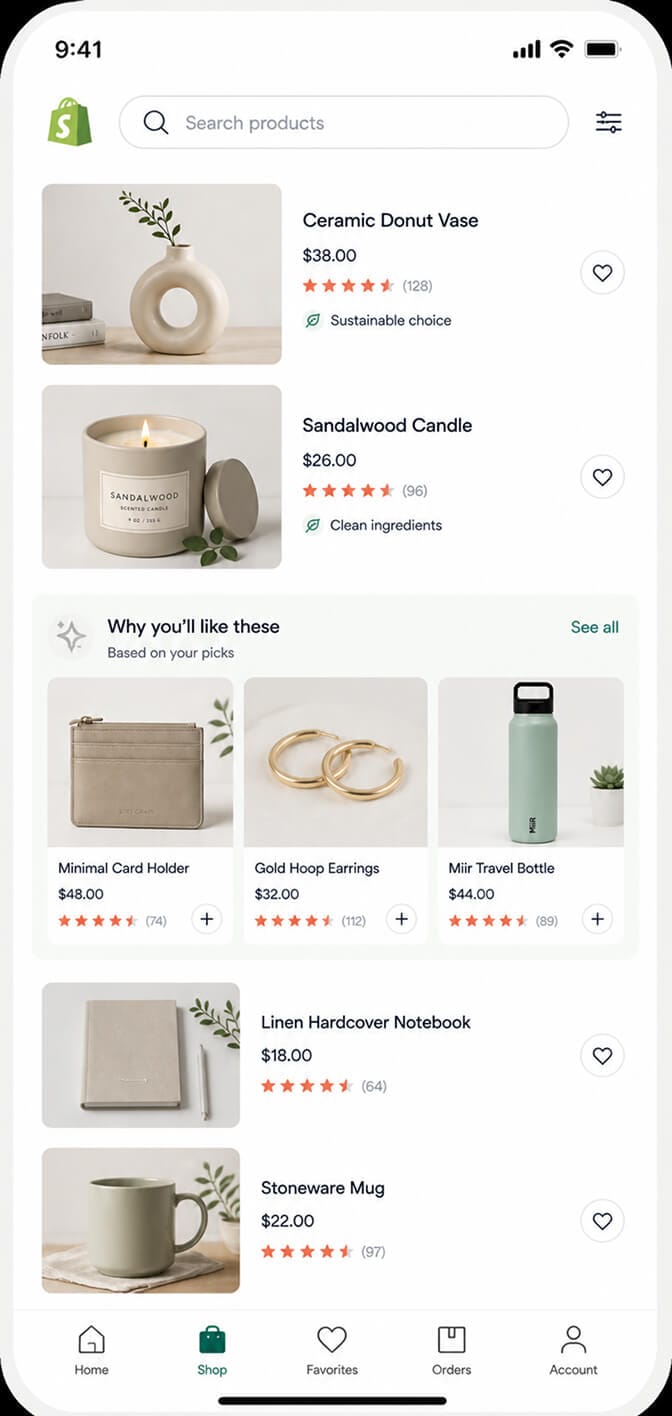
Pagination is a relic. Even infinite scroll has limits.
The pattern that's replacing both is continuous discovery: the page never visibly ends. As the shopper scrolls, the system surfaces increasingly personalized suggestions, relevant collections, and contextual recommendations based on what they've engaged with so far. This is the same logic our AI recommendations layer applies on the product page.
There's no "next page" button to click and lose context. There's no "end of results" wall to hit. The shopper keeps moving down the page, and the page keeps adapting.
The trick is keeping the experience focused. Continuous discovery isn't an excuse to dump every related product on the screen. It's a way to extend the shopping session by offering the right next product at the right moment. Our piece on personalized search for Shopify covers the personalization mechanics behind this.
If you're watching customers exit your search results page and want to know exactly which queries are dying there, Sparq fixes most of this in about 10 minutes. Free to try, no-code setup, and the analytics show you the zero-click moments as they happen.
What This Means for Your Analytics
Here's the part Shopify doesn't tell you. Your existing search analytics are about to feel inadequate.
Traditional search reporting shows query volume, click-through rate to product pages, and conversion from search. Those metrics still matter. But in a zero-click world, they miss the most important data.
You also need to track:
Search exit rate (shoppers who leave from the results page itself, not after clicking a product).
Top result click depth (how often shoppers click the very top match versus scrolling past it).
Reformulation rate (how often shoppers re-type or refine because the first results didn't satisfy them).
Conversational engagement (in conversational interfaces, how many turns shoppers take before buying or leaving).
Most Shopify search apps don't surface these natively yet. The ones that do are the ones built for this shift, not retrofitted from the keyword era. We covered the broader analytics framework in our piece on search bar analytics for ecommerce, and the new metrics layer on top of those fundamentals. If you want to size what these gaps are costing you in revenue terms, run your numbers through our ROI calculator.
How to Start Without Rebuilding Everything
You don't need to throw out your storefront. Pick two of the five patterns and ship them this month.
Most Shopify merchants we work with start with two: predictive filters and answer-first results. They're the two that fit cleanly inside the existing storefront without theme rebuilds.
Predictive filters appear in your search bar dropdown. The shopper taps one and lands on a smart pre-filtered view. No grid redesign required.
Answer-first results require a search engine that can rank and label a top match. Most AI-powered Shopify search apps support this with no theme changes.
After those two land, you can add conversational search, comparison cards, and continuous discovery as the next phase. The point is not to rebuild your store overnight. The point is to retire the parts of the old results page that are quietly killing conversions. The same direction shows up across the broader ecommerce search trends for 2026.
A Quiet Shift That Will Define the Next Two Years
Zero-click commerce isn't a hypothesis anymore. The behavior is in your traffic logs. The exit rates from generic results pages are climbing. The conversion lifts from answer-first formats are documented. The same shift is also reshaping how agentic search and multimodal search interact with your store, since all three depend on the same answer-first foundation.
The merchants who modernize their search results page in 2026 will retain shoppers that everyone else lets bounce. The merchants who don't will keep watching their search-driven revenue plateau and blame the algorithm, when the actual culprit is the format.
Your search bar is fine. Your products are fine. Your traffic is fine. The piece in the middle, the one that's supposed to convert intent into a purchase, is the part that needs the rethink.
Want to see how many shoppers are exiting from your results page right now? Install Sparq from the Shopify App Store and check your search analytics. Look at the search exit rate column. The number will probably be higher than you'd guess, and that's the number worth fixing first. If you'd rather see what's possible before installing, the Sparq features overview, pricing, and option to book a demo all walk through the full picture first.
Frequently Asked Questions
What is zero-click commerce?
Zero-click commerce is the shopper behavior pattern where customers expect synthesized answers and curated recommendations instead of long lists of search results. Trained by AI tools like ChatGPT and Google AI Overviews, shoppers now exit traditional product listing pages without clicking on any product because the wall-of-grid format no longer feels like an answer.
How does zero-click commerce affect Shopify on-site search?
Zero-click behavior is showing up as rising exit rates from search results pages. Shoppers search, see a generic grid of 100+ products, and leave because they wanted an opinionated answer, not a comparison exercise. Stores that replace the traditional results page with conversational interfaces, predictive filters, and answer-first formats see meaningful conversion lifts on search-driven traffic.
Will I lose Shopify sales if I keep my traditional product listing page?
Likely yes, especially as mobile traffic and AI-shaped shopping behavior keep growing. Stores tracking it see climbing search-results exit rates year over year. The fix doesn't require a full theme rebuild. Adding predictive filters and answer-first ranking captures most of the lift without disrupting the rest of your storefront.
How do conversational search interfaces compare to traditional search bars on Shopify?
Traditional search bars match keywords against product data and return a ranked list. Conversational interfaces let shoppers describe what they want in natural language and respond with a curated handful of products plus short reasoning. The conversational format reduces decision fatigue and typically converts shoppers at 2 to 3 times the rate of a generic grid.
Will modernizing my Shopify results page slow down my store?
No. AI-powered search and discovery apps process queries on external infrastructure and return results in under 200 milliseconds. The shopper experiences faster, more relevant results than a traditional theme-side search. The pattern shifts (conversational, predictive, answer-first) are rendering changes, not performance penalties, and most Shopify search apps are optimized for Core Web Vitals.