
Your search bar is lying to you. Here's what your product data isn't telling your customers.
Last Tuesday, a store owner in our Sparq community sent us a screenshot that stopped us cold.
A customer had typed "red running shoes size 10" into her search bar. The results? A black wallet. A green yoga mat. And a pair of sandals that hadn't been in stock for six months.
This wasn't a broken store. The theme was beautiful. The products were well-photographed. The descriptions were solid.
But the search bar? It was working with almost nothing.
Here's the thing most Shopify merchants don't realize: your search bar is only as smart as your product data. And for most stores, that data is shockingly thin.
That gap between what your customers type and what your store understands? That's the problem search enrichment solves.
So What Actually Is Ecommerce Search Enrichment?

Think of it this way.
You sell a "Women's Lightweight Packable Rain Jacket in Navy." That's your product title. It's fine for a human browsing your collection page.
But when a customer types "waterproof jacket for travel," your search bar has no idea that's the same product. The word "waterproof" doesn't appear in the title. Neither does "travel." Your data has a gap, and the search engine can't bridge it.
Search enrichment bridges that gap.
It does this by layering additional context onto your products: synonyms, related attributes, inferred categories, behavioral signals, and natural language understanding. So when someone searches in their own words, your store actually speaks their language.
If you want to understand how ecommerce search actually works under the hood, we've written a full breakdown. But for now, stay with me here. This gets practical fast.
The Five Layers of Search Enrichment (And Why Each One Matters)
Not all enrichment is created equal. Here are the five layers that separate stores with great search from stores where customers give up and leave.
Layer 1: Synonym and Terminology Mapping
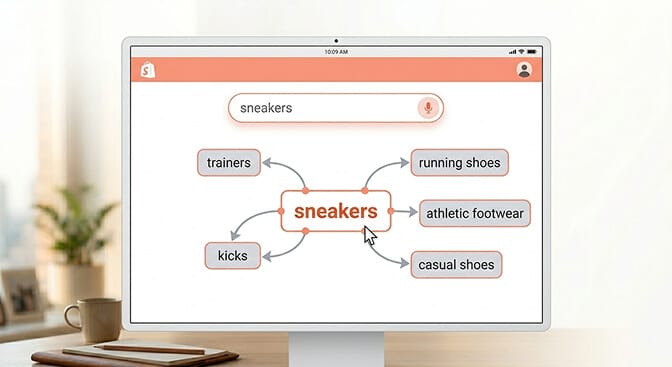
A fashion store might tag products as "trousers." But half their customers search for "pants." A home decor store sells "throw pillows" but customers type "couch cushions."
Without synonym mapping, every mismatch is a missed sale. And you'd be stunned how many there are.
Enrichment at this layer means: building a synonym graph that connects your catalog language to the way real people actually talk about your products. We've seen this play out across hundreds of stores, and if you're curious about the data, here's how synonyms directly improve ecommerce search conversions.
Layer 2: Attribute Extraction and Tagging
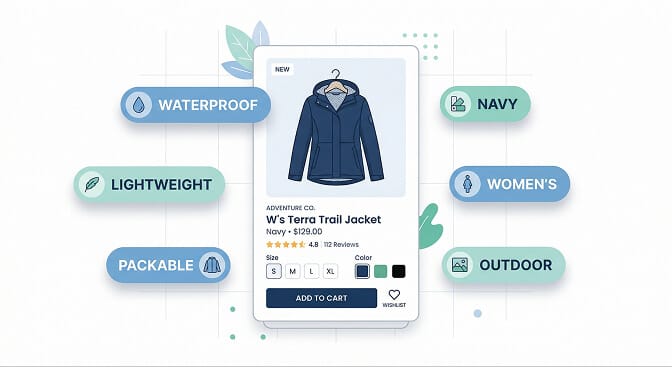
Attribute extraction pulls structured data out of unstructured text. It identifies that your "Cozy Merino Wool Crewneck Sweater" is: material: merino wool, style: crewneck, category: sweater, warmth level: mid-weight.
This is where most stores are weakest. And this is where most stores bleed money.
When your search engine knows a product's attributes, it can match against filters, understand intent, and rank results with real precision. If you want to see what great filtering looks like in practice, check out these faceted search examples that actually convert.
Layer 3: Category and Taxonomy Inference
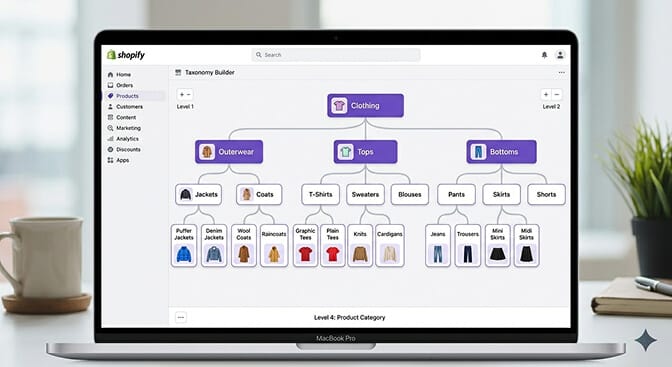
It isn't.
Taxonomy inference automatically classifies products into a logical hierarchy, even if your collections are messy or inconsistent. A product tagged only as "Summer '24 Drop" gets recognized as a "Women's Dress > Casual > Midi Length" because the enrichment layer reads the full product context.
Why this matters for search: When a customer searches "casual dresses," the store needs to know which products qualify, even if nobody manually tagged them that way. This ties directly into how search algorithms rank and surface products behind the scenes.
Layer 4: Behavioral Signal Integration
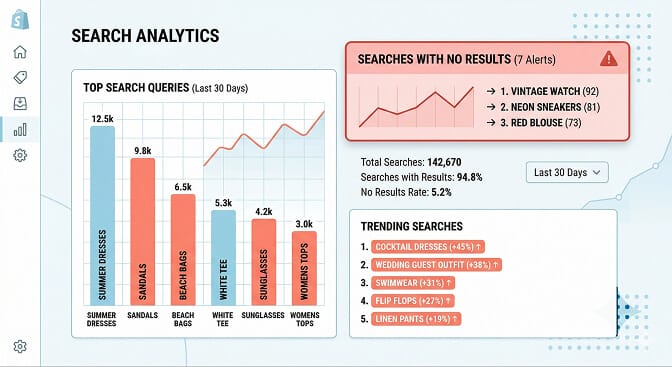
Behavioral enrichment uses real customer data: what people search for, what they click after searching, what they buy, what they bounce from.
If 200 people search "gift for mom" and 80% of them end up buying scented candles, that's a signal. A smart search engine learns from that and starts surfacing candles higher for that query.
But then something clicked for us when building Sparq. Most Shopify stores have this data. They just can't use it because their search tool doesn't know it exists.
Enrichment at this layer means: feeding real shopping behavior back into your search rankings so results get smarter over time, not just on day one. Your search bar analytics hold the map to exactly where you're losing money.
Layer 5: Natural Language Understanding

Natural language understanding (NLU) means your search bar can interpret intent, not just keywords.
"Something warm for a winter wedding" isn't a keyword string. It's a complex request with multiple signals: warmth, formality, occasion, season. A basic search engine sees five unrelated words. An enriched search engine sees a customer looking for an elegant wool wrap or a velvet blazer.
This is the difference between search that works and search that sells.
Most Shopify stores are stuck at Layer 0. No synonyms. No attribute extraction. No behavioral learning. No NLU. Just raw text matching against product titles.
And then they wonder why their search conversion rate is below 2%.
For a deeper look at how NLU is changing ecommerce discovery, we wrote a full guide on natural language search for ecommerce.
What This Actually Looks Like on a Shopify Store
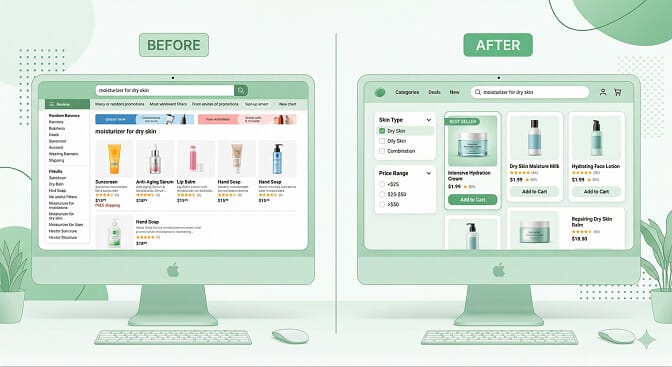
Before enrichment: A customer searches "moisturizer for dry skin" on a beauty store. The results show every product with the word "moisturizer" in the title, ranked by date added. The $12 body lotion shows up before the $45 face cream that's the store's bestseller for dry skin. No filters. No relevance. No intelligence.
After enrichment: The same query returns the top-rated face moisturizers tagged for dry skin, ranked by purchase behavior and relevance. A filter sidebar appears with options for skin type, price range, and product format. The customer finds what they need in two clicks.
The difference isn't magic. It's data. Enrichment makes your existing product catalog searchable in the way customers actually think.
If you're tired of customers searching and leaving empty-handed, Sparq fixes that in about 10 minutes. Free to try, and the search analytics alone will show you exactly where you're losing people.
Why Shopify's Default Search Can't Do This
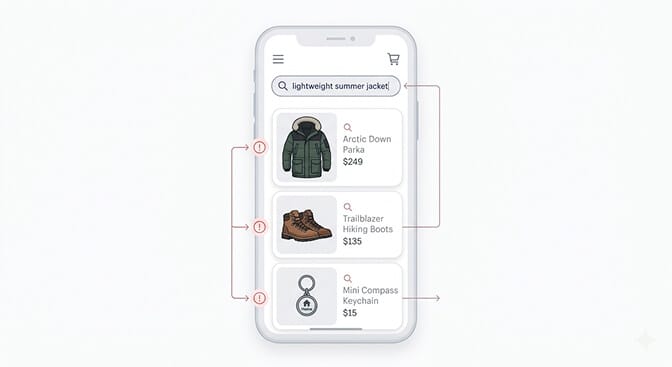
Shopify's native search is keyword-based. It matches words in your query against words in your product titles, descriptions, and tags. That's it.
No synonym handling. No attribute inference. No behavioral learning. No natural language understanding.
For a store with 50 products and straightforward naming, it's fine. For a store with 500+ SKUs, seasonal collections, and customers who search the way humans actually talk? It falls apart fast.
This isn't a knock on Shopify. Search enrichment is a specialized problem. Shopify builds a platform. Tools like Sparq build the intelligence layer that sits on top. If you've been thinking about making the switch, here's a practical walkthrough on how to replace Shopify's default search.
The Cost of Ignoring Search Enrichment
Industry data shows that site search users convert at 2-3x the rate of browsers. They already know what they want. They're telling you.
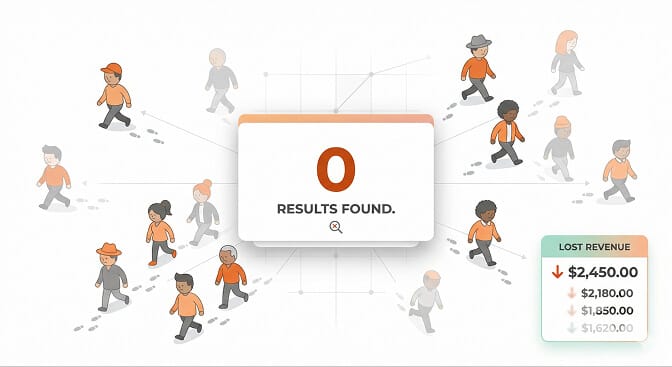
But if your search bar gives them garbage results, they don't try again. They leave. And most of them don't come back.
Every zero-result search is a customer telling you: "I wanted to buy something and you made it impossible." If you want to see how much that's actually costing you, run your numbers through our ROI calculator. The results tend to be sobering.
Search enrichment isn't a nice-to-have for stores past a few hundred SKUs. It's the infrastructure that turns your search bar from a liability into your highest-converting feature.
We wrote about this exact problem in depth: how to reduce search abandonment before it eats your revenue.
Getting Started Without a Developer
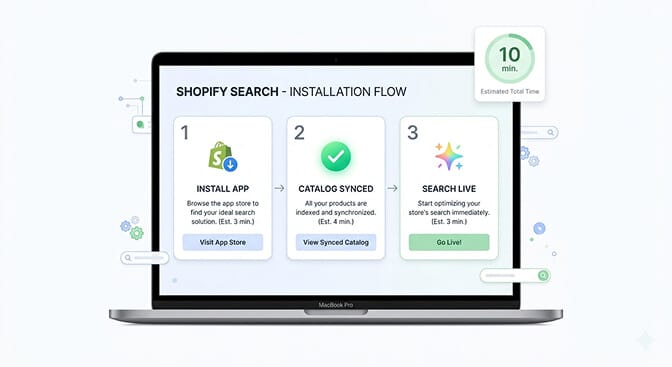
Modern Shopify search apps handle enrichment automatically. Sparq, for example, runs enrichment on your entire catalog the moment you install it. Synonyms, attribute extraction, NLU, behavioral learning. It's all running in the background while you do other things.
No CSV uploads. No manual tagging marathons. No developer needed.
The setup takes about 10 minutes, and the first thing you should do after installing is check your search analytics. Look at your top searches with zero results. That's your enrichment gap, staring you right in the face.
Want to see what your customers are actually searching for? Check out Sparq's pricing and get started. It's eye-opening.
The Quiet Advantage
But they'll find what they're looking for. They'll filter with precision. They'll convert at rates that make your paid ads jealous.
And you'll stop losing sales to a search bar that doesn't understand the difference between "sneakers" and "running shoes."
That's the quiet advantage. And it compounds every single day your store is open.
Frequently Asked Questions
What is ecommerce search enrichment?
Ecommerce search enrichment is the process of enhancing your product data with additional context like synonyms, attributes, category tags, and behavioral signals so your site search engine can better understand and match customer queries to relevant products. It turns basic keyword matching into intelligent product discovery.
How does search enrichment improve Shopify conversion rates?
Search enrichment improves conversion by ensuring customers see relevant results when they search. When queries like "lightweight summer jacket" actually return lightweight summer jackets instead of unrelated products, customers find what they want faster. Stores with enriched search typically see 1.5-3x higher conversion rates from search users compared to those relying on Shopify's default search.
Do I need a developer to set up search enrichment on Shopify?
No. Modern Shopify search apps like Sparq handle enrichment automatically during installation. The app analyzes your product catalog, builds synonym maps, extracts attributes, and enables natural language search without any manual configuration or coding. Most merchants are fully set up in under 10 minutes.
How does AI-powered search enrichment compare to Algolia for Shopify stores?
Algolia is a powerful enterprise search platform, but it requires significant developer resources to configure, maintain, and optimize for Shopify. AI-powered Shopify-native tools like Sparq deliver similar enrichment capabilities (NLU, synonyms, behavioral ranking) out of the box, at a fraction of the cost and complexity. For most Shopify merchants, a purpose-built app outperforms a general-purpose API.
Will adding a search enrichment app slow down my Shopify store?
No. Well-built search apps like Sparq run search processing on external servers, not on your Shopify storefront. The search queries are handled via API calls that typically return results in under 200ms. There's no impact on your store's page load speed or theme performance.