
Ecommerce Search ROI: The 2026 KPIs That Actually Prove Search Is Worth It
Conversion rate stopped telling the full story two years ago. Here's the measurement framework Shopify merchants are using to prove search ROI in the age of agents, voice, and dynamic filters.
A Shopify merchant emailed me last month with a problem I've heard a hundred times.
She'd installed an AI search and filtering app three months earlier. Conversions on search-driven traffic had gone up 14%. Filtered traffic was converting 22% better. Her search analytics looked healthier in every way she knew how to measure.
But her CFO asked the question every operator dreads: "How do we know this is real ROI, not just a healthy month?"
She didn't have a clean answer. She had a conversion lift. She had some anecdotes about happier shoppers. She had a vague feeling that things were better.
What she didn't have was a framework. A way to say, "Here are the five numbers I track to prove search investment is paying back, and here's how each one moves the bottom line."
Here's the weird part. Most Shopify merchants running advanced search and filtering apps are in the same situation. They feel the lift. They can't defend it.
And this is the part that costs you money. When you can't prove ROI cleanly, the next budget cycle quietly cuts the line item that was actually working.
This article is the framework. Five KPIs. Each one tied to a real revenue mechanic. All five together build a measurement story that holds up in any operator review.
Why Conversion Rate Alone Stopped Working
Stay with me here, because this matters.
In the keyword-search era, conversion rate from site search was a clean signal. Shoppers searched, clicked a result, bought or didn't. The funnel was linear. Conversion rate captured most of the value.
Three things broke that simplicity in 2026.
First, agentic and AI traffic doesn't behave like human traffic. An AI agent visiting your store on behalf of a shopper might query, evaluate, and bounce within seconds, then return hours later via a different session to complete the purchase. Conversion rate per visit looks terrible. The actual revenue impact is fine.
Second, voice and conversational queries are longer and lower-volume but materially higher-intent. Treating them with the same metric as keyword traffic obscures their real value.
Third, dynamic filters and personalization lift average order value and repeat purchase, not just immediate conversion. If you're only watching conversion rate, you miss the AOV and loyalty side of the lift entirely.
The result is that traditional search KPIs undercount real ROI. Most stores running modern search are leaving 30 to 50% of the actual lift unaccounted for in their dashboards. Our older piece on the 5 KPIs every Shopify ecommerce store needs to track is the right baseline; what follows is the 2026 layer on top of it.
Conversion rate measures whether shoppers buy now. The 2026 search ROI question is whether shoppers find, return, expand, and stay.
Five KPIs That Actually Capture Search ROI in 2026
Here's the practical part. Five KPIs. Each measurable in a Shopify store today. Each tied to a specific revenue mechanic.
KPI 1: Zero-Result Reduction Rate
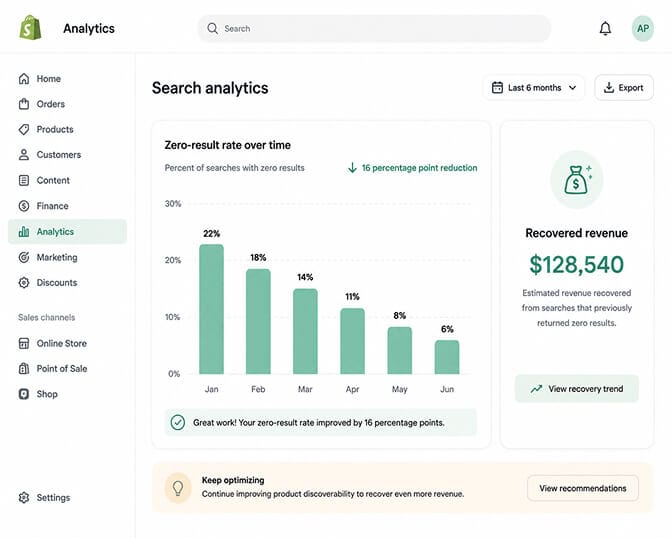
The zero-result rate is the percentage of search queries that return no products. In most untouched Shopify stores, this number sits between 12 and 30%, and most merchants don't track it at all.
Every zero-result query is a lost sale signal. The shopper told you what they wanted in their own words. Your store told them you don't carry it (even if you do). If yours is high, the Shopify search relevance audit playbook walks through the fixes.
The KPI to track is the reduction in zero-result rate over time. Pre-search-app baseline minus current rate equals improvement. Multiply that improvement by your average search session value to get recovered revenue.
A practical example: if your zero-result rate dropped from 20% to 7% on 5,000 monthly search sessions worth $40 each on average, you've recovered roughly $26,000 in revenue per month. That number defends the search app investment instantly. Run the math on your own numbers through our ROI calculator.
KPI 2: Agent Interaction Success Rate
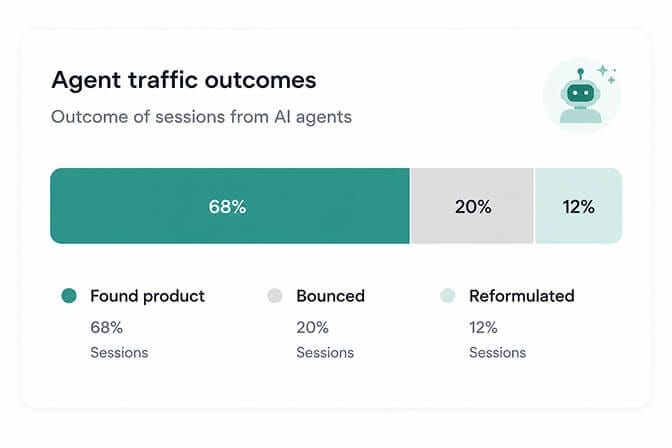
This is the new KPI most stores aren't tracking yet. Agent interaction success measures how often AI shopping agents that hit your store complete their query path successfully (find a viable product, retrieve structured data, return to a conversion).
The data is in your traffic logs if you know where to look. Agents typically have identifiable user-agent strings (ChatGPT, Perplexity, Anthropic, Operator) and patterns of structured-data requests.
The KPI to track is the percentage of agent sessions that retrieved at least one product page successfully versus the percentage that bounced from search results or no-results pages. A healthy rate is above 60%. A struggling rate is below 30%.
We covered the agent-readiness work in our piece on agentic search, and this KPI is the way to prove that work paid off.
KPI 3: Voice and Conversational Query Fulfillment Rate
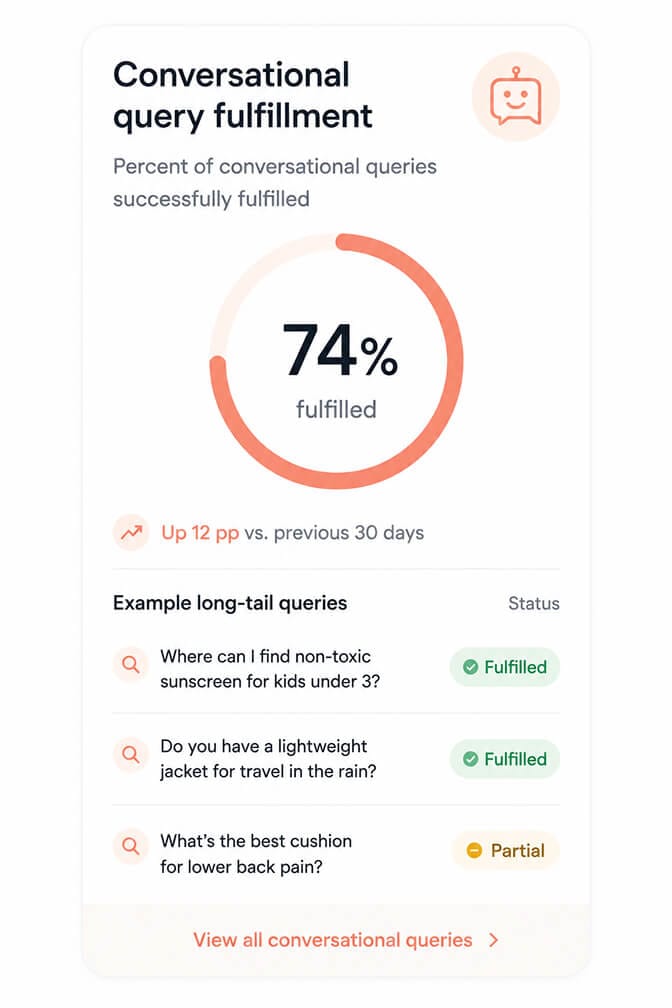
Conversational queries (long phrases, full sentences, voice transcripts) tend to convert higher than keyword queries when they're fulfilled, and disappear without trace when they're not.
Track the fulfillment rate: percentage of conversational queries (typically anything over six words or with question words) that returned at least three relevant products and led to a click.
If your fulfillment rate is below 50%, your search engine doesn't handle natural language well. If it's above 70%, you've operationalized natural language understanding effectively. The gap between those two states is usually worth a measurable percentage of total search-driven revenue. AI semantic search is the layer that closes that gap.
This metric becomes more important as voice and AI-mediated traffic grows. Stores with weak conversational fulfillment will see total search revenue plateau even as their query volume grows. Our multimodal search deep dive covers how voice and visual queries are reshaping this.
KPI 4: Average Order Value Lift From Dynamic Facets
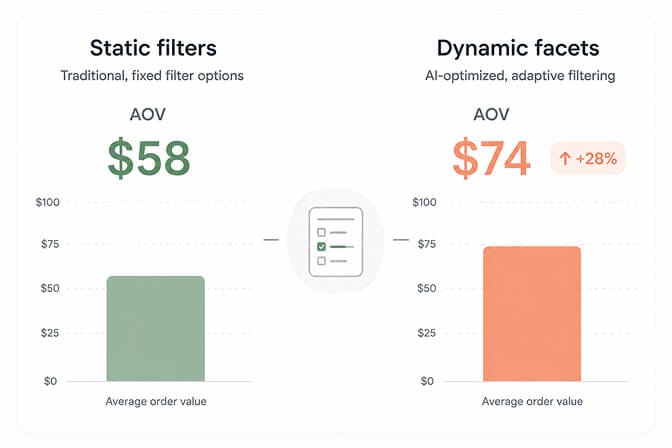
Dynamic facets do something static filters can't: they help shoppers narrow toward specific high-value purchases instead of bouncing on irrelevant options.
The KPI to measure is AOV among shoppers who applied at least one filter, before and after switching to dynamic faceted filtering. Stores that move to dynamic facets typically see filtered-traffic AOV rise 15 to 30%, especially in fashion, beauty, and home goods.
The math is straightforward: filtered sessions per month, multiplied by AOV difference, equals incremental revenue per month. This number alone often justifies the search app cost three times over.
We covered the underlying mechanics in our piece on dynamic facets vs static filters, and this KPI is how you prove the lift to a CFO. AI merchandising is the engine that makes those filtered sessions convert higher.
KPI 5: Loyalty Curve From Personalized Discovery
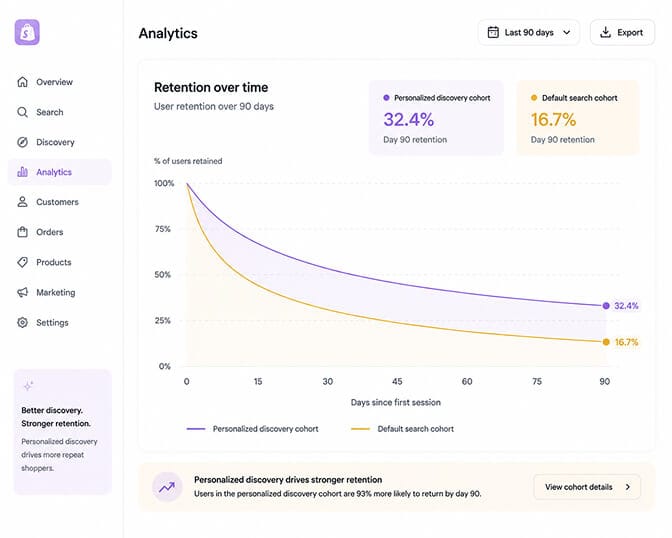
This is the slowest-burning KPI and often the most valuable.
Track the 30, 60, and 90-day repeat purchase rate of shoppers who made their first purchase via personalized search or filter pathways, versus shoppers who made their first purchase via default browsing.
In stores running personalized search consistently, the personalized-cohort retention curve stays measurably higher. The lift compounds over months and years, not weeks. The same dynamic is at the center of our privacy-first personalization piece.
This KPI is harder to track than the others (it requires cohort analysis with at least 90 days of data), but it's the one that proves search isn't just a conversion lever, it's a retention lever. And retention is where ecommerce margins actually live. The predictive search customer story shows what this curve looks like in production.
If you're tired of defending search investment with vibes instead of metrics, Sparq fixes most of this in about 10 minutes. Free to try, no-code setup, and the analytics expose all five KPIs in a single dashboard.
A Simple Search ROI Calculator (Steal This)
You don't need a data team. You need five inputs and a spreadsheet.
Here's the framework. Apply it monthly. Compare it quarter over quarter.
Input 1: Monthly search sessions. Pull from your search analytics tool.
Input 2: Average revenue per search session. Total search-driven revenue divided by total search sessions.
Input 3: Zero-result rate change. Baseline rate minus current rate, expressed as a percentage.
Input 4: Filtered-traffic AOV change. Current filtered AOV minus baseline filtered AOV.
Input 5: Personalized cohort 90-day retention lift. Current personalized cohort retention minus default cohort retention.
The math:
Recovered revenue from zero-result reduction = (Input 3 / 100) × Input 1 × Input 2
Incremental AOV revenue = (filtered sessions per month) × Input 4
Incremental retention revenue = (personalized cohort size) × Input 5 × average lifetime value
Sum the three and you have a defensible monthly ROI number. Multiply by 12 for an annual number that holds up in budget reviews.
This isn't enterprise modeling. It's a five-input calculator most merchants can run in 30 minutes once a month. Plug your numbers into our ROI calculator if you'd rather skip the spreadsheet.
The Part Most Stores Get Wrong (And the Easy Fix)
This is where most operators stumble. They install a search app, watch conversion rate tick up 8 to 15%, and report that as the win.
The conversion rate lift is one of five metrics. The other four are doing equal or greater work. Reporting only conversion rate is leaving 30 to 50% of the actual ROI on the table during budget conversations.
The fix is using a search app that exposes all five KPIs natively, not just the conversion-rate slice. Most do not. The ones that do tend to be the ones built for the 2026 measurement environment, not retrofitted from the keyword era.
We covered the broader analytics framework in our piece on search bar analytics for ecommerce, and the five KPIs above sit on top of those fundamentals. If your current setup makes measuring Shopify search effectiveness hard, that's the gap to close first.
What Comes Next (And Why Measurement Matters More Than Ever)
Search-driven revenue is shifting fast. Agent traffic is growing. Voice queries are climbing. Personalized discovery is producing measurable retention curves. Dynamic facets are lifting AOV in categories that used to be flat. The bigger picture is in our piece on ecommerce search trends for 2026, and the zero-click commerce shift is reshaping what your search results page should even look like.
The merchants who measure these mechanics individually are the ones making confident search investment decisions. The merchants who don't are the ones cutting search budgets in 2027 without realizing they cut the most valuable channel they had.
Your job isn't to know every metric. It's to know which five matter and watch them monthly. The compounding return on doing that well is one of the highest in ecommerce.
Want to see all five KPIs for your own store? Install Sparq from the Shopify App Store and check your search analytics. The numbers will probably surprise you, and the gaps you find will be exactly where the next dollar of investment should go. If you'd rather see what's possible before installing, the Sparq features overview, pricing, and option to book a demo all walk through the full picture first.
Frequently Asked Questions
What KPIs should I track to measure ecommerce search ROI in 2026?
Track five KPIs together: zero-result reduction rate, agent interaction success rate, conversational query fulfillment rate, AOV lift from dynamic facets, and 90-day retention from personalized discovery cohorts. Conversion rate from search alone undercounts real ROI by 30 to 50% in stores running modern search and filtering tools, so a multi-metric framework is the standard now.
How do I calculate search ROI for my Shopify store?
Combine three numbers: recovered revenue from zero-result reduction (rate change times search sessions times revenue per session), incremental AOV revenue from dynamic facets (filtered sessions times AOV change), and incremental retention revenue (personalized cohort size times retention lift times average lifetime value). Sum them for a monthly ROI number, then annualize for budget conversations.
What is a good zero-result rate for a Shopify store?
Below 5% is excellent, 5 to 10% is healthy, 10 to 15% suggests room for improvement, and above 15% indicates a meaningful search relevance gap. Stores running AI-powered search with synonym handling, typo tolerance, and natural language understanding typically run zero-result rates under 7%.
Are agent and voice queries worth tracking separately on Shopify?
Yes. Agent traffic and voice queries have different conversion profiles, longer success cycles, and higher-intent behavior than typical keyword traffic. Tracking them as separate cohorts reveals where your store is or isn't ready for AI-mediated and conversational shopping, which is increasingly where high-quality ecommerce traffic is headed.
Will tracking advanced search KPIs slow down my Shopify store?
No. Modern search analytics tools (including Sparq) compute these metrics on external infrastructure and surface them in dashboards without instrumenting heavy scripts on your storefront. There's no measurable impact on page load, and the data is usually available within minutes of installation rather than requiring a multi-week setup.