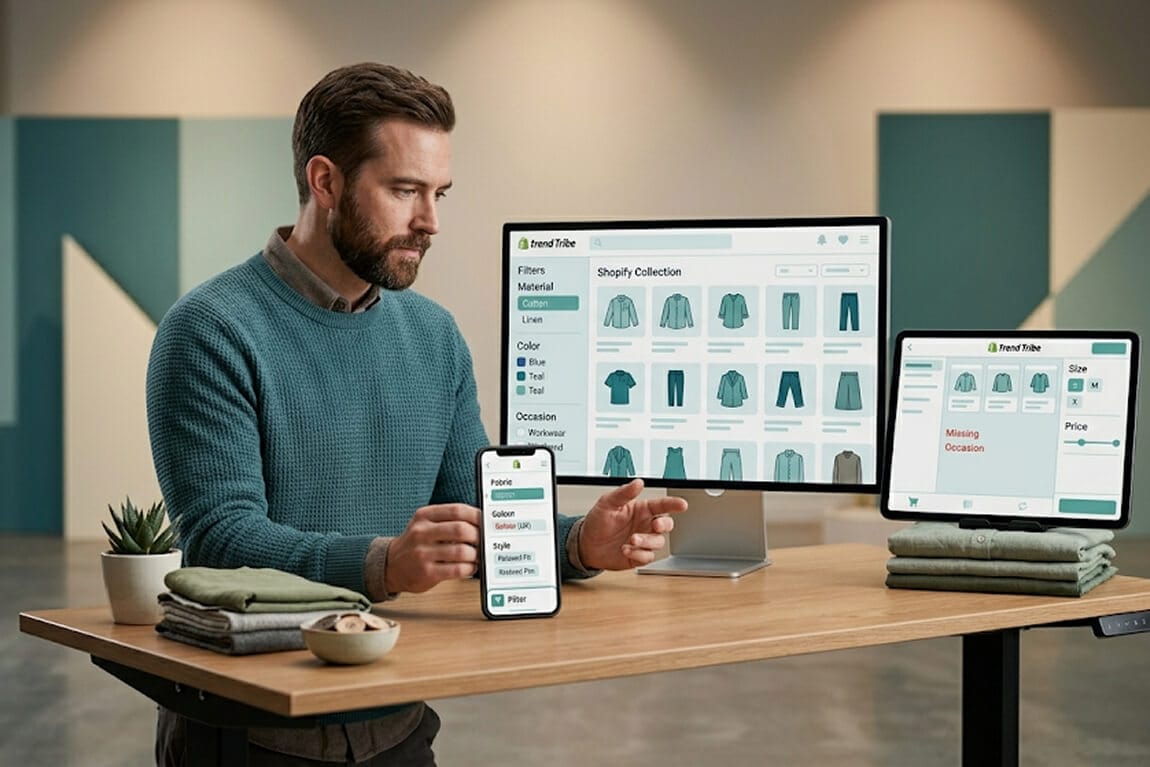
Privacy-First Personalization Ecommerce: The 2026 Predictive Layer Most Shopify Stores Are Missing
Cookies are dying. Personalization isn't. Here's how the smartest Shopify stores are using zero-party data and real-time signals to predict what customers want without tracking them around the internet.
A Shopify merchant I work with looked at her personalization vendor's monthly report last week and noticed something disturbing.
Her "audience match rate" had dropped from 78% to 31% over six months.
Same store. Same products. Same traffic volume. Roughly half her customers were now appearing as anonymous strangers to a stack she'd built around third-party data.
She wasn't doing anything wrong. The world had simply moved.
iOS privacy updates, Chrome's gradual third-party cookie deprecation, GDPR enforcement actions getting more aggressive, and a quiet wave of consumer-side privacy tools had collectively rewritten what "personalization" can know about a shopper.
She'd built a personalization machine on a foundation that was now sand.
Here's the weird part. She didn't actually need most of that third-party data to personalize well. Her customers were giving her better signals every session, voluntarily, in ways that didn't require any cookies at all.
She just hadn't built a system to use them.
This is the part most Shopify stores get wrong about 2026 personalization. They think the privacy era weakens personalization. The opposite is true. Zero-party signals are higher quality than the third-party noise they replace, and the merchants who pivot fast end up with better personalization than they had before.
What Privacy-First Personalization Actually Means
Stay with me here, because the terminology gets fuzzy.
Privacy-first personalization is the practice of customizing a customer's shopping experience using consented, voluntary signals (zero-party data), real-time session behavior (first-party data), and non-identifying contextual cues (device, time, location at a coarse level). Without third-party cookies, fingerprinting, or cross-site tracking.
It's not weaker personalization. It's different personalization, built on a different data foundation.
Three categories matter:
Zero-party data is what shoppers tell you on purpose. Their preferences, sizes, style, occasion, budget. Asked openly, given willingly.
First-party session data is what shoppers do on your store right now. Search queries, filter clicks, products viewed, dwell time, add-to-cart events.
Contextual signals are what your store can infer without identifying anyone. Time of day, device type, region, referral source, season.
Combine these three layers and you get personalization that's often more relevant than the third-party-cookie era ever produced. The catch is that you have to actually build the loops, not just buy a tool. Our piece on personalized search for Shopify covers the underlying ranking mechanics.
Why Basic AI Personalization Isn't Enough Anymore
This is where most store owners get it wrong.
The first wave of AI personalization (the one most stores still run) learned from purchase history and browsing patterns. It assumed the customer was the same person across sessions, identifiable through cookies, with a stable behavioral signature.
That assumption is broken in 2026. The same shopper might appear three times on your store: once on mobile in Safari with privacy mode on, once on desktop with their cookies cleared, and once via a private browser. Three separate "users" to your old personalization stack. One actual person.
Basic AI can't bridge these sessions reliably anymore. So it falls back to coarse behavioral averages, and personalization quietly degrades to "popular among similar visitors," which is barely personalization at all.
The new wave is different. It works within the session, predicts intent in real time, and uses voluntary signals from the shopper to personalize without needing a continuous identity.
The 2026 personalization stack isn't built around who the shopper is. It's built around what the shopper is signaling right now, and what that predicts about the next three minutes.
Five Patterns That Make Personalization Work in 2026
Here's the practical part. Five patterns Shopify merchants can ship inside the next few weeks, without violating consent or chasing third-party data that's already evaporating.
Pattern 1: Zero-Party Data Collection at Useful Moments
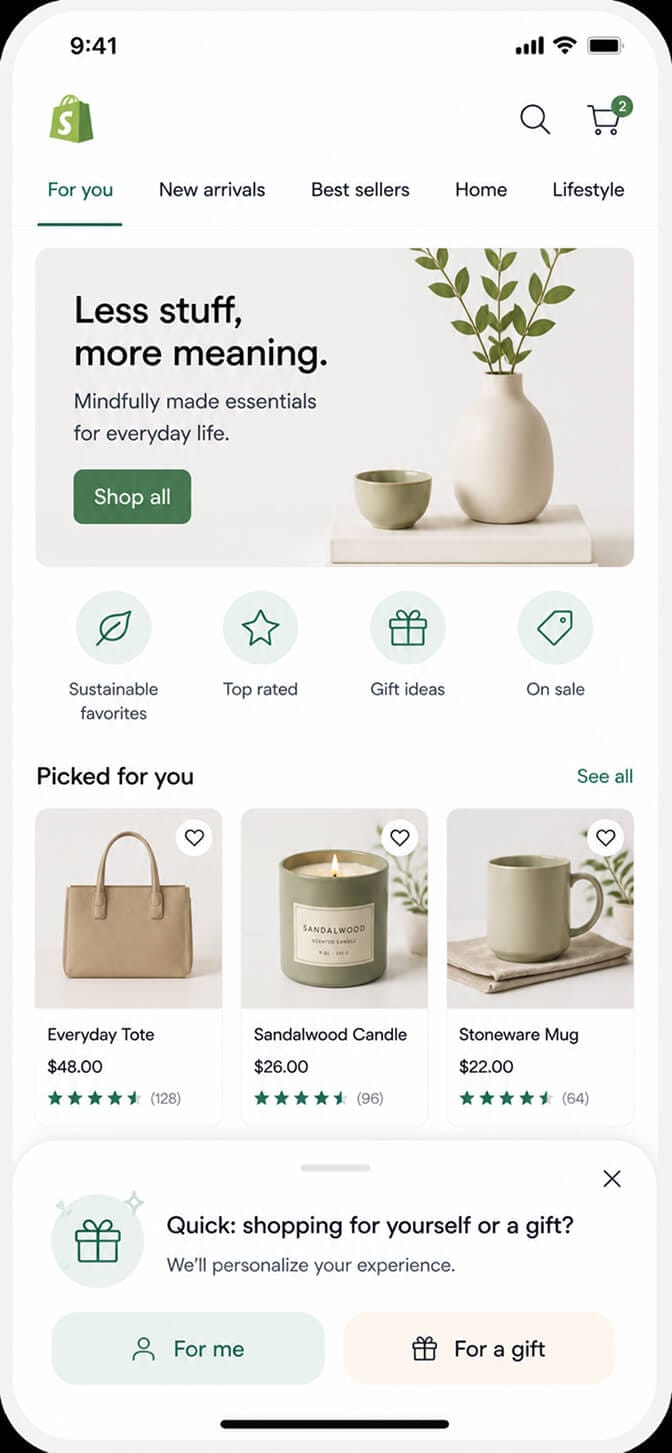
Zero-party data is information shoppers volunteer. The trick is asking at moments where the answer feels useful, not creepy.
The patterns that work: a one-question micro-survey on the homepage ("Shopping for yourself or a gift?"), a style preference quiz embedded in a category page ("What's your style: minimalist, classic, bold?"), a sizing preference saved to the session ("Want to filter by your usual size?").
Each answer becomes a session-level personalization signal. The shopper sees relevant products faster. The merchant gets a higher-quality data point than any cookie could provide.
The mistake most stores make is asking too many questions, too early, with no obvious benefit to the shopper. One question, one moment, one immediate payoff.
Pattern 2: Real-Time Session Signal Personalization
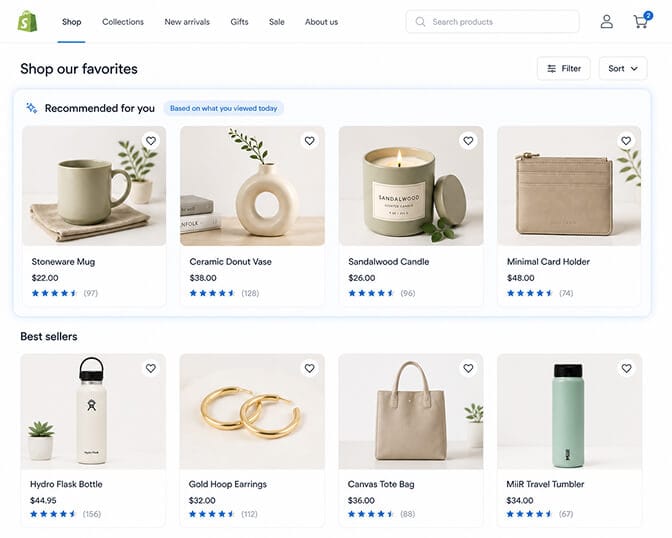
Without persistent identity, your personalization horizon shrinks from "this user across months" to "this session right now." That's actually fine, because most purchase decisions happen within a single session.
Real-time session personalization watches the current visitor's behavior (search queries, filter applications, product views, dwell time) and adapts the storefront in response. View three pairs of running shoes? The next collection page surfaces running gear above hiking gear. Search for "summer dresses"? The homepage banner shifts to summer collections for the rest of the session.
The personalization is anonymous, ephemeral, and high-precision. No cookies. No persistent identity. Just live signal-to-response within the session. The same approach drives our predictive search customer story.
Most Shopify stores have these signals available and don't act on them. The data is in your search analytics, your click streams, your scroll-depth metrics. The fix is plugging that data into your search and recommendation surfaces, not collecting more of it. Pair real-time session ranking with AI merchandising and the storefront adapts at each scroll.
Pattern 3: On-Device Personalization (Privacy Stays on the Phone)
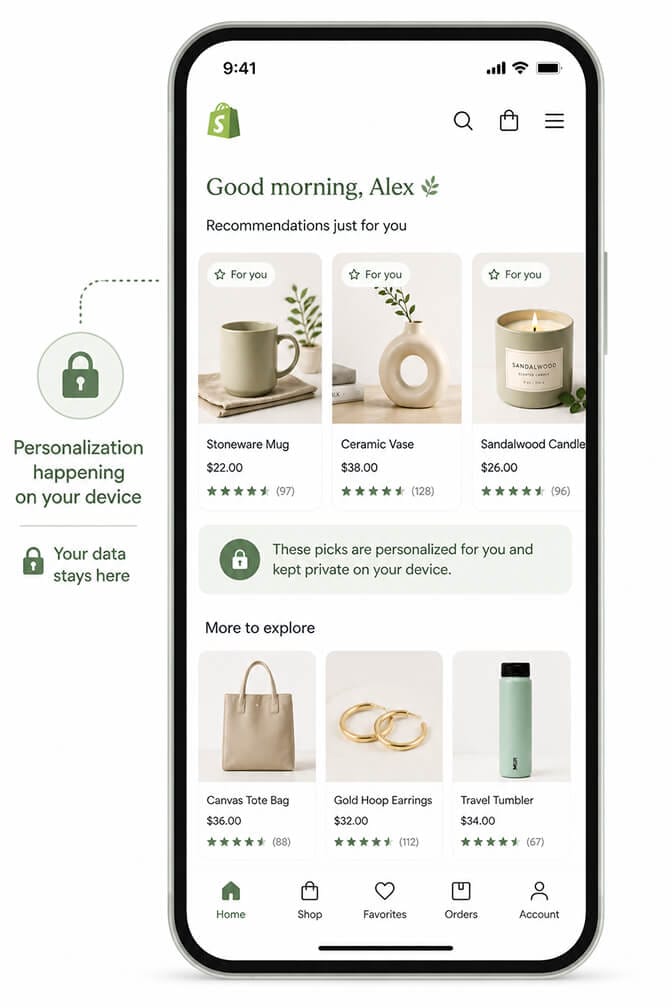
On-device personalization processes shopper signals locally on their phone or laptop instead of sending them back to a server. The results render in the storefront, but the raw data never leaves the device.
This pattern is newer and a bit more technical, but it's worth knowing about. Some Shopify search and personalization tools are starting to ship lightweight client-side models that personalize the homepage, recommend related products, and rerank search results without phoning home.
The privacy story is strong. The shopper's data never gets stored centrally. The merchant still gets the conversion lift. Regulators stay calm.
For most Shopify merchants this is a 2027 conversation, but worth tracking now because the tooling is improving fast.
Pattern 4: Predictive Intent Layering (Multi-Step Forecasting)
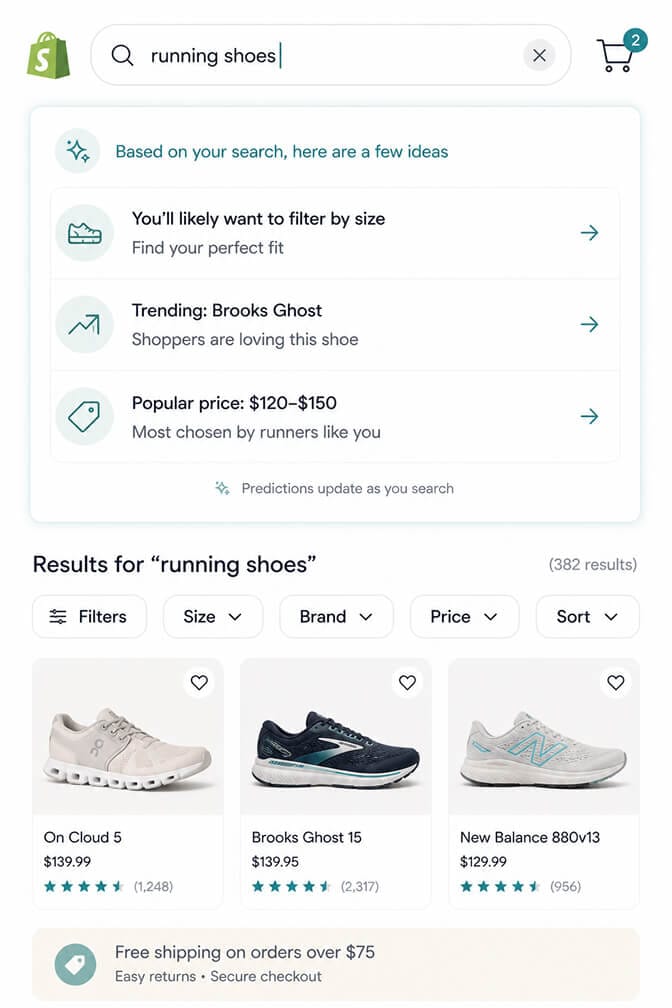
This is where 2026 personalization moves past where most apps live today. Instead of personalizing the current page, predictive intent layering forecasts the shopper's next step and pre-positions the experience for it.
A shopper who searched "running shoes" and clicked into a product page will most likely want to filter by size next. The predictive layer pre-loads the size filter, surfaces sized inventory at the top, and pre-fetches the product detail page they're most likely to view third. The same intent-prediction primitive sits behind dynamic facets and zero-click commerce results pages.
These predictions don't require persistent identity. They're driven by aggregate behavior across thousands of similar sessions, applied to the shopper's current path.
The conversion math is favorable because every removed step is a conversion barrier eliminated. Stores with predictive intent layering see materially shorter session-to-purchase paths than stores running basic personalization.
Pattern 5: Cohort-Based Personalization (Privacy-Safe Grouping)
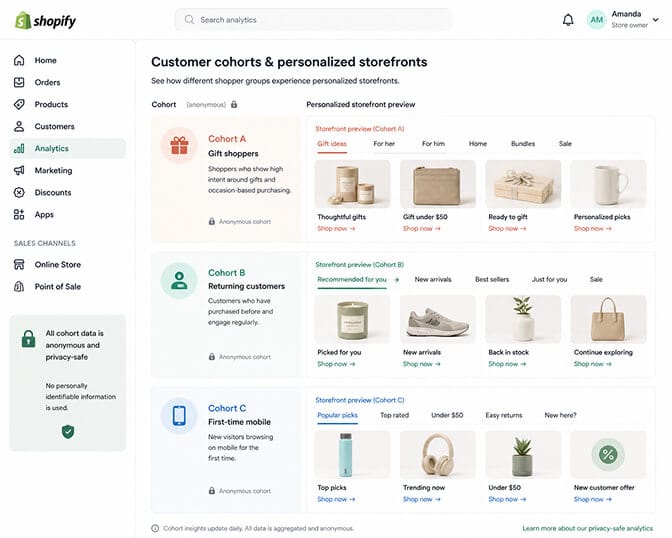
Cohort-based personalization assigns the shopper to an anonymous group based on session behavior and contextual cues, then personalizes the experience for that cohort instead of for the individual.
A first-time mobile visitor in evening hours from a cold-weather region looking at outerwear belongs to a cohort. The cohort gets a personalized storefront variant. The individual stays anonymous.
This pattern fits cleanly inside Google's Privacy Sandbox direction, GDPR's preference for aggregate processing, and CPRA's data minimization principles. It also works without cookies.
Some Shopify search and personalization tools are starting to expose cohort-level personalization out of the box. The setup is usually a few configuration choices, not a development project. AI recommendations is the layer that operationalizes cohort ranking on the product page.
If you're watching your old personalization stack quietly degrade and want a privacy-first replacement that ships fast, Sparq fixes most of this in about 10 minutes. Free to try, no-code setup, and the search analytics show you the session signals you're already capturing but not using.
How to Build the Stack Without a Compliance Headache
Here's the part Shopify doesn't tell you. Most stores can ship a privacy-first personalization layer this quarter without rebuilding their site.
The work breaks into three phases.
Phase one is consent hygiene. Audit your cookie banner, consent mode setup, and data flows. Make sure nothing is firing before consent is granted, especially analytics and personalization scripts. This isn't optional. Regulators are getting aggressive, and the fine math is brutal.
Phase two is zero-party signal capture. Pick two or three useful moments to ask shoppers a single, low-friction question with an immediate payoff. Save the answer to a session metafield. Wire it into search and filter ranking.
Phase three is real-time session personalization. Use your search and recommendation engine to react to in-session behavior. View pattern, search query, filter application, product dwell. Each one feeds the next personalization decision.
You don't need a 12-month roadmap. You need three sprints.
We covered the broader catalog and search work in our piece on how search enrichment works, and the personalization layer sits on top of that foundation. If you want to size what the lift is worth in revenue terms, run your numbers through our ROI calculator.
What This Means for Your Search and Filter Stack
Search and filtering are the highest-leverage personalization surfaces on your store. They handle high-intent moments. The customer is telling you something specific. The system can respond with something equally specific.
Generic search returns the same results to everyone. Personalized search uses session signals to rerank for the current shopper. The ranking changes for someone who answered "shopping for a gift" earlier in the session. It changes again when they apply a "for him" filter. It changes a third time when they dwell on a particular price band. This is exactly what AI semantic search is built to do.
None of this requires identity. All of it requires structured data and a search engine that can read session context.
This is exactly the gap most Shopify stores still have. Their default search ignores session context entirely. Their filters are static. Their results pages don't react to the shopper at all.
Closing that gap is one of the highest-ROI moves in 2026, and it's a privacy-first move because it relies entirely on the shopper's own session, not on cross-site tracking. The same session-context logic also matters for agent-mediated search, since both depend on real-time signals rather than persistent identity.
The Quiet Shift That's Already Underway
Privacy-first personalization isn't waiting for regulators to act. It's already preferred by shoppers, especially Gen Z and Millennials, who actively avoid stores that feel surveillant.
The stores that pivot to zero-party data, real-time signals, and predictive intent layering will keep their personalization quality (or improve it) while their competitors watch coverage degrade. The stores that don't will spend the next two years explaining to themselves why their conversion rates keep softening.
Your shoppers are giving you better signals than they ever have. Voluntary, contextual, session-level signals that any privacy regulator on earth is happy with. The question is whether your stack is built to use them.
Want to see the session signals your store is already capturing but not personalizing on? Install Sparq from the Shopify App Store and check your search analytics. The patterns you'll find in real-time queries are the foundation of your privacy-first personalization layer. If you'd rather see what's possible before installing, the Sparq features overview, pricing, and option to book a demo all walk through the full picture first.
Frequently Asked Questions
What is privacy-first personalization in ecommerce?
Privacy-first personalization customizes the shopping experience using consented zero-party data (preferences shoppers volunteer), first-party session signals (live behavior on your store), and non-identifying contextual cues. It does not rely on third-party cookies, fingerprinting, or cross-site tracking. The result is often higher-quality personalization than the cookie-based stack it replaces, because voluntary signals carry stronger intent.
How is zero-party data different from first-party data on Shopify?
Zero-party data is information shoppers explicitly volunteer (preferences, size, style, occasion). First-party data is information your store observes (page views, searches, clicks, purchases). Zero-party is higher signal but lower volume. First-party is higher volume but lower precision. The best 2026 personalization stacks combine both, plus contextual signals like device and time of day.
Can I personalize my Shopify store without using cookies?
Yes. Real-time session personalization, on-device inference, and cohort-based grouping all deliver personalization without third-party cookies. Most modern AI search and recommendation tools for Shopify support these patterns out of the box, usually with a configuration toggle rather than a development project.
Will privacy-first personalization hurt my Shopify conversion rates?
No, and often the opposite. Stores that pivot to zero-party data and real-time session personalization typically see conversion rates hold steady or improve, because the new signals are higher quality than the third-party data they replace. The transition feels uncomfortable for stacks built on cookie-based identity, but the underlying personalization mechanics are stronger.
Will adding a privacy-first personalization layer slow down my Shopify store?
No. Modern AI personalization apps process signals on external infrastructure (or on-device for newer patterns) and return personalized results in well under 200 milliseconds. The shopper experience is faster than a default storefront, not slower, because personalized ranking surfaces relevant products earlier in the page.