
Headless Commerce Search: Why Decoupled Search and Filters Are Non-Negotiable for 2026 Scale
Going headless made your storefront fast. Then your search bar slowed it back down. Here's why decoupling search and filters is the part of the migration most teams skip, and the part that actually decides whether headless pays back.
A Shopify Plus merchant migrated to a headless storefront last quarter. Hydrogen front-end, custom domain, edge-deployed.
The first month was beautiful. Lighthouse scores climbed into the 90s. Largest Contentful Paint dropped under 1.2 seconds. Mobile traffic stuck around 30% longer than before. Their dev team threw a small party.
The second month, conversion rate flatlined.
They couldn't figure out why. The site was faster. The traffic was healthier. The cart flow was tighter. Something in the experience wasn't compounding the way they expected.
Then their product manager pulled up search analytics and noticed it. The search bar response time had crept from 250 milliseconds to 1.4 seconds during peak traffic. The filter sidebar took two full seconds to repaint after a click. The fastest storefront in the company's history was getting bottlenecked by the one piece of infrastructure they'd left attached to the legacy backend.
Here's the weird part. They thought they'd gone headless. They hadn't. They'd gone partially headless, and the part they'd left coupled was the part that handled the most high-intent traffic.
This is the part most teams get wrong about headless migrations. Going headless on the storefront without decoupling search and filters is like installing a sports car engine on a car with the original brakes. The improvement isn't what you expected, and the failure mode is hiding inside the parts you didn't replace.
What Headless Commerce Search Actually Means
Stay with me here, because the terminology gets weaponized fast.
Headless commerce decouples your storefront (the visual experience) from your commerce engine (catalog, checkout, customer data). The storefront talks to commerce through APIs. You can swap front-ends, deploy on edge networks, and scale rendering independently of your backend.
Headless commerce search means the same thing applied to search and filtering. Your search runs as its own service, with its own API, its own caching, its own AI layer, and its own response surface. The storefront calls the search API. The commerce engine never enters the loop for search queries.
The opposite (the way most stores still operate) is coupled search: search runs through your commerce backend's native query system. Every search hit goes through the commerce engine. Every filter recomputes against the live catalog query. Every result waits for the slowest part of your stack.
In a low-traffic store, the difference is invisible. At scale, it's the failure point that defines whether headless pays back.
Going headless on the storefront without decoupling search is the most expensive half-migration in commerce.
Why Coupled Search Quietly Kills Headless ROI
This is where most store owners get it wrong.
The whole point of headless is independent scaling, edge delivery, and millisecond-grade response times. Search is the highest-frequency, lowest-tolerance interaction on a storefront. Shoppers expect 200-millisecond responses. They notice 500. They abandon at 1,000.
When search runs through a coupled commerce backend, three things happen.
First, search response times track your backend's load curve. Peak traffic on the catalog means slower search, exactly when you can afford it least.
Second, your storefront's beautiful edge caching gets neutered. The page renders in 200 milliseconds, but the search bar dropdown takes 800 milliseconds, and that's the interaction the shopper actually feels. If you've already audited Shopify store speed you'll have seen this pattern.
Third, AI search and filter features become hard to add. Most modern AI search engines run as decoupled services with their own data ingestion, their own indexing, and their own query processing. If your stack assumes search lives inside the commerce backend, integrating AI is a fight at every step.
The decoupled alternative removes all three problems at once.
Five Patterns That Make Headless Search Work at Scale
Here's the practical part. Five patterns the merchants who actually win at headless are using. Each one matters whether you run Hydrogen, Next.js, Remix, Astro, or a custom stack.
Pattern 1: Decoupled Search API Layer
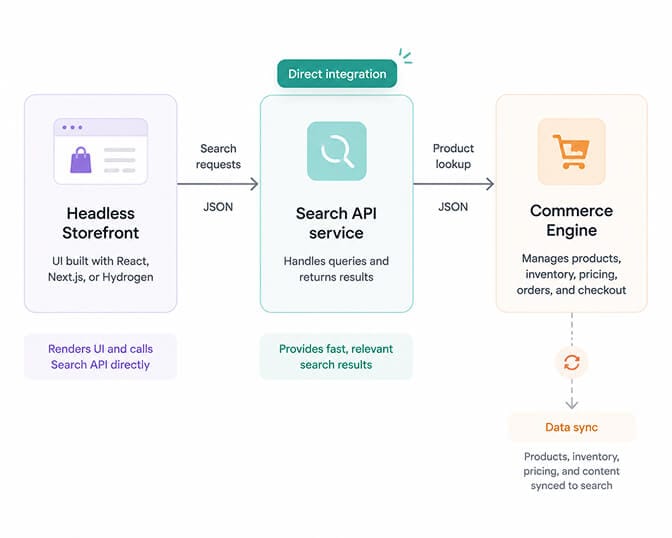
The first move is the most fundamental. Your search runs as its own API service, separate from your commerce backend. The storefront calls the search API directly. Search query traffic never touches your commerce server.
Behind the scenes, the search service ingests your catalog data via webhook or scheduled sync. It indexes products, builds inverted indexes, computes embeddings for AI matching, and stores everything in its own data store optimized for query speed. The underlying ecommerce search algorithm work happens inside this service, not inside Shopify.
When a shopper searches, the storefront sends the query to the search API. The search API returns ranked results in 80 to 200 milliseconds. Your commerce backend doesn't even know the query happened.
This decoupling is non-negotiable at scale. Stores running 50,000+ search sessions per month see materially better performance and uptime by isolating search from the commerce engine.
Pattern 2: Edge-Cached Search Responses
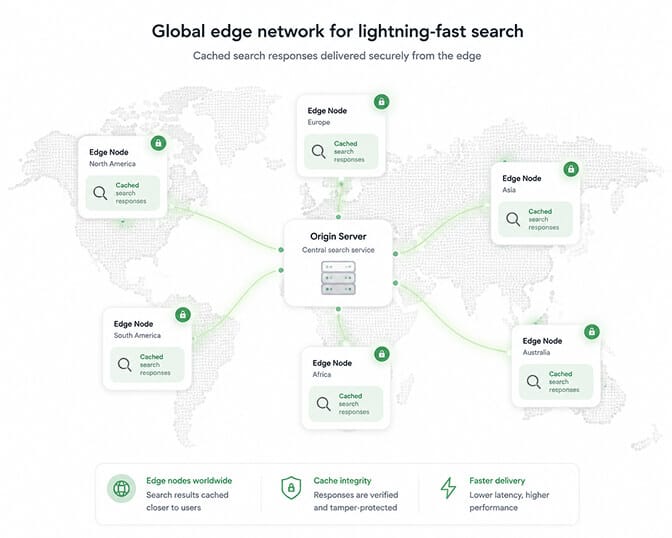
A decoupled search API gives you something the coupled version can't: cacheable responses at the edge.
Common queries (popular search terms, filter combinations, default sort orders) get cached on a CDN edge node near the shopper. The first shopper from each region pays the latency cost of computing the query. Every subsequent shopper from that region gets the cached response in under 50 milliseconds.
Edge caching turns search into the fastest part of your storefront instead of the slowest. The numbers compound during traffic spikes (seasonal campaigns, viral product moments, paid media bursts) when the cache hit rate climbs into the 80% range and your origin search service barely breaks a sweat. The filters-boosting-site-speed-and-SEO customer story shows what this lift looks like in production.
We covered the broader architectural payoff in our piece on ecommerce site search architecture. The edge caching layer is what turns the architecture from theoretical into actual performance.
Pattern 3: AI-Augmented Search Behind the API
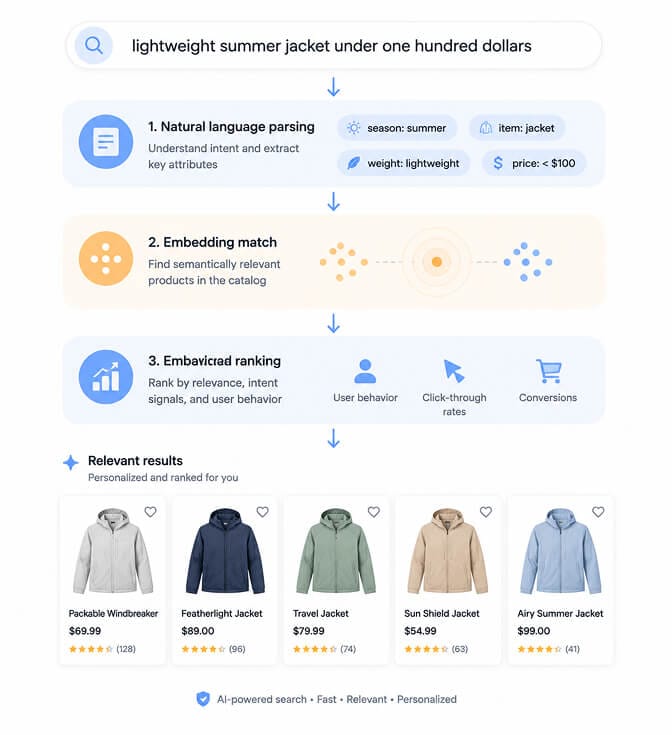
Once search is decoupled, AI integration becomes simple instead of painful.
The AI layer sits inside the search API service, transparent to the storefront. The storefront sends a query, the search service runs natural language parsing, semantic matching, behavioral ranking, and synonym handling, then returns ranked results. The storefront just renders. This is exactly what AI semantic search is built to do.
Three concrete capabilities become easy to ship in this pattern.
Natural language understanding (parsing "lightweight summer jacket under $100" into structured filters) lives in the search service.
Personalization signals (current session behavior, cohort membership, contextual cues) get applied during ranking inside the API.
Behavioral learning (which products clicked through, which converted, which got bounced from) feeds back into the ranking model without any storefront changes. AI merchandising is the surface that exposes those signals to the merchant.
The result is that AI features ship as configuration changes inside the search service, not theme rebuilds. The same primitives also make your store agent-ready, since AI shopping agents query the search API the same way the storefront does.
Pattern 4: Filter Rendering in Modern JS Frameworks
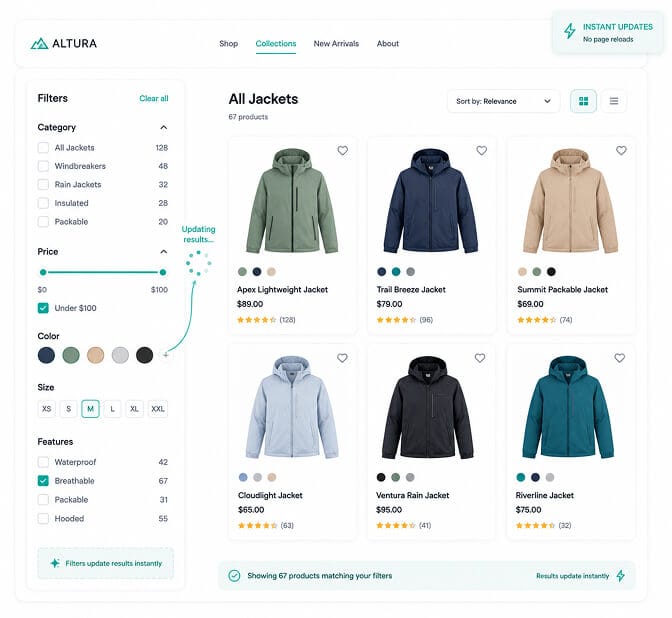
Headless storefronts built on Next.js, Remix, Hydrogen, or Astro have a real advantage on filtering: they can update filtered results without full page reloads.
The pattern that wins: filter state lives in URL query parameters (so it's shareable and SEO-friendly), but the rendering happens client-side via the framework's data-fetching layer. Click a filter, the storefront fetches updated results from the search API in 100 milliseconds, and the grid repaints without flashing the page.
The shopper experience feels like a native app. The SEO experience stays clean because the URL still reflects the filter state and search engines can crawl the filtered views as separate pages. Pair this with dynamic facets and your filter sidebar adapts to the current query without a single round trip to the commerce backend.
Most coupled-search Shopify stores can't do this without a fight. Headless setups with a decoupled search API ship it as a default behavior.
Pattern 5: Multi-Storefront Unified Search
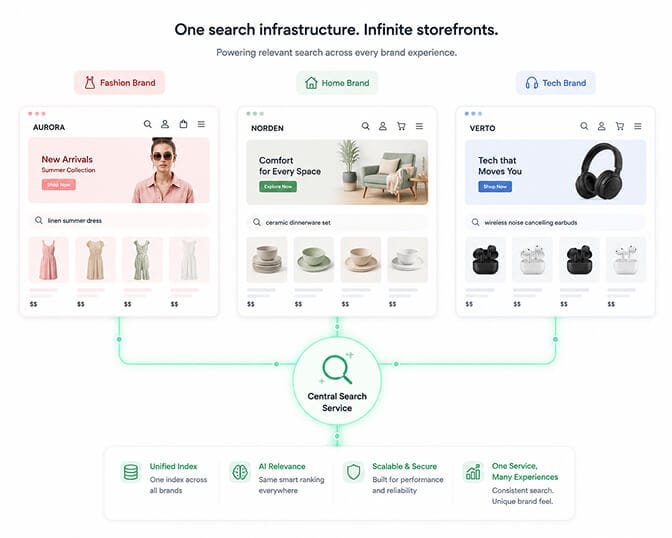
For brands running multiple storefronts (different markets, different brand lines, B2B and DTC variants), headless commerce search lets one search service power all of them.
The pattern is straightforward: a single search API with namespace-aware indexing serves multiple storefronts. Each storefront filters its results to its own catalog scope at query time. Shared analytics aggregate across all storefronts. Shared AI models learn from all behavior.
The operational wins are large. One search service to maintain instead of three. One AI model to tune. One analytics dashboard. One source of truth for what shoppers across all brands are searching for.
This pattern is especially relevant for Shopify Plus merchants running multi-storefront setups, and for brands that operate sub-brands or international variants on separate domains. We compared the underlying options in the best ecommerce search engines for Shopify.
If you're running headless and watching your search and filter layer drag down everything else, Sparq fixes that without forcing a re-platforming project. Free to try, no-code setup, and the storefront API integration takes most teams a single sprint.
The SEO and Core Web Vitals Story Most Teams Miss
Here's the part Shopify doesn't tell you. Decoupled search isn't just about speed and scale. It's about SEO.
Google's Core Web Vitals weight Largest Contentful Paint and Interaction to Next Paint heavily. Both are sensitive to slow search and filter responses on collection pages.
A coupled search bar that takes 800 milliseconds to respond after a keystroke kills your INP score on every search interaction. A coupled filter that recomputes against your commerce backend on every click pushes LCP up on collection pages. Both feed Google's quality signals, both affect organic ranking, and both are invisible to most theme-side performance audits. We covered the page-load specifics in our piece on whether Sparq affects page load time.
Decoupling search and filters typically improves INP by 30 to 60% on filtered pages and stabilizes LCP across collections. Stores tracking organic traffic post-migration usually see ranking improvements that compound over months as Google revalidates page experience signals.
The SEO win is the quiet payoff. The speed win is the loud one. Both come from the same architectural move. If you want to size both in revenue terms, run your numbers through our ROI calculator.
How to Tell If Your Headless Setup Is Half-Migrated
Pick three signals. If any of them describe your stack, your search and filter layer is still coupled to your commerce backend.
Your search bar response time fluctuates with backend load. If response times degrade during peak traffic, your search is going through the commerce engine.
Your filter clicks trigger full page reloads. If clicking a filter reloads the page or causes a visible flash, your storefront is fetching from the commerce backend instead of a dedicated search API.
Adding an AI search feature requires a developer-heavy backend integration. If the answer is "we'd need to refactor our backend," you're coupled.
Pass any of those three? You're partially headless. The fix is decoupling search as a discrete project, ideally with a search service designed for the headless pattern.
We covered the broader migration considerations in our piece on ecommerce site search architecture, and the headless-specific work usually fits inside a single sprint with the right tooling.
A Quiet Architectural Shift That Compounds
Headless commerce search isn't a buzzword. It's the architectural decision that decides whether your headless migration delivers what was promised.
The merchants who decouple search and filters along with the rest of the storefront capture the speed, the SEO, the AI flexibility, and the scaling headroom that headless was supposed to deliver. The merchants who don't end up with a beautiful storefront bottlenecked by a search bar that runs slower than the version they were trying to leave behind.
You don't have to re-platform. You don't have to rebuild. You do have to recognize that search and filtering are their own architectural concern, and that "headless" without "decoupled search" is most of the way there but not all of it.
Want to see what your search service is actually doing under load? Install Sparq from the Shopify App Store and check your search analytics. The latency and query volume patterns tell you whether decoupling pays back, and how soon. If you'd rather see what's possible before installing, the Sparq features overview, pricing, and option to book a demo all walk through the full picture first.
Frequently Asked Questions
What is headless commerce search and why does it matter?
Headless commerce search runs your search and filtering as a separate API service, decoupled from your commerce backend. The storefront calls the search API directly, which means search response times are independent of commerce engine load and can be edge-cached for sub-100ms responses. It matters because going headless on the storefront without decoupling search creates a hidden bottleneck that undoes most of the migration's speed and SEO benefits.
How does headless search compare to native Shopify search at scale?
Native Shopify search runs through the commerce backend, which works fine at low traffic but slows under peak load. Headless search runs as its own service with dedicated indexing, edge caching, and AI processing, which gives consistent sub-200ms response times even during traffic spikes. For stores running 50,000+ search sessions monthly, the performance and reliability gap is large.
Do I need a developer team to set up headless commerce search?
For full headless setups, yes, you need developer involvement to integrate the search API into your storefront framework (Hydrogen, Next.js, Remix, etc.). However, the search API itself can usually be configured by a non-developer in under an hour, and the actual integration is typically a single sprint of work for an experienced front-end developer.
Will switching to headless search improve my SEO and Core Web Vitals?
Yes, in most cases meaningfully. Decoupling search and filters typically improves Interaction to Next Paint by 30 to 60% on filtered pages and stabilizes Largest Contentful Paint on collections. Both feed Google's page experience signals, and stores tracking organic traffic post-migration usually see ranking improvements compound over the following two to three months.
Is headless commerce search worth it for stores with under 5,000 SKUs?
It depends on traffic and scale ambitions, not SKU count alone. Stores with under 5,000 SKUs but heavy traffic (100k+ monthly visitors) benefit clearly from decoupled search. Stores with smaller catalogs and modest traffic can run native Shopify search effectively. The break-even point is usually around traffic volume and the importance of search-driven revenue rather than catalog size.