
E-commerce Search Trends 2026: Why 72% of Stores Are Bleeding Money Through Bad Search
The search bar is quietly killing your conversions. Here's what's changing and how the smartest Shopify stores are fighting back.
I watched it happen in real time.
A friend runs a skincare store on Shopify. About 2,000 SKUs. Decent traffic. She asked me to look at her analytics because "something felt off."
So I pulled up her search data.
A customer had typed "moisturizer for dry skin" into her search bar. The result? Nothing. Zero products. The customer bounced within eight seconds.
The thing is-she had seventeen moisturizers specifically formulated for dry skin. They were just tagged as "hydrating facial cream" in her backend.
One word mismatch. One lost sale.
And this is where most store owners get it wrong.
They obsess over ads. They tweak their homepage. They run endless A/B tests on button colors. Meanwhile, their search bar-the single highest-intent touchpoint on their entire site-is actively driving customers away.
Here's the uncomfortable truth: customers who use your site search convert at 2-3x the rate of browsers. They account for nearly 45% of total revenue despite being only 15% of traffic.
But here's the part that costs you money.
The average "no results" rate across e-commerce sits between 10% and 30%. That means up to one-third of your most motivated buyers are hitting dead ends.
In 2026, that's not just a UX problem. It's a survival problem.
The Search Experience Has Fundamentally Changed
Let me be direct: your customers don't search like they did three years ago.
They don't type "blue dress size 8." They type "something cute for a summer wedding under $150."
They ask questions. They describe feelings. They use the same conversational language they'd use with a friend-or with ChatGPT.
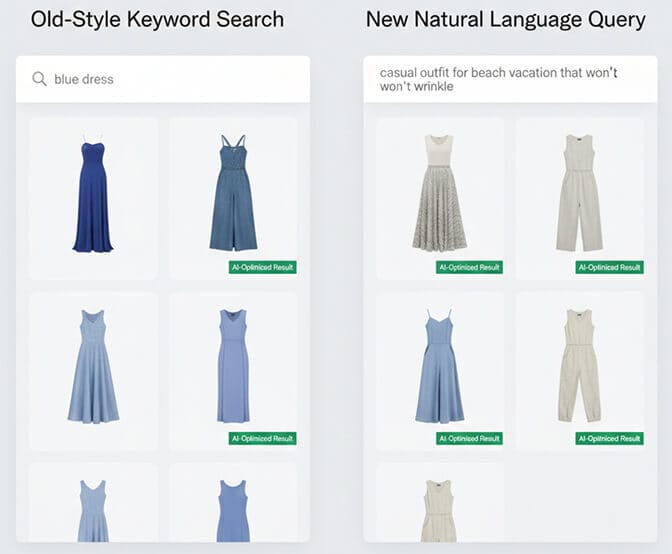
This shift isn't coming. It's already here.
According to recent data, 7 in 10 shoppers now want AI-powered shopping features, including smarter search that understands what they actually mean. Voice search is accelerating. Visual search is maturing. And the expectation gap between "how customers search" and "how most Shopify stores handle search" is widening fast.
The stores winning in 2026 aren't just selling products. They're translating intent.
Traditional keyword matching-where "sneakers" only returns products literally tagged "sneakers"-feels broken to modern shoppers. They expect your search to understand that "running shoes," "trainers," and "athletic footwear" are the same thing.
They expect typo tolerance. Synonym recognition. Contextual understanding.
And when they don't get it? They leave.
What AI Search Actually Means (Beyond the Buzzwords)
I'll be honest-"AI search" has become one of those terms that means everything and nothing.
Every vendor claims it. Few deliver it.
So let me break down what actually matters for Shopify merchants in 2026:
Natural Language Processing (NLP): This is the ability to understand queries the way humans actually phrase them. Not just matching keywords, but interpreting meaning. When someone searches "gift for mom who likes gardening," a real AI search engine surfaces gardening gloves, planters, and seed kits-even if none of those products contain the word "gift" or "mom."
Semantic Search: This goes deeper than synonyms. It understands relationships between concepts. "Waterproof" and "rain-resistant" aren't identical, but they're related. Good semantic search knows when to surface both.
Behavioral Learning: The best AI search engines learn from what your customers actually do. When shoppers search "summer dress" and consistently click on floral patterns, the system starts prioritizing florals for that query-without you manually merchandising anything.
Stay with me here.
The reason this matters isn't just "better UX." It's money.
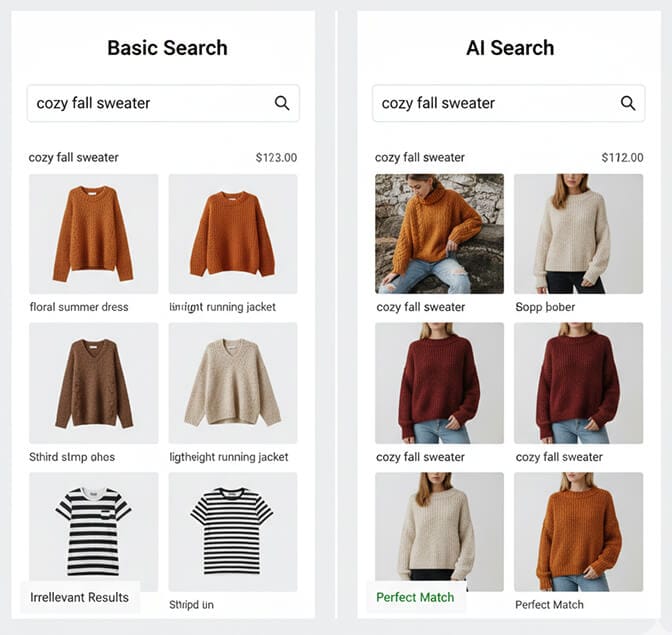
Stores with advanced search capabilities see conversion rates up to 50% higher than those with basic keyword matching. That's not a marginal improvement. That's the difference between a struggling store and a profitable one.
The Four Trends Reshaping E-commerce Search Right Now
1. Zero-Result Pages Are Being Treated Like Conversion Killers
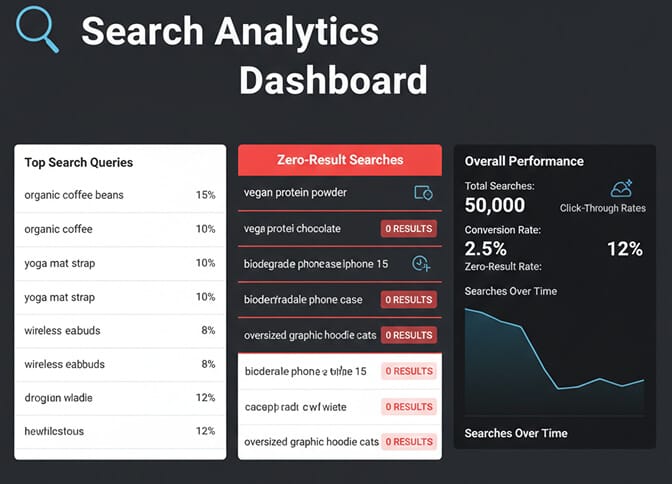
Top-performing stores now track their zero-result rate as a core KPI-right alongside cart abandonment and checkout completion.
The benchmark? Best-in-class stores maintain under 2-3% zero-result rates. Anything above 10% signals a broken discovery experience.
Here's the weird part.
Most zero-result searches aren't about missing inventory. They're about search engines that can't interpret customer language. In one study, 63% of all zero-result queries were caused by the search engine simply not understanding the query-not by products being out of stock.
That's fixable. And stores that fix it are seeing 5-10% revenue improvements sitewide.
2. Search Analytics Are Becoming Strategic Gold
Every query typed into your search bar is first-party intent data.
Smart merchants are using this data to:
- Identify products customers want but can't find
- Spot inventory gaps before they become problems
- Understand exactly how customers describe their needs (hint: it's rarely how you describe your products)
- Inform product descriptions, category names, and even ad copy
If you're not reviewing your search analytics monthly, you're flying blind.
3. Personalization Is Moving From "Nice to Have" to "Expected"
The same search query from two different customers should return different results.
A first-time visitor searching "running shoes" might need broad options. A returning customer who previously bought trail gear should see trail-specific results surfaced first.
This level of personalization was enterprise-only territory two years ago. Now it's accessible to Shopify merchants through AI-powered search apps.
4. Mobile Search Is Finally Getting the Attention It Deserves
Mobile drives over 70% of e-commerce traffic. But mobile conversion rates still lag desktop significantly.
Why? Partly because search on mobile is harder. Smaller screens. Slower typing. Less patience.
The solution isn't just "make the search bar bigger." It's predictive autocomplete that reduces typing. It's smart filters that adapt to mobile behavior. It's instant results that load before the customer finishes their query.
The Part Shopify Doesn't Tell You
Shopify's native search is... fine.
It handles basic keyword matching. It's included in your plan. It works.
But "works" and "converts" aren't the same thing.
Shopify's built-in search doesn't offer AI-powered natural language understanding. It doesn't learn from customer behavior. It doesn't provide search analytics showing you which queries fail. It doesn't handle synonyms automatically.
For stores under 100 SKUs with simple product lines, that might be acceptable.
For anyone scaling past 500 products-especially in fashion, home goods, beauty, or any category with complex attributes-native search becomes a bottleneck.
Your search bar is either your best salesperson or your worst employee. There's no middle ground.
What I Wish I Knew Before We Built Sparq
When we started building Sparq.ai, we assumed the hard part would be the AI.
We were wrong.
The hard part was convincing merchants that search mattered at all.
Everyone wanted to talk about Facebook ads. About influencer partnerships. About email flows. Search felt... boring. Invisible.
But then we'd show them the data.
We'd pull up their search analytics (most had never looked) and show them queries like "gift for husband" returning zero results. We'd show them customers searching for products they definitely stocked-and bouncing anyway.
If you're tired of customers searching and leaving empty-handed, Sparq Search fixes that in about 10 minutes. Free to try.
The shift usually happened right there. When you can see the actual queries your customers are typing-and watch them fail in real time-search stops feeling like a technical feature and starts feeling like a revenue lever.
How to Know If Your Search Is Actually Costing You Money
Here's a quick diagnostic. Answer honestly:
- Do you know your zero-result rate? If you've never checked, it's probably higher than you think.
- When you search your own store for a product you know exists, does it appear in the top 3 results? Try searching the way a customer would, not the way your product is titled.
- Does your search handle typos? Try misspelling a popular product and see what happens.
- Can you see what customers are searching for? If your search doesn't provide analytics, you're missing critical intent data.
- Does your search understand synonyms? Try "couch" vs. "sofa." "Sneakers" vs. "tennis shoes." Same results?
If you answered "no" or "I don't know" to more than two of these, your search is likely underperforming.
The Merchants Who Are Getting This Right
I've watched stores transform their numbers by focusing on search.
One home goods merchant reduced their zero-result rate from 18% to under 3%. Their search-to-purchase conversion jumped 34% in the first month.
A fashion boutique added synonym handling and natural language support. Average session duration increased by 40 seconds-a lifetime in e-commerce terms.
A beauty brand started reviewing their search analytics weekly. They discovered customers were constantly searching for "travel size" products-a category they had but hadn't properly highlighted. They created a dedicated collection, promoted it based on search data, and saw a 22% revenue increase from that collection alone.
None of these required massive investments. No dev teams. No six-month implementations.
Just attention to something most stores ignore.
Where Search Is Heading Next
The next wave is already visible.
Conversational commerce is merging search with chat. Customers won't just type queries-they'll have back-and-forth conversations with AI assistants that guide them to products.
Visual search is maturing. Upload a photo, find similar products. This is already standard in some categories and expanding fast.
Voice search optimization is becoming mandatory as smart speakers and mobile voice assistants handle more product queries.
But here's my honest take:
You don't need to chase every trend.
What you need is a search experience that understands your customers today-that handles natural language, learns from behavior, and stops turning high-intent shoppers into frustrated bouncers.
Get that foundation right, and you'll be positioned for whatever comes next.
The Bottom Line
Your search bar sees more buying intent than any other element on your site.
Every failed search is a customer telling you exactly what they want-and leaving because you couldn't deliver it.
In 2026, the gap between "basic search" and "intelligent search" isn't a nice-to-have. It's the difference between stores that scale and stores that stagnate.
The good news? Fixing search is one of the highest-ROI improvements you can make. It's faster than redesigning your site. It's cheaper than acquiring new traffic. And the results show up almost immediately.
Want to see what your customers are actually searching for? Install Sparq.ai and check your search analytics-it's eye-opening.
Because the truth is, your customers are already telling you what they want.
The question is whether your search bar is listening.
Frequently Asked Questions
1. What are the biggest e-commerce search trends in 2026?
The most significant trends include AI-powered natural language search that understands conversational queries, real-time personalization based on shopper behavior, aggressive zero-result reduction strategies, and the use of search analytics as a strategic business tool. Mobile search optimization and voice search compatibility are also accelerating as mobile traffic continues to dominate.
2. How does AI search compare to traditional keyword search for e-commerce?
Traditional keyword search only returns results when products contain the exact words typed. AI search uses natural language processing to understand intent, synonyms, and context-so "running shoes for bad knees" can surface supportive athletic footwear even without those exact words in product titles. Studies show AI-powered search can deliver up to 50% higher conversion rates compared to basic keyword matching.
3. What is a good site search conversion rate for Shopify stores?
Site search users typically convert at 2-3x the rate of non-searchers, with top-performing stores seeing search conversion rates between 4-6%. If your search conversion rate is below 2%, there's likely significant room for improvement. The key metric to watch alongside this is your zero-result rate-anything above 5% indicates search relevance problems.
4. Does improving site search actually increase revenue?
Yes, significantly. Visitors who use site search account for nearly 45% of e-commerce revenue despite representing only about 15% of traffic. Stores that implement advanced search with AI capabilities, synonym handling, and typo tolerance consistently report 10-25% improvements in overall conversion rates. Reducing zero-result searches alone can boost sitewide revenue by 5-10%.
5. Will a search app slow down my Shopify store?
Modern search apps like Sparq.ai are built for speed, with query latency under 100 milliseconds-essentially instant. Well-architected search solutions actually improve perceived site performance because customers find products faster. The key is choosing a search app built specifically for Shopify rather than a generic solution, ensuring proper integration and optimized performance.