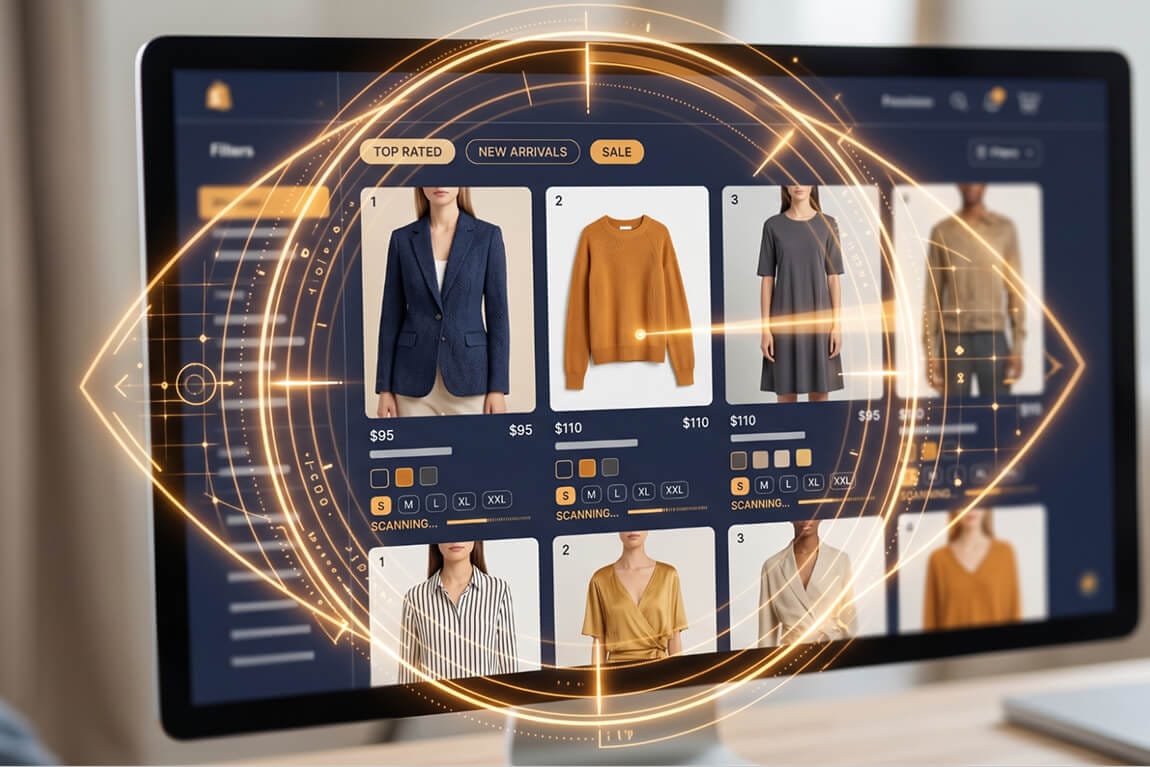
Agentic Vision Search Is Already Shopping Your Store: Why Your Visual Filters Are Behind
AI agents are now browsing, comparing, and buying on behalf of customers. Most Shopify stores are completely invisible to them. Here's what's happening, why your current filters are the problem, and what you need to change.
A merchant I know runs a mid-size furniture store on Shopify. Around four hundred SKUs. Solid photography. Clean product descriptions. An okay filter sidebar.
Last quarter she noticed something in her analytics. Traffic up. Conversion down. Not by a dramatic amount, but consistently. Week over week, the gap was widening.
She called it a "traffic quality problem." More visitors, fewer buyers.
Here's what was actually happening.
A growing slice of her traffic was coming from AI shopping agents. Tools that research, compare, and surface products on behalf of real humans. These agents were landing on her store, trying to understand her catalog, and mostly failing. Not because her products weren't good. Because her filters and her product data were structured for humans, not for machines that see products differently than humans do.
The agents were finding her. They just couldn't read her.
That's the agentic vision search problem in 2026. And most Shopify merchants don't know it exists yet.
What AI Agents Actually Do When They Visit Your Store
Let's be specific about what's happening, because this isn't science fiction. It's already in your analytics.
AI shopping agents, the kind embedded in ChatGPT, Google's AI Mode, and increasingly in browser extensions and standalone shopping apps, are actively browsing ecommerce stores on behalf of users. Someone tells an agent "find me a solid oak dining table under $900 that ships within a week" and the agent goes to work. It visits product pages. It reads attributes. It compares options. It surfaces recommendations. We covered the broader framework in our piece on agentic search for Shopify in 2026.
The agent doesn't browse the way a human does. It doesn't respond to visual appeal in the way a human does. It parses structured information. It reads attributes, filter categories, product metadata, and catalog organization to understand what your products are and whether they match the request it's working from.
Here's the problem.
Most Shopify filter systems were designed for humans clicking dropdowns, not for AI systems parsing product attributes at scale. When an AI agent hits a store where the filtering architecture is vague, inconsistently labeled, or missing key attributes entirely, it can't confidently match products to user requests. It moves on.
Your filter sidebar is no longer just a UX element. It's part of your machine-readable catalog. If an AI agent can't understand your filters, it can't recommend your products, no matter how good they are.
How Agentic Vision Actually Works (The Part That Changes Everything)
Here's where it gets genuinely interesting, and genuinely urgent.
Agentic vision search combines two capabilities that used to be separate. Computer vision, which lets an AI system look at a product image and identify what it actually is, and natural language understanding, which lets the same system match that visual understanding to a shopper's stated intent. The broader multimodal context is in our voice and visual search deep dive.
An agent browsing a fashion store doesn't just read your product title. It looks at the image. It identifies the garment type, the silhouette, the color family, the apparent material, the styling cues. It cross-references that visual interpretation with your product attributes and your filter structure. If the visual data and the attribute data are inconsistent or incomplete, the agent's confidence in recommending that product drops.
This is the visual filter evolution problem. The agent isn't just filtering by the categories you've defined. It's independently forming an understanding of what your products look like, and then checking whether your filter architecture helps it communicate that understanding accurately.
The filters that work for agentic vision search in 2026 share three characteristics that traditional Shopify filters don't always have.
Attribute specificity. "Blue" is not specific enough for an AI agent comparing products. "Cobalt blue" or "navy" or "powder blue" is. The more specific and standardized your attribute vocabulary, the more accurately an agent can match your products to precise user requests.
Visual-to-text alignment. The color you call "midnight" in your product title should match the color family your filter labels as "navy" or "dark blue." When visual signals and text labels diverge, agents lose confidence in the match.
Hierarchical category structure. An agent trying to find "a small side table in natural wood finish under $200" needs to understand that your "accent tables" category contains "side tables" and "end tables" as subcategories. Flat, shallow category structures that humans can navigate intuitively are harder for agents to parse at speed. The underlying search enrichment work is what makes this hierarchy machine-readable.
Why Traditional Shopify Filters Are Failing This Test
Most Shopify stores built their filters for one purpose: helping a human narrow down search results by clicking. That's a fundamentally different task from helping an AI agent understand and represent your catalog accurately. We covered the broader filter gap in dynamic facets vs static filters.
The four most common filter failures we see in Shopify stores that are struggling with AI discoverability:
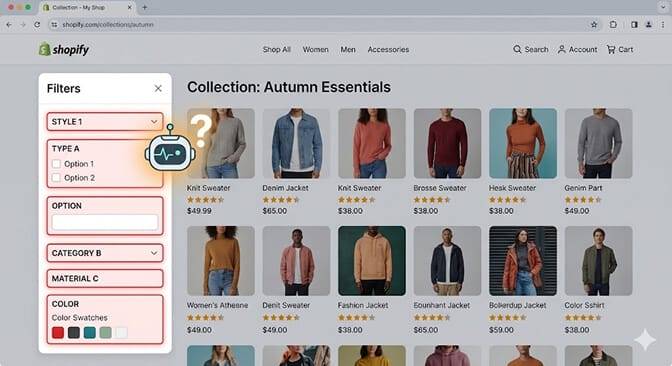
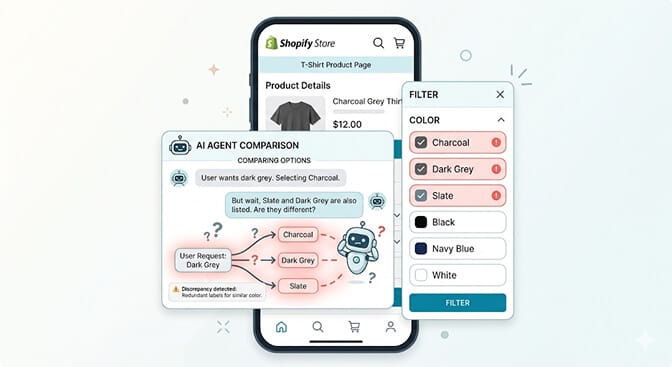
Generic filter values. Filters labeled "Color 1," "Color 2," and "Color 3" mean nothing to a human and less to an agent. Even well-intentioned stores that use color names often use inconsistent naming conventions across products. "Charcoal" on one product, "dark grey" on another, "slate" on a third, all describing the same color family. An agent can't confidently group these.
Missing size and dimension filters. For furniture, home goods, and any category where physical specifications matter, missing or inconsistent size filters are a significant discoverability problem. An agent tasked with finding a sofa that fits a specific room dimension needs precise attribute data, not "available in multiple sizes."
No material or composition filters. As sustainability and material preferences become more important to shoppers, and as AI agents get better at understanding material-based queries, stores without material filters are missing an entire category of matchable intent. Our piece on sustainability filters for Shopify covers this in detail.
Static filters that don't adapt to inventory. A filter showing "Wool" when none of your current wool products are in stock creates friction for agents trying to surface available products. Smart filters that reflect actual inventory states are both more useful for humans and more trustworthy for agents.
The Four Filter Evolutions Your Store Needs Now
This is where the practical guidance gets specific. These aren't theoretical future-proofing moves. They're the specific changes that make your store more readable to AI agents operating right now.
Evolution 1: Standardized, Granular Color Attributes
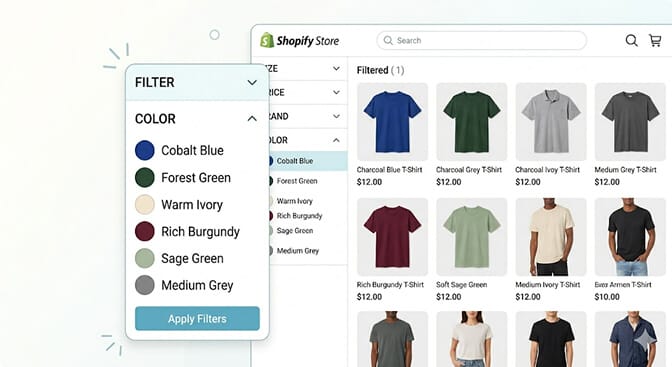
The move from "Blue, Green, Red" to a standardized palette vocabulary is the single highest-impact change for AI discoverability in color-heavy categories. Pick a vocabulary (you can use common color naming conventions as your guide) and apply it consistently across your entire catalog.
For fashion stores, include both family and variation: "Blue: Cobalt, Navy, Powder, Teal." For home goods, include finish and undertone: "White: Warm White, Cool White, Off-White." Every product in your catalog should use the same vocabulary, not improvised descriptions.
This benefits humans and agents equally. A shopper searching for "navy blue dress" finds what they need. An agent tasked with sourcing "dark blue formal options" matches your products with confidence.
Evolution 2: Dimension and Size Filters That Match How Agents Query
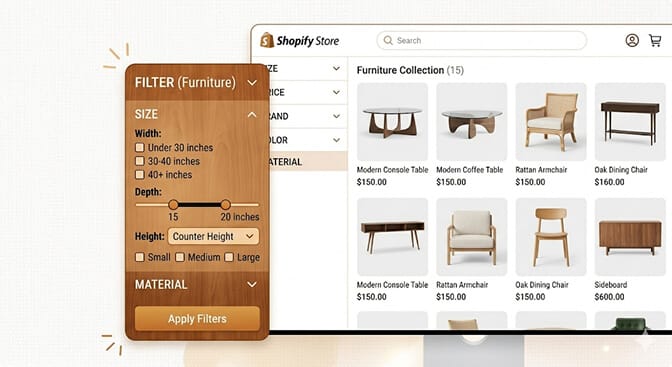
For any category where size matters (furniture, rugs, luggage, clothing, electronics), your size filters need to speak the language of natural language queries. "Size M" is a human label. "Width: 30 to 36 inches" is something an agent can use to answer "find me a nightstand that fits between my bed and the wall."
This means adding specification-level filters in addition to or instead of generic size labels. Width ranges. Height categories (counter height, bar height, standard height). Volume ranges for bags and luggage. Screen size ranges for electronics.
The upfront work is real. The payoff is that every size-specific query from an AI agent now has something to match against in your catalog.
Evolution 3: Material and Composition Filters
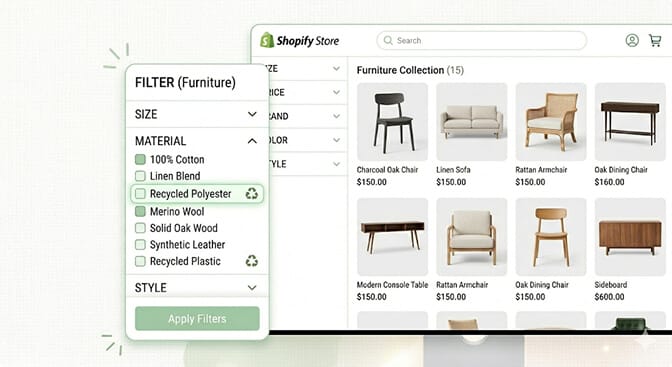
Material queries are growing fast. "Cotton only," "no synthetic materials," "sustainable fabrics," "solid wood not veneer" are all queries that AI shopping agents are regularly working with in 2026. Stores with material filters set up correctly match these queries directly. Stores without them are invisible to them.
For apparel: fabric composition as a filter, not just a product description. For furniture: material type (solid wood, engineered wood, metal frame, upholstered) as a filter, not buried in the product details tab. For home goods: care requirements, material properties, and sustainability attributes.
Natural language search tools like AI semantic search already understand material-based queries from humans. As AI agents adopt the same natural language querying patterns, the stores that have structured their material attributes correctly will win.
If you want to see how your current filter architecture handles natural language queries from both humans and agents, the Sparq features page shows exactly how smart filtering works in practice.
Evolution 4: Dynamic Filters That Reflect Real Inventory
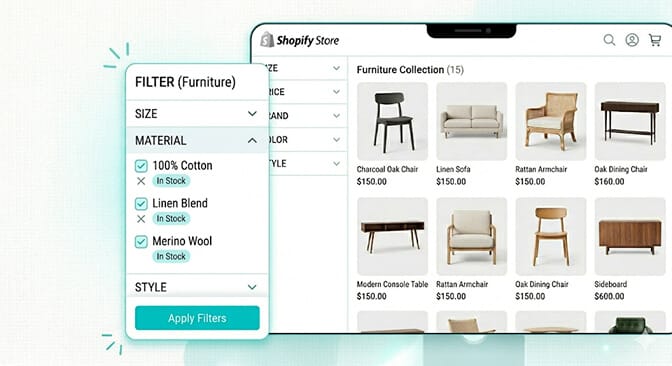
This is the one that most merchants never think about until an agent or a customer tells them something is wrong.
A filter that shows "Available in Cashmere" when your last cashmere product sold out three weeks ago is worse than no filter at all. An AI agent that matches a "cashmere sweater" query to your store, follows the filter signal, and finds nothing available learns not to recommend your store for cashmere queries.
Dynamic filters that update with your inventory signal accuracy and reliability to agents. They also improve the human experience significantly. No one wants to filter to a specific attribute and find an empty result page.
Smart filter systems that sync with your actual inventory, showing only what's genuinely available, perform better for humans and are more trustworthy signals for AI agents trying to surface in-stock products. AI merchandising is the layer that ranks the remaining in-stock products by what shoppers and agents actually want.
The Store That Gets This Right
Here's what the merchant who did this well looks like in 2026.
She runs a mid-size apparel store. Around 600 SKUs. She spent two weeks standardizing her color vocabulary across her entire catalog (48 specific color names across 8 color families), adding material composition filters for every product, and updating her size filters to include both standard size labels and actual measurements. The canadian-street-fashion customer story walks through a similar fashion-side transformation.
Her search analytics before and after tell the story clearly. Before: queries like "blue linen dress" returned partially matched results because "blue" wasn't a standardized attribute and "linen" wasn't a filterable category. After: those same queries return immediate, accurate results.
The agentic traffic piece is harder to measure directly, but she reports a meaningful improvement in conversion rate on traffic arriving from AI referral sources, which her analytics platform now tracks separately. Our piece on generative engine optimization for Shopify covers how to track that AI traffic in more depth.
The filters she built for AI agents also made her store faster and easier for human shoppers to use. The two goals aren't in conflict. Precise, standardized, inventory-accurate filters serve both audiences at once.
The Part That Costs You Money Right Now
Most merchants treat filter architecture as a one-time setup task. Build the filters. Launch the store. Revisit never.
But in 2026, your filter architecture is a living part of your catalog that needs to evolve as your inventory changes, as new product categories are added, and as the queries that AI agents and human shoppers are bringing to your store shift. The Shopify search relevance audit playbook is a good cadence to copy.
Stores that audit their filter structure quarterly, standardize new products to existing attribute conventions on intake, and use search analytics to identify the queries that aren't matching to products are the ones that stay discoverable to both humans and agents.
Stores that don't are building an invisible catalog. Good products that nobody, human or agent, can find efficiently.
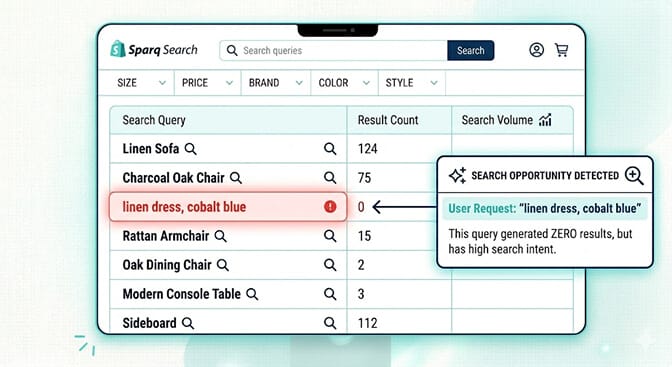
Sparq's search analytics show you exactly what queries are arriving at your store and which ones are failing to return relevant results. That data is the starting point for every filter architecture decision that actually moves conversion. Plug your numbers into our ROI calculator to size what the missed queries are costing you.
The Coming Wave: What Agentic Vision Search Looks Like at Full Scale
Stay with me here, because this is where the urgency really lands.
The agents operating in 2026 are early versions of what's coming. Camera-based visual search (point your phone at something and find where to buy it) is already mainstream. The next layer is agents that combine that visual recognition with your product catalog in real time. An agent sees a product in a social post, identifies it visually, scans catalogs that match its attributes, and surfaces purchasing options, all in seconds.
For that to work, your catalog needs to be structured in a way that the agent can match visual signals to product attributes reliably. The filters you build today are the vocabulary that makes that matching possible.
The stores that build precise, standardized, visually aligned filter architecture now will be the ones that AI agents recommend when that capability reaches full scale. The stores that don't will be invisible to a discovery channel that's becoming more important every quarter.
When you're ready to see what a smarter filter and search setup looks like for your store, install Sparq on your Shopify store and see how much your current search is missing. If you'd rather see what's possible first, the Sparq features overview, pricing, and option to book a demo walk through the full picture.
Frequently Asked Questions
What is agentic vision search and why does it matter for Shopify stores?
Agentic vision search refers to AI shopping agents that combine visual product recognition with natural language understanding to browse, compare, and recommend products on behalf of human shoppers. In 2026, these agents are actively visiting Shopify stores, reading product attributes and filter structures, and using that data to surface recommendations. Stores with precise, standardized filter architectures are readable by these agents and get recommended. Stores with vague or incomplete filters are effectively invisible to agent-driven discovery traffic.
How do AI agents "see" products differently from human shoppers?
Human shoppers respond to visual appeal, browse intuitively, and can tolerate filter inconsistencies because they're making qualitative judgments. AI agents parse structured data. They read your product titles, attributes, filter labels, and catalog organization systematically, cross-referencing visual signals from product images against your structured metadata. When visual data (what the image shows) and structured data (what your attributes say) are inconsistent, agents lose confidence in the match and are less likely to recommend those products.
Which filter changes have the highest impact on AI discoverability for Shopify stores?
The four highest-impact changes are: standardizing your color vocabulary across your entire catalog using specific, consistent color names; adding dimension and specification filters for any size-dependent category; adding material and composition filters; and implementing dynamic filters that automatically reflect current inventory states. Each of these changes serves both AI agent discoverability and human shoppers simultaneously.
Does improving filter architecture for AI agents require developer work?
It depends on your current setup. The filter architecture changes described in this article (standardizing attribute values, adding new filter categories, syncing filters with inventory) can typically be implemented through your search and filter app without coding, depending on the app you're using. Sparq handles filter creation, smart filtering, and inventory-aware display without developer involvement for most Shopify stores. The content work of standardizing your attribute data across your catalog is a merchandising task rather than a technical one.
How do I know if my current Shopify filters are failing AI agent queries?
The most direct signal is your search analytics. Look at the queries arriving at your store through search and check which ones are returning zero or low-quality results. Queries like "navy linen blazer" or "solid oak under $500" that fail to return accurate results despite having matching products usually indicate filter architecture gaps. Sparq's search analytics show you exactly which queries are underperforming so you can prioritize which filter changes to make first.