
Sustainability Filters That Sell: How to Meet 2026 Shopper Demand Without Lecturing Anyone
Eco-conscious shoppers don't want a manifesto. They want a filter that lets them find your responsibly made products in three taps.
A Shopify merchant I work with watched a customer leave her store last month in real time.
She had session replay running. The customer was 28, on mobile, browsing women's basics. Spent four minutes scrolling through 40 t-shirts. Tapped open the filter sidebar. Looked for "organic cotton." It wasn't there. Closed the filter. Scrolled for another minute. Left.
The merchant had organic cotton t-shirts. She had GOTS certification on three SKUs. She had a Fair Trade partner factory documented in her about page.
None of that information was filterable.
The customer didn't ask for a brand essay. She asked for a filter. The store didn't have one. So she went somewhere that did.
This is the part most store owners get wrong. They assume sustainability is a brand story problem. It's not. It's a filter taxonomy problem.
Stay with me here, because the conversion math on this is wild.
What Sustainability Filters Actually Are (Without the Buzzwords)
A sustainability filter is a facet on your product listing or search results page that lets shoppers narrow products by environmental, ethical, or social attributes.
Not a banner. Not a dedicated "eco collection." Not a green leaf icon next to your logo.
A filter. The same kind of filter that lets shoppers narrow by size or color, applied to attributes like material origin, certifications, manufacturing location, recyclability, or lifecycle.
The shift sounds small. It isn't. A shopper looking for organic cotton t-shirts needs to find them in three taps, not by reading three pages of brand copy. If your filter sidebar can't answer that query, the shopper assumes you don't sell what they want, even if you do.
Here's the weird part. Most Shopify stores with genuinely sustainable products have built zero filter infrastructure to make those products findable. The certifications sit in product descriptions. The materials are in unstructured tags. The shopper has to read like a forensic researcher to find what should be a checkbox.
Your sustainability story belongs in your about page. Your sustainability data belongs in your filter sidebar.
The Demand Data Most Merchants Are Underestimating
Let me put real numbers on this.
Recent industry research shows that more than 70% of Gen Z shoppers say sustainability influences their purchase decisions, and roughly 50% will pay a premium for products with verified sustainability credentials. Millennials track close behind, especially in fashion, beauty, and home goods. We covered the broader market shift in our piece on green ecommerce.
But here's the part that costs you money. Across the same surveys, only about 30% of shoppers say they trust brand sustainability claims. The other 70% want third-party certification, transparency, or filter-level proof.
Translation: telling shoppers you're sustainable doesn't move them. Letting them filter by GOTS, Fair Trade, or recycled content does.
Stores that operationalize sustainability as filters (instead of as marketing copy) typically see filtered-traffic conversion lifts in the 12 to 25% range on relevant SKUs, plus a noticeable increase in average order value because conscious shoppers tend to bundle.
You don't need to rebrand. You need to surface what's already true about your products in a way shoppers can act on.
Five Sustainability Filter Patterns That Actually Convert
Here's the practical part. Five patterns, each with its own implementation pattern. Mix and match based on your category. Don't do all five at once.
Pattern 1: Material and Composition Transparency Filters
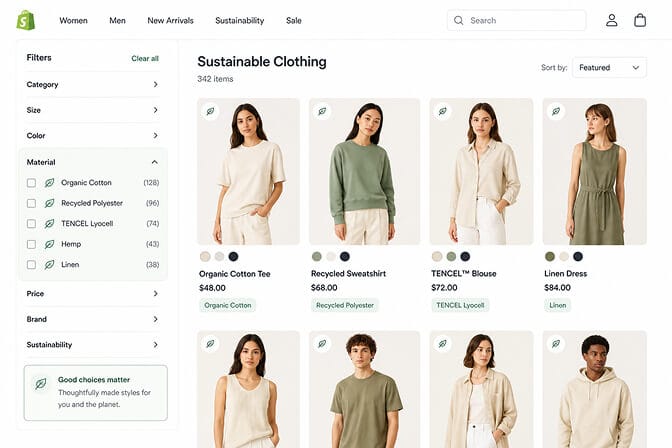
The simplest, highest-impact filter for fashion, home, and beauty stores. Shoppers want to filter by what the product is actually made of, with sustainability-relevant materials surfaced as their own values.
Materials worth surfacing: organic cotton, recycled polyester, recycled cotton, TENCEL Lyocell, hemp, linen, recycled wool, recycled nylon, plant-based leather alternatives, FSC-certified wood, recycled plastics by post-consumer percentage.
The implementation is a Shopify metafield. Each product gets a structured "material" or "primary fiber" field with consistent values. The filter pulls from that field.
The mistake most stores make is leaving material data in free-text descriptions. AI can extract it (we covered this in our piece on how search enrichment works), but for filter use, you want it structured.
Pattern 2: Certification Badge Filters (B Corp, GOTS, Fair Trade, OEKO-TEX)
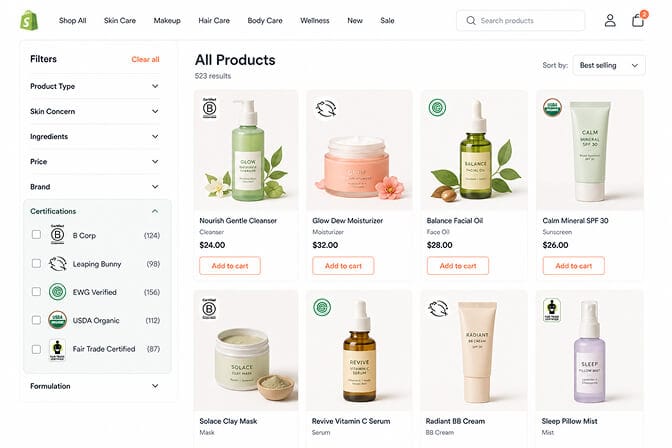
Certifications are the closest thing to objective proof in sustainability. Shoppers trust them more than brand claims because they involve external audits.
Surface them as a filter group called "Certifications" with checkboxes for the certifications relevant to your category.
Fashion and textile: GOTS, OEKO-TEX, Fair Trade Certified, B Corp, Bluesign.
Beauty: Leaping Bunny, EWG Verified, USDA Organic, COSMOS, Vegan Society.
Food and grocery: USDA Organic, Non-GMO Project, Fair Trade USA, Rainforest Alliance.
Home goods: FSC, GREENGUARD, Cradle to Cradle.
Each certification gets its own checkbox. Don't combine them into a generic "sustainable" toggle. The whole point is letting shoppers filter by which certification they trust. The same granularity principle is why our best ecommerce filter design examples avoid generic catch-all toggles.
Pattern 3: Digital Product Passports and Traceability Filters
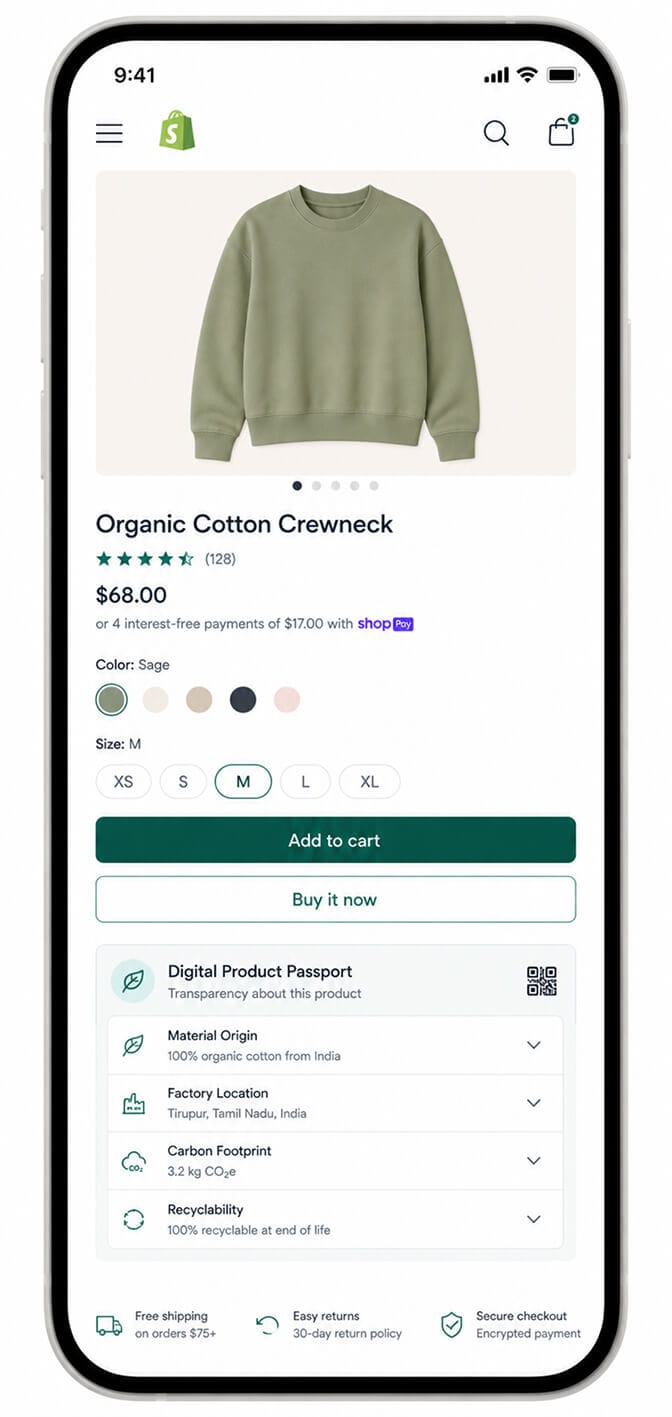
Digital Product Passports (DPPs) are about to become regulatory in the EU for textiles, electronics, and batteries, and the rest of the world will follow because consumers want them.
A DPP is a structured record of a product's origin, materials, manufacturing, and end-of-life information, often accessible via QR code or product page widget.
For Shopify stores, you don't need to wait for regulation. Add a DPP-style block on each product page that exposes:
Material origin (where the cotton was grown, where the wood was sourced).
Manufacturing location (which country, ideally which factory).
Carbon footprint (kg CO2e per unit, if measurable).
Recyclability and end-of-life options.
These attributes can also become filters: "Made in Europe," "Carbon footprint under 5kg CO2e," "Recyclable at end-of-life."
The implementation is metafields plus a search and filter app that can expose those metafields as facets. Our overview of ecommerce faceted search covers the underlying mechanics.
Pattern 4: Carbon Footprint and Impact Range Filters
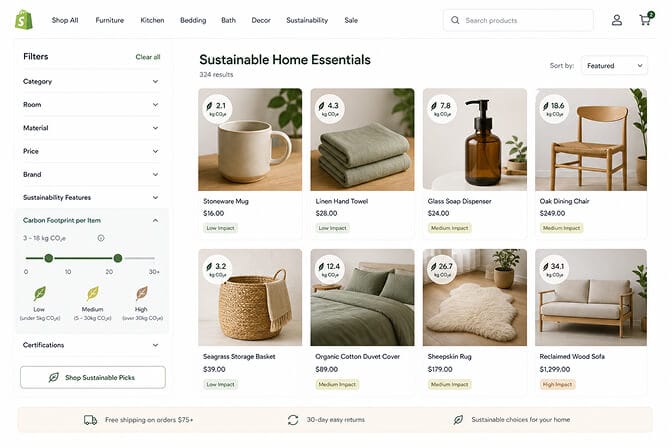
Carbon footprint filtering is newer and harder to implement, but for stores with measurable impact data, it's a powerful differentiator.
Categorize products into impact bands (low, medium, high) based on lifecycle carbon estimates. Surface the band as a filter and as a small icon on the product card.
Don't pretend to be more precise than your data. If you can only categorize broadly, do that. If you have per-product carbon data, expose it. Don't fabricate numbers.
This pattern works especially well in furniture, electronics, and apparel where supply chain impact varies meaningfully across SKUs.
Pattern 5: Lifecycle Filters (Repairability, Recyclability, Take-Back)
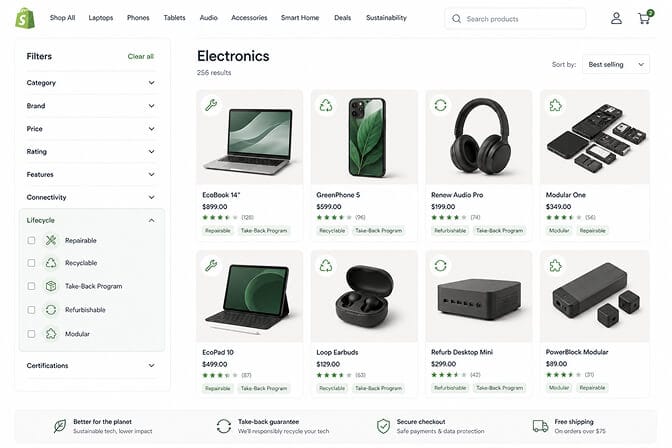
Some shoppers care less about how a product was made and more about what happens after. Lifecycle filters surface those attributes.
Useful filter values: Repairable (parts available), Recyclable (curbside or program), Take-Back Program (brand accepts returns at end-of-life), Refurbishable, Modular (components replaceable separately), Compostable.
These matter most in electronics, furniture, fashion (especially shoes and outerwear), and beauty packaging.
The implementation is straightforward: tag products with structured lifecycle attributes, expose them as filters. Some Shopify search and filter apps now support these out of the box if you populate the metafields. AI merchandising ensures those tagged products surface in the right ranking moments instead of getting buried.
If your shoppers want to filter by what's actually true about your products and your store doesn't surface it, Sparq fixes that in about 10 minutes. Free to try, no-code setup, and the analytics tell you which sustainability filters your shoppers are looking for whether you've added them yet or not.
How to Add Sustainability Filters Without Crowding Your Sidebar
Here's the part most stores get wrong on the implementation side. They go all-in on sustainability filters and bury the basics.
A shopper buying a t-shirt still wants to filter by size and color first. Sustainability is a secondary filter, not a replacement.
The implementation pattern that works: add a separate filter group titled "Materials and Certifications" or "Sustainability" below the traditional filters (size, color, price, brand). Make it collapsible. Default to collapsed for first-time visitors, default to expanded for returning visitors who've previously applied a sustainability filter.
This way, eco-conscious shoppers find what they need in three taps. Everyone else doesn't get a wall of unfamiliar filters they don't care about. Our piece on filtering UX best practices is a good audit checklist for this kind of secondary-filter placement.
Dynamic facets help here too. We covered this in our piece on dynamic facets vs static filters. Sustainability filters work best when they appear automatically for queries where they're relevant ("organic cotton tee") and stay in the background for queries where they aren't ("sale"). The same intelligence layer is what powers our AI semantic search, so the two surfaces stay in sync.
What the Conversion Data Looks Like
Stores that implement sustainability filters consistently see three patterns:
Filtered-traffic conversion rate increases 12 to 25% on relevant categories. The biggest gains come from fashion, beauty, and home goods stores with diverse catalogs.
Average order value rises 8 to 18% for shoppers who apply at least one sustainability filter. Conscious shoppers tend to buy more when they trust the store.
Bounce rate from product listing pages drops 15 to 30% when sustainability data is filterable instead of buried. The drop is steeper on mobile.
These aren't theoretical. They're outcomes from stores that switched their filter taxonomy without changing anything else about their themes or merchandising. The filters-boosting-site-speed-and-SEO customer story shows the lift in production. If you want to size what this looks like on your specific revenue, run your numbers through our ROI calculator.
The Part Shopify Doesn't Tell You
Shopify's native filtering supports basic facets (size, color, price, brand) and custom metafields, but it's not designed for sustainability taxonomy at scale. You can build it manually with metafields and theme customization, and it works.
It does not auto-generate certification filters. It does not adapt sustainability facets to query context. It does not support DPP integration out of the box. It does not give you analytics on which sustainability filters shoppers actually use.
This isn't a knock on Shopify. Sustainability filtering is a specialized problem, and the platform expects apps to close the gap. Our walkthrough of the best faceted search examples shows what stores doing this well actually look like.
If you're a small store with 50 SKUs and three certifications, you can ship the basics with metafields and a clean theme override. If you're scaling past a few hundred SKUs across multiple sustainability dimensions, you'll save weeks of work by using a search and filter app that supports custom facet configuration and behavior analytics.
A Quiet Shift That Compounds
Sustainability filters aren't a marketing campaign. They're infrastructure.
The merchants who treat them as filter taxonomy work, with proper metafields and search-side configuration, are the ones who quietly capture the eco-conscious traffic everyone else is bidding on with paid ads. The merchants who treat them as a brand essay are still wondering why their organic cotton tees aren't selling.
Want to see whether your shoppers are searching for sustainability terms and bouncing because you don't surface them? Install Sparq from the Shopify App Store and check your search analytics. Look at your zero-result queries for terms like "organic," "fair trade," "recycled," "vegan," "eco-friendly." If they're returning nothing on a store that actually carries those products, you've found the gap. If you'd rather see what's possible before installing, the Sparq features overview, pricing, and option to book a demo all walk through the full picture first.
Frequently Asked Questions
What are sustainability filters in ecommerce?
Sustainability filters are facets on a product listing or search results page that let shoppers narrow products by environmental, ethical, or social attributes (organic cotton, B Corp certified, recycled content, carbon footprint, etc.). They turn unstructured brand sustainability claims into actionable, filterable data points that shoppers can use to find responsibly made products quickly.
How do sustainability filters compare to traditional filters on Shopify?
Traditional filters narrow by size, color, price, and brand. Sustainability filters narrow by material origin, certifications, manufacturing transparency, and lifecycle attributes. The two should sit alongside each other, with traditional filters at the top of the sidebar and sustainability filters in their own collapsible section below. Stores that combine both see filtered-traffic conversion lifts of 12 to 25%.
How do I add a Digital Product Passport to my Shopify store?
Use Shopify metafields to store DPP-relevant data (material origin, factory location, carbon footprint, recyclability) per product, then surface that data on the product page through a custom block or a search-and-filter app that can render structured information. Some apps now support DPP-style displays out of the box. EU regulations are making DPPs mandatory for textiles, electronics, and batteries, so building this now puts you ahead of compliance.
Do sustainability filters actually increase Shopify conversion rates?
Yes, when implemented correctly. Stores that surface certifications, material attributes, and lifecycle data as structured filters typically see 12 to 25% higher filtered-traffic conversion and 8 to 18% higher average order value among shoppers who apply at least one sustainability filter. The biggest gains appear in fashion, beauty, and home goods.
Will adding sustainability filters slow down my Shopify store?
No. Sustainability filters are metafield-driven and add negligible weight to your pages. Modern AI-powered search and filter apps process facet generation on external infrastructure and return results in under 200 milliseconds. The performance impact is essentially zero, and the conversion gains compound month over month.