
Structured Data for AI Agents: The Schema Checklist That Makes Your Shopify Store Actually Visible in 2026
AI shopping agents are already browsing your Shopify store. Most of them leave empty-handed. Not because your products are wrong. Because your structured data doesn't speak their language. Here's the fix.
The support message came in on a Thursday.
"My products aren't showing up in ChatGPT shopping. Someone told me I need structured data. I have no idea what that means."
Honestly? Most merchants in 2026 are exactly here. They've heard that AI agents are surfacing products. They've heard their competitors are appearing in places they aren't. They're vaguely aware that "schema" is involved. But nobody has given them a plain explanation of what's actually broken and what to do about it.
So here it is.
AI shopping agents, the ones inside ChatGPT, Google AI Mode, Copilot, and Perplexity, do not browse your Shopify store the way a customer does. They don't scroll product grids. They don't read your brand story. They parse structured data. Specific, labeled, machine-readable fields that tell them exactly what you sell, at what price, in what variants, with what attributes. We covered the broader behavior pattern in our piece on agentic search for Shopify in 2026.
If those fields aren't there, your store isn't there either. Not to the agent.
And since AI-driven traffic to Shopify has grown roughly 8 times in the past year, "not there to the agent" is now a revenue problem, not a future problem.
What "Structured Data" Actually Means for a Shopify Merchant
Here's the weird part.
Most Shopify stores do have some structured data. Shopify's default themes generate basic Product schema automatically. So when merchants hear "you need structured data," their first reaction is "I thought I already had that."
You do. But "basic" is the floor, not the ceiling.
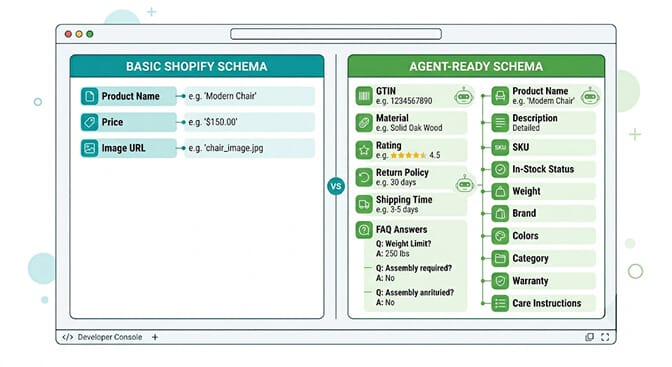
Your basic Product schema tells an agent your product name, price, and image URL. That's it. It does not tell the agent what material your product is made from. It does not tell the agent what your return policy is. It does not give the agent your verified GTIN identifier so it can cross-reference your product against other data sources. It does not tell the agent your aggregate review rating in a form it can read. It does not answer the product-specific questions a buyer might ask.
Basic schema makes you technically present. Complete schema makes you recommended.
The gap between those two things is the structured data problem every Shopify merchant needs to close right now. The same gap shows up in our pieces on generative engine optimization for Shopify and agentic vision search, where structured product data is the deciding factor in whether an AI engine cites you or skips you.
Why This Connects Directly to Your Filter Architecture
Stay with me here, because this is the link most guides miss entirely.
Your filter sidebar and your structured data are not separate systems. They're two outputs from the same source: your product attribute architecture.
When a merchant builds good filters, they're defining the attributes that matter for their catalog. Color, material, size, fit, care instructions. These attributes power the filter sidebar that human shoppers use. Those same attributes, when structured as metafields and schema markup, power the queries that AI agents process.
A store with precise filter attributes has precise structured data almost by accident. A store with vague or inconsistent filter labels has vague structured data that agents can't confidently act on. Our piece on dynamic facets vs static filters covers the filter side of this; search enrichment covers the underlying catalog work.
The merchant who fixes their structured data for AI agents also fixes their filter sidebar for human shoppers. One architecture improvement. Two audiences served.
This is why the structured data conversation isn't separate from the search and filter conversation. They're the same conversation.
The 5 Schema Types You're Probably Missing
Let's get specific. These are the five structured data elements that appear most often in AI inclusion audits as missing or incomplete on Shopify stores.
Schema Gap 1: GTIN Identifiers
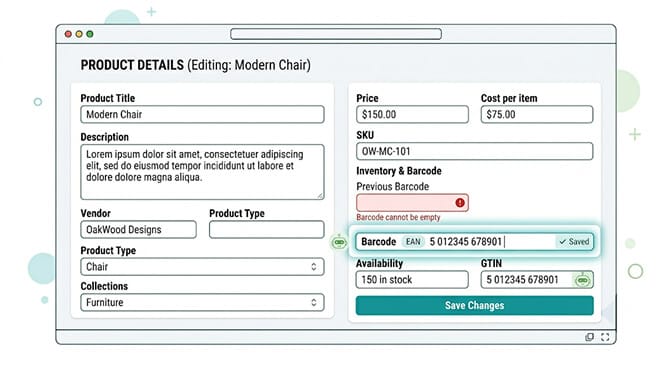
A GTIN (Global Trade Item Number) is the universal identifier that tells an AI agent this product is a specific, verifiable thing in the world. It's the EAN or UPC barcode on your product.
Without a GTIN, an agent can't confidently cross-reference your product against review databases, pricing comparisons, or catalog verifications. It has to trust your own data in isolation, which is a much weaker signal than verifiable data.
The fix: In your Shopify admin, every product has a Barcode field under the Shipping section. If your products have manufacturer-assigned GTINs (check your packaging or supplier data), fill them in. If you're a private label brand without GTINs, consider registering through GS1. Start with your top 50 products by traffic and revenue.
Schema Gap 2: AggregateRating Schema
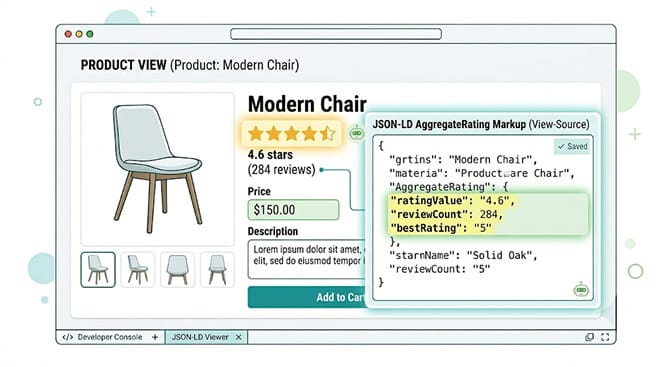
Your reviews are almost certainly rendered by a JavaScript app. That means an agent crawling your page sees no review data at all. The JavaScript hasn't loaded. The rating doesn't exist to the agent.
An agent recommending a product for a query like "best reviewed yoga mat under $60" is working from machine-readable rating data. If your rating is only visible after JavaScript execution, you're invisible to that recommendation.
The fix: Add AggregateRating schema in JSON-LD format to your product pages. The three fields you need are ratingValue, reviewCount, and bestRating. Several Shopify structured data apps handle this without theme editing. This is one of the highest-leverage schema additions available because rating data is a primary trust signal in agent recommendation logic.
Schema Gap 3: Return Policy and Shipping Schema
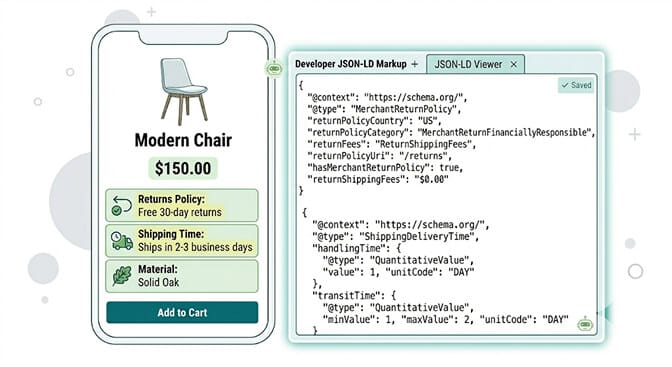
Buyers using AI agents to shop are often asking policy-specific questions. "Find me a sofa I can return if it doesn't fit the space." "What's available that ships before Saturday?" These queries require structured policy data that the agent can confidently match against.
Your return policy is probably in your footer. Your shipping timeframe is probably in your product description. Neither of those is readable by an agent processing structured queries at scale.
The fix: Add MerchantReturnPolicy schema at the store level and ShippingDeliveryTime schema at the product level. These are standard schema.org types that let agents read your policies as structured fields. Your return window, whether returns are free, and your standard shipping timeframe become queryable attributes rather than prose the agent has to interpret.
Schema Gap 4: Variant-Level Data Completeness
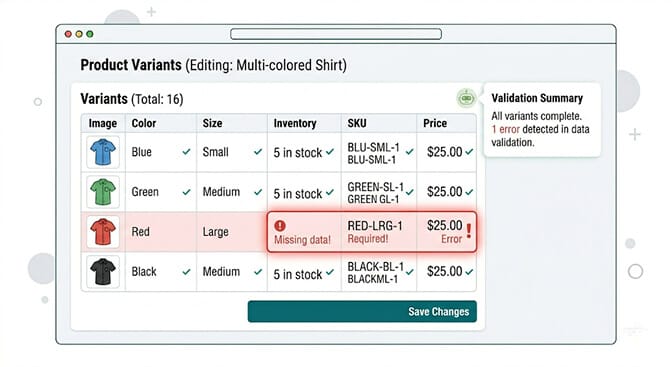
This is the schema gap that costs the most money and gets the least attention.
AI agents use your variant options as filtering attributes. Size, color, material. When an agent processes "a size large navy blazer in stock," it's querying variant-level data. If your navy colorway is labeled "Ink" in one product and "Dark Blue" in another, those don't map to the same query. If your large size variant shows no inventory data, the agent can't confirm it's available. The same issue plays out in the best ecommerce filter design examples, which all share consistent variant vocabularies.
And here's the specific failure that's probably happening in your store right now: if you use a sale pricing app that renders discounted prices via JavaScript client-side, the agent sees your full price, not your sale price. The buyer sees a recommendation with the wrong price. Trust broken before the visit begins.
The fix: Audit your top 20 products for variant-level completeness. Every variant needs: a standardized, consistent option name that matches your filter vocabulary, current inventory quantity at the variant level, a SKU or variant identifier, and pricing that is server-rendered rather than JavaScript-injected. Move critical variant attributes to Shopify metafields using standard namespaces so they're accessible to the Storefront API, and therefore to agents querying your catalog.
Schema Gap 5: FAQ Schema on Product Pages
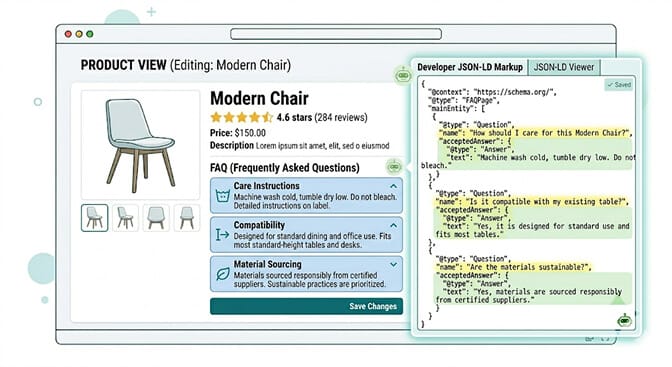
This is the opportunity that almost no Shopify merchant is using. And it's one of the most effective things you can do for AI agent discoverability.
An agent processing a buyer's query doesn't just match product attributes. It answers questions on the buyer's behalf. "Is this machine washable?" "Is this compatible with X?" "Is this suitable for vegans?" When the agent has structured FAQ answers to pull from, it can respond confidently and attribute its answer to your product. When it doesn't, it either skips your product or guesses.
Guessing is bad. Guessing wrong is very bad.
The fix: Add FAQPage schema in JSON-LD format to your product pages. Start with the five questions your customer service team answers most often. Care instructions. Compatibility. Material or ingredient sourcing. Sizing accuracy. Assembly or setup requirements. Each Q&A pair becomes a structured field the agent can use to answer buyer questions accurately and attribute the answer to your product.
If you want to see which search queries your customers are already asking that your current product data can't answer, explore Sparq's search analytics features. The queries that return zero results are usually the clearest signal of where your structured data gaps are. Or just install Sparq directly — no-code setup, free to try.
The Metafield Architecture That Ties It All Together
Beyond the five schema types above, there's an underlying architecture question that determines whether your structured data is a one-time fix or a sustainable advantage.
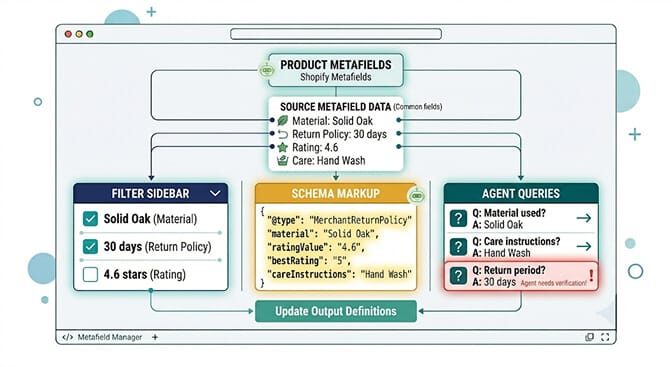
Your product metafields are the source of truth for everything. Schema markup, filter attributes, variant data, and agent-queryable attributes all derive from what you've defined in your metafields.
A store with a thoughtful metafield architecture, one that uses consistent namespaces, standardized value vocabularies, and complete population across the catalog, maintains structured data quality as the catalog grows. A store that puts everything in the product description and relies on text parsing for everything else is building structured data debt with every new product.
The practical starting point: identify the ten attributes that matter most for your specific catalog. For fashion: color family, material, care method, fit type, occasion. For furniture: material, dimensions, weight capacity, assembly required, room type. For electronics: compatibility, connectivity standard, battery life, dimensions. The principles overlap heavily with the sustainability filter taxonomy work — both are exercises in disciplined attribute design.
Define those as metafields. Standardize the value vocabulary for each. Populate them for every product. That attribute architecture becomes your filter sidebar, your schema markup, and your agent-readable catalog simultaneously.
What a Complete Structured Data Stack Looks Like
Let's put this together as a concrete picture.
A buyer asks an AI shopping agent: "Find me a small batch organic coffee under $25 that ships by Friday and has good reviews."
A Shopify store with complete structured data surfaces in this recommendation because it has:
GTIN populated for every SKU so the agent can verify product identity. AggregateRating schema with a 4.7 rating from 220 reviews as a machine-readable field. Material metafield labeled "origin: single-origin, Honduras" and a "certification: USDA Organic" metafield in standard namespace format. ShippingDeliveryTime schema confirming 2-business-day standard shipping. Pricing as a server-rendered Storefront API value, not a JavaScript-injected sale price. FAQ schema with a pre-answered "Is this organic?" question confirming the certification.
A store missing any of these either doesn't surface at all, or surfaces with incomplete information that leads to a wrong recommendation the buyer notices when they arrive on the product page.
The complete structured data stack isn't about doing ten extra things. It's about making one decision: will your catalog be machine-readable or just human-readable? In 2026, it needs to be both. The same principle drives multimodal search readiness and AI semantic ranking.
The Action Plan: A 30-Day Structured Data Sprint
You don't need to fix everything at once. Here's the sequence that produces the fastest visible impact.
Week 1: The quick wins. Fill in GTINs for your top 50 products. Add AggregateRating schema using a structured data app. Both of these are achievable without developer involvement and produce immediate improvements in AI discoverability.
Week 2: Policy schema. Add MerchantReturnPolicy and ShippingDeliveryTime schema. Check that your sale pricing is server-rendered rather than JavaScript-injected.
Week 3: Variant audit. Review your top 20 products for variant-level data completeness. Standardize your color and size naming conventions across the catalog. This directly improves both your filter sidebar accuracy and your agent-queryable attribute data. If you're running an audit on Shopify search relevance at the same time, the work compounds.
Week 4: FAQ schema. Add FAQPage schema to your top 20 product pages. Pull questions from your actual customer service inbox. Real questions, real answers, structured and machine-readable.
Ongoing: Define your metafield architecture if you haven't already. Apply it to new products on intake. Review structured data quarterly as your catalog evolves. Pair it with AI semantic search and AI merchandising and your store reads correctly to both humans and agents.
The merchant who sent that Thursday support message? Three weeks after implementing this sequence, AI-attributed traffic showed up in their analytics for the first time. Not a huge number yet. But it was there. And it was converting at roughly double the rate of their organic search traffic, because AI-referred buyers are pre-qualified by the model before they arrive. The same conversion pattern shows up in our predictive search customer story.
The stores winning AI discovery in 2026 aren't the ones with the most products. They're the ones whose products the agent can actually understand, compare, and recommend with confidence.
That's entirely within your control. And it starts with a metafield definition and a GTIN field.
Ready to see what queries your customers are already bringing to your store that you're not capturing? Install Sparq from the Shopify App Store and check your search analytics first. The gaps are usually more obvious than you think. If you'd rather see what's possible before installing, the Sparq features overview, pricing, ROI calculator, and option to book a demo walk through the full picture first.
Frequently Asked Questions
What is structured data for AI agents in Shopify stores?
Structured data for AI agents is product information organized in standardized, machine-readable fields rather than written in prose descriptions or rendered by JavaScript. AI shopping agents such as those inside ChatGPT, Google AI Mode, and Copilot parse structured fields including schema markup and metafields to determine what a store sells, whether products match a buyer's query, and whether to recommend them. Shopify's default themes generate basic Product schema automatically, but the fields most critical for AI agent recommendation logic (GTIN identifiers, aggregate ratings, return policies, shipping times, and FAQ answers) are missing by default.
How does structured data affect Shopify filter performance and AI discoverability at the same time?
Your filter sidebar and your agent-readable structured data share the same source: your product attribute architecture. When you define precise color, material, size, and care metafields for your catalog, those attributes power your human-facing filter sidebar and become queryable structured data for AI agents simultaneously. Improving your metafield architecture and standardizing your attribute vocabulary is a single change that improves both filter accuracy for human shoppers and agent discoverability in AI shopping flows.
How do I add structured data to my Shopify store without a developer?
Several approaches work without coding. GTINs can be added through the standard Shopify product admin Barcode field. AggregateRating schema can be added using structured data apps available in the Shopify App Store. MerchantReturnPolicy and ShippingDeliveryTime schema can be added using the same apps or through theme settings in some Shopify themes. Metafields can be created and populated through the Shopify admin without any code. The FAQ schema addition typically requires a structured data app or minimal theme editing, but is achievable without a developer for most standard Shopify themes.
Does improving structured data for AI agents slow down my Shopify store?
No. JSON-LD structured data is added as a script block in the page head or footer and has no impact on visual rendering or page load performance. It doesn't make additional HTTP requests and doesn't affect the critical rendering path. Metafield data loads as part of standard product data requests, not as additional calls. Structured data improvements are one of the few store optimizations that carry essentially zero performance cost while improving discoverability across multiple channels simultaneously.
Is structured data worth adding if my store is small or has fewer than 500 products?
Yes, even for smaller catalogs. The structured data gaps described in this article (missing GTINs, no AggregateRating schema, invisible review data, missing policy schema) apply regardless of catalog size. A 50-product store with complete structured data will consistently outperform a 500-product store with incomplete structured data in AI agent recommendations for overlapping queries. AI inclusion isn't a scale game. It's a data quality game. Smaller stores that invest in structured data quality early build a durable discovery advantage that compounds as AI shopping channels grow.