
Your Shopify Filters Are Speaking the Wrong Language: How Emotion and Occasion Discovery Converts the Customers You're Losing
"Blue" is not why someone buys a dress. "Something I can wear to my sister's bachelorette weekend" is. Here's why shopping intent lives in moments, not attributes, and how to build the filter system that captures it.
Three separate customers left the same review in the same week.
Different stores. Different categories. Almost identical words.
"Couldn't find what I was looking for. Your site has a lot of stuff but I couldn't figure out how to narrow it down to what I actually needed."
All three stores had working filter sidebars. Color. Size. Price range. Material. All technically complete.
But none of the stores had filters that answered the actual question each of those customers had when they arrived.
One was looking for "something comfortable enough for a long flight but still cute when I land." One wanted "gifts I can give without knowing her exact taste." One needed "pieces that work for a beach vacation but aren't beachy."
These are shopping missions. And the gap between the shopping mission the customer arrives with and the filter system that greets them is where the sale evaporates.
The Problem With Thinking in Attributes
Let's get specific about what's actually happening when a customer bounces.
Most Shopify filter systems are built to answer a very specific type of question: "Show me all products that match these specifications." Color: Navy. Size: Medium. Price: under $80. That's useful when a customer knows her specifications. And for a meaningful slice of your traffic, she does.
But for a larger slice, she doesn't. She knows her situation. She knows what she's shopping for in a human sense. She doesn't know the product specs.
The customer shopping for "a comfortable but stylish airport outfit" doesn't know yet whether she wants navy or rust or olive. She doesn't know whether she wants wide-leg trousers or a midi skirt or a jumpsuit. She knows she needs to walk a lot, sit for six hours, look put-together when she lands, and not need to change before dinner.
Your attribute filters force her to answer attribute questions she hasn't thought about yet. She either picks answers at random (and often picks wrong, and abandons), or she gives up and leaves because the filter sidebar doesn't feel relevant to the decision she's actually trying to make.
Every customer who arrives with occasion-based intent and encounters only attribute-based filters is being asked to translate their human thought into product specification before they're ready. Most of them don't bother. They leave instead.
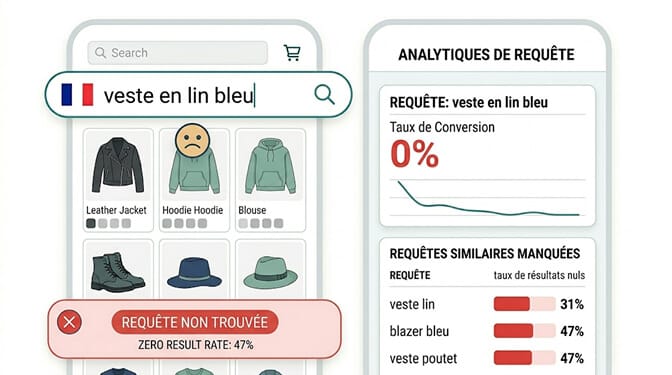
This translation burden is the conversion cost. And it's invisible in your analytics because you see "bounced from collection page" rather than "couldn't express their shopping intent."
Why This Problem Is Getting Worse, Not Better
Here's the part that should sharpen your attention.
Customer search behavior has changed significantly over the past three years. Voice assistants, conversational AI, and natural language interfaces have retrained how people express what they want. People type the way they talk now. They type shopping missions, feelings, and contexts rather than product specifications.
Search queries are getting longer and more conversational. "Gifts for dad who likes golf under $50." "Dress that looks expensive but is comfortable." "Furniture for a small apartment that doesn't feel cheap." These are how customers actually search.
A filter system built for "Color + Size + Price" was designed for a customer who shops like a search engine. But your customers don't shop like search engines. They shop like humans with a specific problem to solve on a specific occasion.
The stores that are winning the discovery layer in 2026 are the ones who have built filter systems that meet customers in their human language, not in product specification language. The same shift is reshaping how agentic AI search interprets Shopify queries, and the filter layer needs to keep up.
The Five Occasion and Emotion Filter Patterns That Close the Gap
Each of these patterns is implementable in your current Shopify setup with metafield tagging and a capable filter app. Each one directly captures a shopping intent that attribute filters miss entirely.
Pattern 1: Shopping Mission Filters
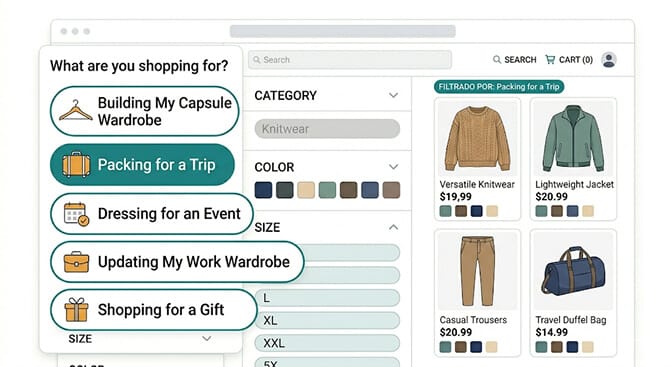
This is the highest-level occasion filter. It sits above all other filter options and routes customers to the relevant product subset based on their shopping mission before they've made any attribute decisions at all.
"Building My Capsule Wardrobe" surfaces versatile, mix-and-match basics. "Packing for a Trip" surfaces packable, wrinkle-resistant, multi-functional pieces. "Dressing for an Event" surfaces formal and elevated options. "Updating My Work Wardrobe" surfaces professional, structured pieces. "Shopping for a Gift" activates the gift-intent filter pathway.
The mechanics: each mission option maps to a set of product tags maintained by your merchandising team. A linen wrap dress might appear in both "Packing for a Trip" and "Dressing for an Event" depending on your tagging judgment. A blazer appears in "Work Wardrobe" and "Building Capsule" but not "Beach Day."
The vocabulary for your mission labels should come directly from your search analytics. Pull your most common search queries that currently return no results or poor results. The missions customers are describing in those queries are the labels you need.
Pattern 2: Vibe and Aesthetic Chips on Mobile
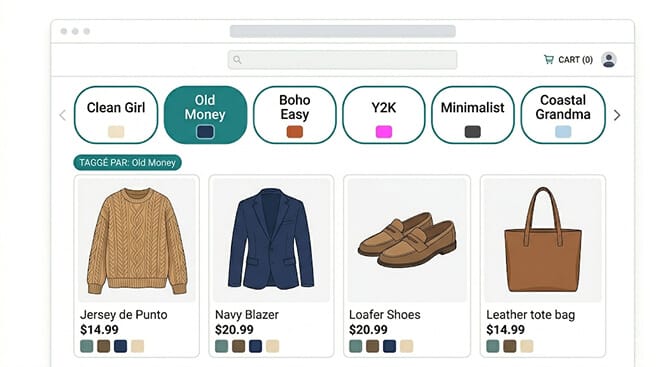
Fashion customers often know their aesthetic before they know their attribute preferences. The customer who knows she's a "Clean Girl" aesthetic shopper knows more about what she'll buy than if you ask her "what color are you looking for?"
Aesthetic or vibe filters translate culture-native style vocabulary into product-level tagging that connects to your catalog. "Old Money" maps to structured, heritage-influenced, understated luxury pieces in neutral tones. "Coastal Grandma" maps to linen, neutrals, loose silhouettes, comfortable footwear. "Boho Easy" maps to earthy tones, flowy fabrics, layerable pieces.
The important implementation decision: use the language your actual customers use, not the language your internal team uses to describe products. If your customers say "clean girl" in support emails and social comments and search queries, use "clean girl" as the filter label, not "minimalist chic" or "elevated casual."
Your customer-facing language and your internal product language are often different. The filter should speak in customer language. The same principle drives the best ecommerce filter design examples we've reviewed across high-converting stores.
Pattern 3: Occasion Calendar Filters
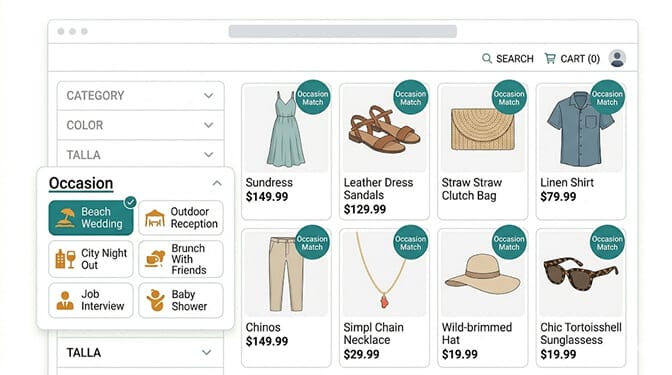
This pattern gets more specific than broad mission categories. It surfaces filters for specific, recognizable life events that your customers are dressing for.
"Beach Wedding." "Outdoor Reception." "City Night Out." "Brunch With Friends." "Baby Shower." "Job Interview." "First Date." These are events with specific dress requirements that a customer knows she's attending before she knows which product she wants.
The conversion mechanism: instead of a customer navigating through attribute filters trying to build toward the right result for a beach wedding, she selects "Beach Wedding" and the catalog narrows to everything you've determined is appropriate for that occasion. She then uses attribute filters within that result set to narrow further.
The click-to-product journey collapses from fifteen steps to three. The conversion follows.
The calendar filter vocabulary requires your merchandising judgment on which products fit which events. This is an editorial decision, not an automated one. Your team knows which pieces are appropriate for a beach wedding versus a black-tie event versus a casual brunch. The filter tags capture that expertise and make it navigable.
Pattern 4: Emotional State and Energy Filters
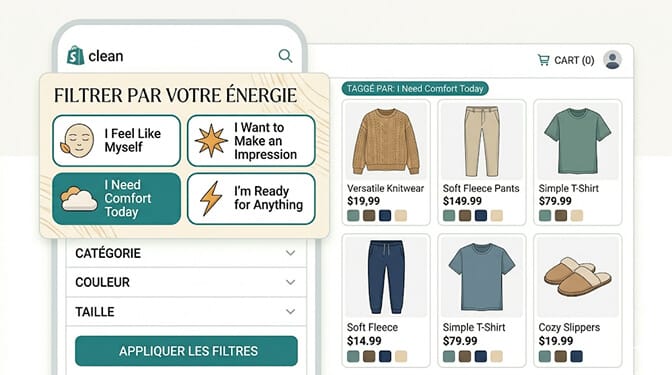
This is the most unconventional pattern and the one that creates the strongest emotional connection with customers who find it.
Some customers shop from a place of specific emotional need. The customer having a hard week who needs something that makes her feel like herself again. The customer preparing for a big presentation who needs something that says "I have my act together." The customer who just wants to be comfortable without thinking about it too hard.
These emotional states map to product qualities. "I Feel Like Myself" maps to pieces in her established personal palette, classic silhouettes she's comfortable in, nothing experimental. "I Want to Make an Impression" maps to elevated, statement pieces, rich colors, polished details. "I Need Comfort Today" maps to soft fabrics, relaxed fits, easy styling. "I'm Ready for Anything" maps to versatile, confidence-building, appropriate across multiple contexts.
Not every store should build emotional state filters. They work best for stores with strong brand identities and loyal returning customer bases who have emotional relationships with the brand. For those stores, they can produce extraordinarily high conversion rates because the customer feels deeply understood in a way no other store achieves. Combined with zero-party preference data, the same emotional signals can persist across visits.
If you want to see what language your specific customers are using when they search, and which of these occasion and emotion patterns matches their actual queries, check your search analytics in Sparq. The emotional and occasion-based queries in your zero-result list tell you exactly which filter vocabulary your customers are bringing to your store.
Pattern 5: Context-Specific Filter Bundles
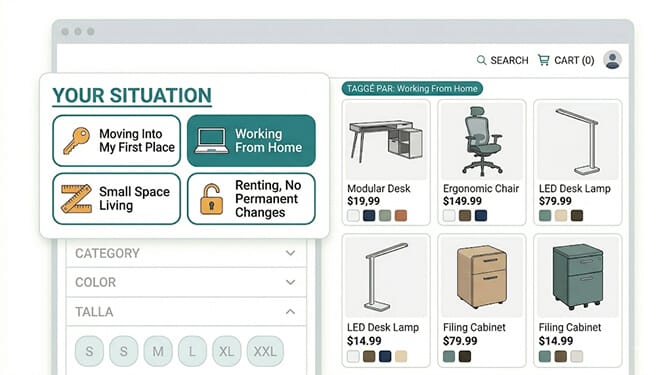
This pattern applies beyond fashion to any product category where the customer's life situation determines which products are actually appropriate.
Home goods customers don't always know what they want. They know their situation. "I'm moving into my first apartment and need to figure out what I need." "I'm setting up a home office but only have a small corner." "I'm renting so I can't drill holes or make permanent changes."
Each of these situations produces a specific subset of your catalog that's actually relevant to that customer. The "first apartment" context surfaces the basics needed to make a space functional and livable without overbuying. The "home office, small corner" context surfaces compact, desk-appropriate furniture and accessories. The "renter-friendly" context filters by products that don't require permanent installation.
Context filters transform an overwhelming catalog into a curated, relevant selection. They work particularly well for stores with wide catalogs where the challenge isn't finding products but finding the right products for a specific situation.
What the Data Actually Says
A fashion store implemented four of these patterns, shopping missions, aesthetic chips, occasion calendar, and context situations over six weeks.
The results at the 90-day mark: occasion-based filter users converted at 2.8 times the rate of attribute-only filter users. Session duration for occasion filter users was 47% shorter, which sounds counterintuitive until you understand what it means: they found what they came for faster.
Average order value from occasion filter sessions was 22% higher than from attribute filter sessions. The theory: when a customer is shopping for a specific occasion, she's already emotionally committed to making a purchase. She's not browsing. She's equipping.
The pattern that produced the highest single conversion lift: the gift-intent filter. Customers who indicated they were shopping for someone else and used the recipient and occasion occasion filters converted at 3.6 times the rate of gift shoppers who navigated without occasion filters.
Gift shoppers are mission-driven. They have a deadline, a recipient, and a purpose. They want to find the right thing quickly and complete the purchase. Every attribute filter they have to manually apply is friction that erodes the buying momentum.
The occasion filter removes that friction and routes them directly to the relevant products. The purchase follows almost immediately. Pair this with generative results pages and the relevance compounds further.
The Tagging Work Behind the Magic
Here's the thing nobody in the filter strategy conversation wants to tell you but that you need to hear.
These filters require product tagging that you maintain. The AI doesn't auto-generate occasion and emotion tags based on product descriptions. You do.
But it's not as overwhelming as it sounds. Here's the path that works:
Pull your top 50 products by revenue. Tag each one for the relevant occasion, mission, aesthetic, and context categories that apply. This is an afternoon of work. Launch your occasion filters with coverage on those 50 products.
Watch which occasion filter categories get the most engagement. Those are the ones your customers care about most. Focus your subsequent tagging on expanding coverage in those categories.
Tag new products at intake as a standard step in your product creation workflow. After three months, your top 200 products are tagged. The filters feel comprehensive and useful. The conversion data compounds.
The tagging work is the investment. The conversion lift is the return. And unlike ad spend, it doesn't stop working when you stop paying.
The Takeaway
The three review messages that opened this piece were saying the same thing in three different ways.
"I couldn't find what I was looking for."
Not because it wasn't there. Because the filter system required them to translate their human shopping intent into product specification language, and they weren't willing or able to make that translation.
The customer who wanted a comfortable airport outfit had to decide between navy and rust before she'd decided on the silhouette. The gift shopper had to pick a price range before she knew whether the recipient was a silver jewelry person or a colorful accessories person. The beach vacation shopper had to filter by material before she knew what silhouette felt right for a beach trip.
Attribute filters ask customers to make decisions in the wrong order.
Occasion and emotion filters ask: "What's the situation you're shopping for?" They let customers answer in their own language, at the top of the discovery flow, before attribute decisions become necessary. The result is a shorter path to purchase, higher confidence in the purchase, and a better overall experience.
Your catalog probably has everything these customers need. The occasion filter is just the language that helps them find it.
Ready to discover which occasions and emotions your customers are already searching for? Install Sparq on your Shopify store and check your search queries. The ones that currently return nothing are the filter categories you should build first. If you'd rather see the bigger picture first, the Sparq features overview, pricing, and option to book a demo walk through everything before you install.
Frequently Asked Questions
What are emotion and occasion-based filters for Shopify stores?
Emotion and occasion-based filters let customers narrow product results using the language of their shopping context rather than product specifications. Instead of filtering by Color and Size, customers filter by occasion ("Beach Wedding," "Work Getaway"), shopping mission ("Building My Capsule Wardrobe"), aesthetic ("Old Money," "Clean Girl"), or life context ("Small Space Living," "Renting No Permanent Changes"). They serve customers who arrive knowing their situation but not yet knowing their attribute preferences, which represents a significant portion of browsing traffic that attribute filters fail to convert.
How do occasion filters improve conversion rates compared to standard Shopify filters?
Occasion filters convert at higher rates than attribute filters for browsing customers because they match the actual intent the customer arrived with. When a customer shopping for a bachelorette weekend outfit can select "Bachelorette Weekend" and see only relevant products, she reaches her decision faster and with more confidence than a customer who has to manually apply four attribute filters to approximate the same result set. The shorter path to the right product reduces decision fatigue and abandonment. Data from stores that have implemented occasion filters consistently shows 2 to 3 times higher conversion rates from occasion filter users versus attribute-only filter users.
How do I know which occasion and emotion filter categories to build for my specific store?
Your search analytics are the most direct answer. Pull your zero-result queries and your low-conversion search queries. The emotional, occasion-based, and context-driven queries in that list, things like "something for a work trip," "gifts for her but not generic," "comfortable but not sloppy," are the filter categories your customers are trying to express. Build the ones with the highest query volume first. After you've built the initial categories, watch which ones get the most engagement and expand coverage in those before building new ones.
Does adding occasion and emotion filters require rebuilding my Shopify theme?
No. Occasion and emotion filters are implemented through product metafields and your filter app configuration, not through theme changes. You create custom metafields for "Occasion," "Aesthetic," "Shopping Mission," or whatever categories you're building. Your team tags products with the relevant values. Your filter app surfaces those metafields as filterable options in your existing filter sidebar. The visual presentation can be customized through your filter app settings. No theme development is required for the core implementation.
Should occasion-based filters replace or supplement my existing attribute filters?
Supplement, not replace. The most effective filter architecture layers occasion and context filters at the top of the discovery flow for customers who think in situations and missions, with attribute filters remaining available for further refinement within the narrowed occasion-based result set. A customer who selects "Beach Wedding" from the occasion filter then uses the price filter to narrow within that result set. Both layers are necessary. The occasion filter narrows to relevant products. The attribute filter provides precision within the relevant set. Only the occasion layer is currently missing from most Shopify stores.