
Digital Product Passports in Your Shopify Filters: The Transparency Features That Turn Eco-Conscious Browsers into Buyers
Sustainability claims without proof are becoming the fastest way to lose a modern shopper. Here's how to build the filter and data architecture that converts the 70% of customers who make decisions based on verified transparency.
The support message arrived on a Wednesday.
"I've been looking at your linen collection for twenty minutes. I can see the products. I can see the prices. I can see the colors. What I can't see is where any of it comes from. Your website says 'sustainably sourced' but I have no idea what that means. I ended up buying from someone else because they could show me the factory."
The merchant was devastated. She'd spent six months working with suppliers to ensure ethical sourcing. She'd invested in organic certifications. She genuinely had the product story. She just hadn't built the architecture to tell it, specifically in the filter and discovery layer where buying decisions actually happen.
That customer didn't leave because the products weren't good. She left because she couldn't verify that they were.
In 2026, that gap between claiming sustainability and proving it is the most expensive mistake a Shopify merchant can make in a category where eco-conscious shoppers are the primary market. We covered the broader market shift in our piece on sustainability filters for Shopify and green ecommerce.
What's Actually Happening in 2026
Let's be specific about the regulatory and consumer landscape, because it's moving faster than most merchants realize.
The EU's Ecodesign for Sustainable Products Regulation is rolling out Digital Product Passports (DPPs) starting with textiles in 2026 to 2027, with full implementation by 2030. A DPP is exactly what it sounds like: a structured digital record attached to every product that contains verifiable information about its origin, material composition, environmental footprint, and end-of-life options.
For EU-based merchants and any Shopify store selling into Europe, this is a regulatory requirement. For merchants selling outside Europe, it's a competitive pressure point arriving from consumer expectations rather than law.
Over 70% of consumers are more likely to trust and buy from brands that share verifiable sustainability and traceability data. Not sustainability claims. Verifiable data. That distinction is the entire ballgame in 2026.
"Sustainably sourced" used to be enough. Now it's a red flag unless you can back it up. Modern eco-conscious shoppers have seen too much greenwashing. The vague claim now triggers skepticism rather than trust.
The merchants winning this customer segment aren't the ones with the strongest sustainability story. They're the ones whose filter and product architecture makes that story immediately verifiable at every point in the discovery journey. The canadian-street-fashion customer story is a good look at what that disciplined attribute work looks like in production.
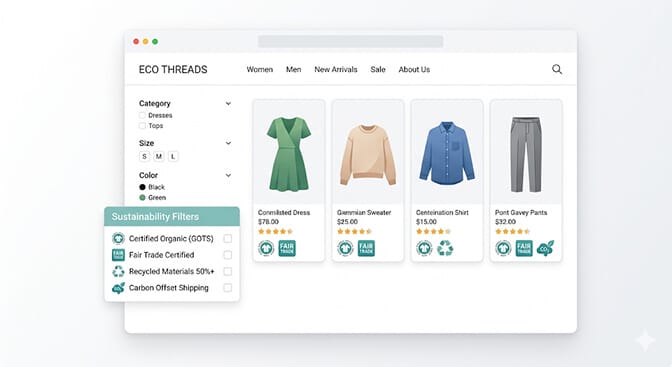
The Five DPP-Inspired Filter and Data Patterns That Convert
Here's the practical architecture. These aren't theoretical future features. They're specific filter and product data patterns that directly improve conversion with eco-conscious shoppers right now, using the data infrastructure you need to build anyway for DPP compliance.
Pattern 1: Material Composition Filters With Percentage Specificity
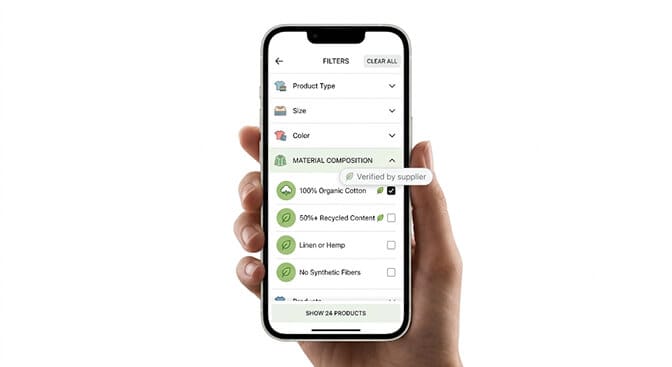
"Organic" and "sustainable" as filter options are nearly worthless in 2026 because everyone uses them and nobody defines them. The filter that converts eco-conscious shoppers is one that shows specific, verifiable material composition.
"100% Organic Cotton" is a filter. "Organic" is a marketing claim. The difference is whether the customer can verify the claim against a recognizable standard and whether the filter shows exactly what percentage of the product meets that standard. Our piece on dynamic facets vs static filters covers why precision filters convert better than generic ones across categories.
The implementation requires one thing above all else: your product metafields need to contain exact material composition data at the percentage level. Not "made with organic cotton." Not "organic cotton blend." "73% GOTS-certified organic cotton, 24% recycled polyester, 3% elastane." That's the data that powers a meaningful composition filter.
When customers can filter by "50%+ recycled content" and know that every product in the results actually meets that standard, they convert. When "sustainable" covers everything from a product with 5% recycled thread to one made entirely from deadstock fabric, the filter is noise, not signal.
Pattern 2: Certification Filters Linked to Verification
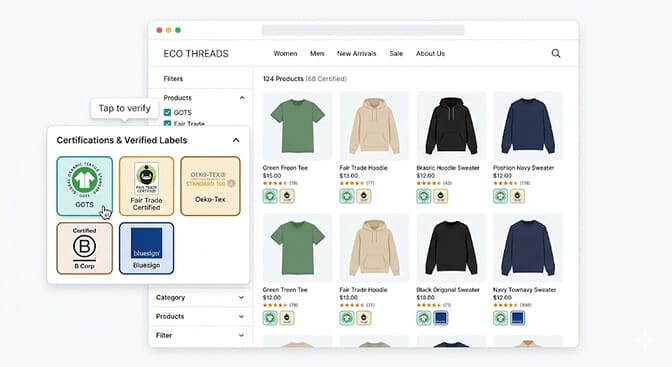
Certification filters are more powerful than material filters for one reason: they involve a third party. A claim that your product is GOTS-certified is verifiable by a customer through the certification body's own database. A claim that your cotton is "sustainably grown" is verifiable by nobody.
The filter architecture here matters as much as the data. Certification filter options should be linked to the certification body's verification page, so a customer who wants to verify a "Fair Trade Certified" filter result can do so with one tap. This turns the filter from a browsing mechanism into a trust-building experience. The same granularity principle appears in our best ecommerce filter design examples.
The practical implementation: add certification metafields to your products with the certification name, the certification body, the certification number or ID, and ideally a verification URL. Your filter app surfaces the certification as a filter option. The product page or filter result shows the badge with a tap-to-verify link.
This is exactly the architecture that DPP requirements are moving toward. Building it now serves your eco-conscious customers immediately and positions you ahead of compliance requirements simultaneously.
Pattern 3: Origin and Traceability Filters
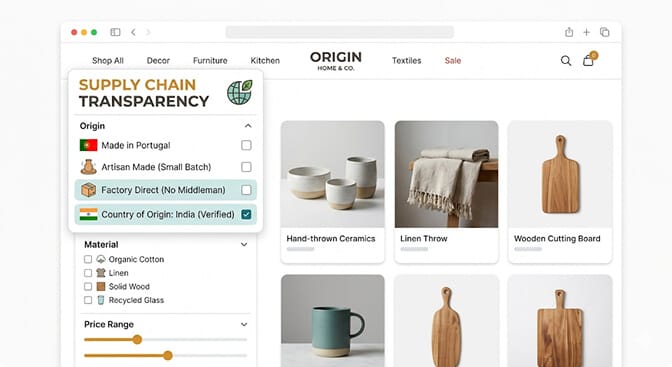
Where something is made matters to a growing percentage of customers, and not just in the obvious ways.
"Made in Portugal" signals quality and craft to some shoppers. "Artisan made, small batch" signals ethical labor practices and product quality. "Factory direct, no middleman" signals price integrity. "Verified supply chain" signals that the brand can actually account for where the product came from.
These are all filterable attributes that belong in a structured origin metafield, not buried in a product description paragraph. The catalog-side work is the same we cover in search enrichment for Shopify.
The specific data your origin filter needs: country of manufacture, production method (industrial, small batch, artisan), production partner type (owned facility, verified third party, certified supplier), and any auditing or certification data that verifies the labor practices.
Most importantly, this data should be at the product level, not the brand level. A brand might manufacture some products in one country and source others differently. Shoppers who care about this are evaluating products, not just brands. Product-level origin data serves them where brand-level claims don't.
Pattern 4: Environmental Footprint Filters
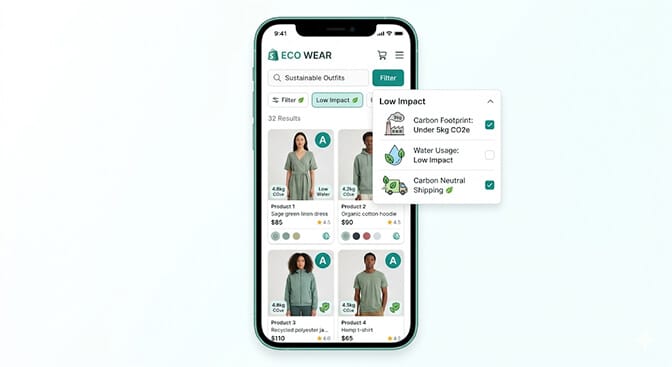
Here's the pattern that fewer than 5% of Shopify merchants are implementing but that represents the clearest competitive differentiation in sustainability-conscious categories.
Environmental footprint filters: carbon footprint range, water usage rating, packaging type, and carbon offset status. These filters require the most work to implement because the data has to come from actual lifecycle assessments or supplier data, not marketing copy.
But they're also the filters that most directly mirror what DPP regulations are requiring brands to capture. The work of building your environmental footprint data architecture for filter purposes is the same work you need to do for DPP compliance. One data project, two payoffs. The same compounding logic shows up in our piece on generative engine optimization for Shopify, where structured data improves both internal filters and external AI citation eligibility.
The practical path for most Shopify merchants who don't yet have lifecycle assessment data: start with what you can verify. Packaging material (recycled, plastic-free, compostable). Shipping offset status (carbon neutral shipping provider). These are binary attributes you can filter on immediately without full lifecycle data.
Then build toward the richer data: supplier-provided carbon footprint estimates per product category, water usage ratings for textile production methods, end-of-life options (recyclable, biodegradable, take-back program available).
If you want to understand which sustainability attributes your specific customers are already searching for before building out this filter architecture, Sparq's search analytics show you the exact queries arriving at your store. The sustainability-related zero-result searches in your data are your filter architecture roadmap.
Pattern 5: End-of-Life and Circularity Filters
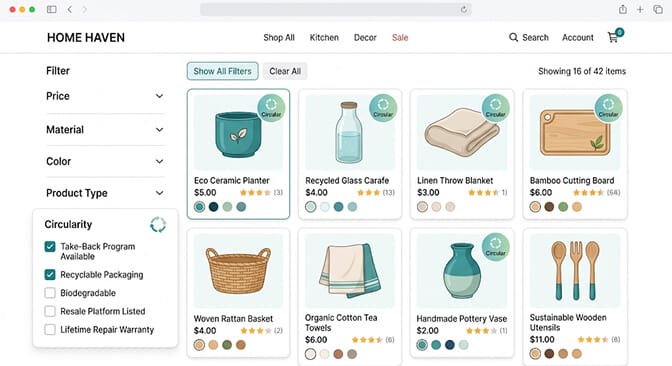
This is the filter category that's coming for every sustainability-focused ecommerce store in the next two to three years, and almost no one is implementing it yet.
End-of-life filters: what happens to this product when the customer is done with it? Is there a take-back program? Is the packaging recyclable in standard recycling? Is the product itself biodegradable? Is it listed on a verified resale platform? Does the brand offer repair services?
These filters matter to the most committed eco-conscious shoppers. The ones who are evaluating the full lifecycle of a purchase, not just the material composition at the point of sale. And in a world where DPP data requirements explicitly include end-of-life and recyclability information, this data needs to exist in your product architecture regardless.
The implementation: create circularity metafields for each product that specify take-back program availability (yes/no, with program details), packaging recyclability (standard recycling, specialist recycling, compostable, non-recyclable), product recyclability, and repair or resale program links.
Surface these as filter options for customers who want to sort by circularity. Surface them as product page highlights for customers who land on individual product pages. The same data serves both discovery and trust-building. AI merchandising is the layer that ranks circularity-attributed products higher when the shopper signals interest in those attributes.
The Search Query That Started This
Here's the thing about eco-conscious shoppers that most merchants haven't fully absorbed.
They search differently. Not "linen dress." "Linen dress organic cotton no synthetics." Not "coffee table." "Coffee table sustainably sourced FSC certified." Not "moisturizer." "Moisturizer no parabens fragrance-free vegan certified."
These are natural language queries loaded with specific sustainability attributes. They're the queries that Shopify's native search fails at most dramatically, because native search looks for exact word matches in product titles. "FSC certified" doesn't appear in most product titles. "No synthetics" certainly doesn't. The query returns nothing, and the customer leaves. The same gap shows up in our Shopify search relevance audit playbook.
An AI semantic search system that understands natural language intent catches "FSC certified" as a timber certification and surfaces products with FSC certification metafields. "No synthetics" becomes a filter for 100% natural fibers. "Vegan certified" surfaces products with vegan certification attributes. The voice-side mechanics are covered in multimodal search for Shopify.
The filter and search system need to work together. The filters surface sustainability attributes for customers who browse. The search catches the same attributes for customers who type specific requirements. Both require the same underlying product data architecture. Pair this with zero-party data preference collection and your store knows which sustainability attributes each visitor cares about most.
Building the Architecture Without Starting From Scratch
The good news: you don't need to implement all five filter patterns at once. Here's the sequence that produces the fastest visible impact with eco-conscious shoppers.
Week 1: Add exact material composition to your top 20 products as a metafield. This is the highest-impact single change because it powers the most-used sustainability filter and the most common sustainability search queries.
Week 2: Add certification data for any existing certifications. If you already have GOTS, Fair Trade, or OEKO-TEX certifications, they belong in a structured metafield, not just in your product description text.
Month 2: Build your origin filter. Country of manufacture, production method, and any supplier verification data you can provide.
Month 3: Add packaging and basic circularity data. Recyclable packaging (yes/no), take-back program (yes/no), basic end-of-life options.
Ongoing: Build toward environmental footprint data as supplier relationships and data infrastructure allow.
Each phase adds searchable, filterable sustainability attributes that serve eco-conscious shoppers immediately and builds the data infrastructure you need for DPP compliance as requirements formalize. If you want to size what this is worth on your specific revenue, plug your numbers into our ROI calculator.
Ready to see which sustainability queries your customers are already sending you that your current setup can't answer? Install Sparq from the Shopify App Store and check your zero-result searches. Free to try, no-code setup, and the sustainability attribute gaps in your product data show up clearly in the queries that return nothing.
The Takeaway
The merchant who got that Wednesday support message? She rebuilt her product data architecture over six weeks. Added material composition metafields. Added her certifications as filterable attributes. Added supplier origin information for each product category. Added take-back program details to every product page.
The customer who had complained came back three months later after finding the store through a search for "GOTS certified linen." Left a review that said: "Finally a brand that actually shows you the proof."
She'd been there the whole time. The merchant just hadn't built the system to show her what she needed to see to buy.
That's the digital product passport opportunity for Shopify merchants in 2026. Not compliance for its own sake. Verifiable transparency as a competitive advantage, built into the filters where buying decisions actually happen. If you'd rather see what's possible before installing, the Sparq features overview, pricing, and option to book a demo walk through the full picture first.
Frequently Asked Questions
What is a Digital Product Passport and why does it matter for Shopify merchants?
A Digital Product Passport (DPP) is a structured digital record attached to every product that contains verifiable information about its origin, material composition, environmental footprint, and end-of-life options. The EU's Ecodesign for Sustainable Products Regulation is making DPPs mandatory for textiles starting in 2026 to 2027, with full enforcement by 2030. For Shopify merchants selling into Europe, it's an upcoming compliance requirement. For all merchants in sustainability-focused categories, it represents the data architecture that eco-conscious shoppers are increasingly expecting to verify before purchasing, regardless of regulatory geography.
How do transparency filters convert eco-conscious shoppers on Shopify?
Transparency filters convert eco-conscious shoppers by making sustainability claims verifiable at the point of discovery rather than requiring the customer to hunt for proof in product descriptions. Filters for material composition (with percentages), specific certifications, country of origin, and environmental footprint let shoppers find products that meet their sustainability criteria before they click through, and they allow those claims to be understood as specific and verifiable rather than vague marketing language. Over 70% of consumers report they are more likely to trust and purchase from brands that share verifiable sustainability data, and filter architecture that surfaces that data in the browsing flow is the most direct way to serve this preference.
How do I add Digital Product Passport data to my Shopify filters?
The practical path is to add sustainability attributes as product metafields in your Shopify admin. Create metafields for material composition (with percentages), certification data (certification name, body, and ID), country of manufacture, packaging recyclability, and end-of-life options. Your filter app reads from these metafields to create filterable options in your filter sidebar. Start with the highest-impact attributes for your specific catalog: material composition metafields for apparel and home goods, certification metafields for any products where you hold verified certifications. Build toward environmental footprint and circularity data as your supplier relationships and data infrastructure develop.
Does building DPP-ready product data improve search performance for sustainability queries?
Yes, directly. Eco-conscious shoppers frequently search with specific sustainability attributes in their queries: "organic cotton no synthetics," "FSC certified furniture," "vegan certified skincare." These natural language queries fail in standard keyword search because the terms appear in descriptions rather than product titles. When sustainability attributes are stored as metafields and indexed by an AI-powered search app, those queries match against structured data rather than requiring exact word matches in product names. The same product data that powers your sustainability filters also enables your search app to return accurate results for sustainability-specific natural language queries.
Will adding sustainability metafields and DPP data slow down my Shopify store?
No. Metafield data is loaded as part of standard product data requests and has no perceptible impact on page performance. Filter apps that read from metafields operate at the same speed as those reading from product tags. The additional data structure improves the accuracy and relevance of both your filter sidebar and your search results without adding any meaningful load time. DPP-related data additions are among the most performance-neutral improvements available to a Shopify store because they enhance the data layer without adding visual elements or additional HTTP requests.