
Voice Commerce for Shopify: Making Your Search Understand How People Actually Talk
Forget plugging your store into Alexa. The real voice opportunity is already arriving in your search bar, spoken out loud, and most stores answer it with a shrug.
A merchant messaged me last week, half-panicked.
"Everyone's saying I need to be on voice. How do I make my store work with Alexa? Do I need an app? A skill? A developer?"
I asked him one question back. "When's the last time you bought something, start to finish, by talking to a speaker and never looking at a screen?"
Long pause. "...Never."
Right. Same as almost everyone. And that's the misunderstanding sitting under most voice commerce advice. People picture a customer barking an order at a kitchen speaker and a package showing up. That happens, but it's the smallest slice of the story.
Here's the weird part. Voice is genuinely huge and growing. Around half of US shoppers now use voice for shopping-related tasks, and US voice commerce is a multi-billion dollar channel. But the dominant behavior isn't buying by voice. It's researching, reordering, list-building, and asking questions. Out loud. In full sentences.
And then they finish on a screen. Yours, if you're lucky.
The voice opportunity for your Shopify store is not the speaker on the counter. It's the way voice trains people to search in plain spoken language, and where that query lands next.
Let me show you what voice actually changes, and the moves that capture it.
First, the myth worth killing
You cannot make Alexa, Siri, or Google Assistant run a search inside your Shopify store's catalog. There's no native pipe for it. Those assistants live in their own walled gardens, and unless you build a dedicated integration most small stores never will, they aren't querying your search bar.
So stop trying to "connect your store to Alexa." That's the wrong job.
The right job is this: voice has rewired how people phrase what they want, and a growing share of those spoken-style queries flow straight into your own on-site search, by dictation or by the voice-to-screen handoff. Most stores answer those queries badly. That's the gap that's actually costing you money.
The rest of this is how to close it.
Pattern 1: Translate the whole spoken sentence, not the keywords
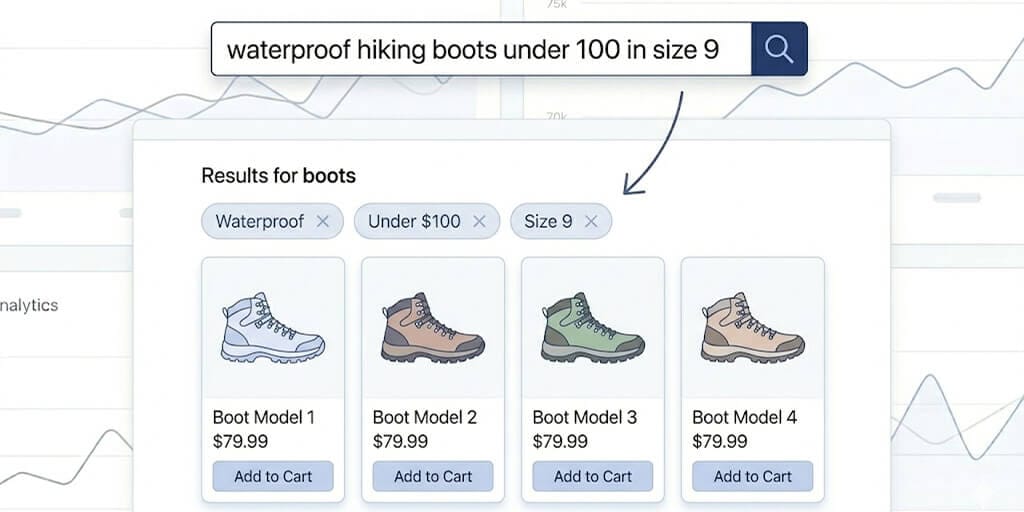
When someone types, they clip. "Boots." When someone speaks, they pour out a full sentence. "I need waterproof hiking boots under a hundred dollars in size nine."
Shopify's default search hears that sentence and basically panics. It looks for products literally titled like the whole string, finds none, and serves a zero-results page. The customer just gave you everything you needed and you said no.
Good voice-ready search reads that sentence as an intent and breaks it into structured pieces. Category: hiking boots. Attribute: waterproof. Price: under 100. Size: 9. Then it returns exactly that.
This is the difference between keyword matching and actually understanding language, which we go deep on in our guide to natural language search for ecommerce. Voice just makes the gap impossible to ignore.
Pattern 2: Pull the filters out of the sentence automatically
This is the part most store owners get wrong.
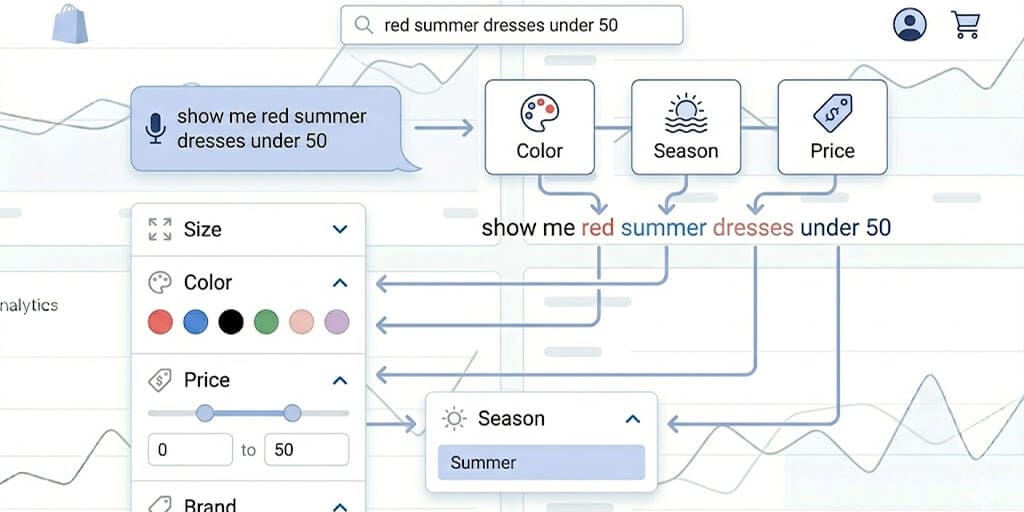
A spoken query isn't just longer. It's loaded with filter values. Color, size, price, material, occasion, all baked into one breath. "Show me red summer dresses under fifty."
If your search treats that as a text string, it wastes every one of those signals. If your search treats it as filters, the customer lands on a perfectly narrowed page without touching a single checkbox.
Every adjective in a spoken query is a filter the customer is handing you for free. The only question is whether your search picks it up or drops it.
That's the whole trick to voice-style discovery. The sentence already contains the facets. Your job is to catch them.
Pattern 3: Answer the questions, not just the nouns
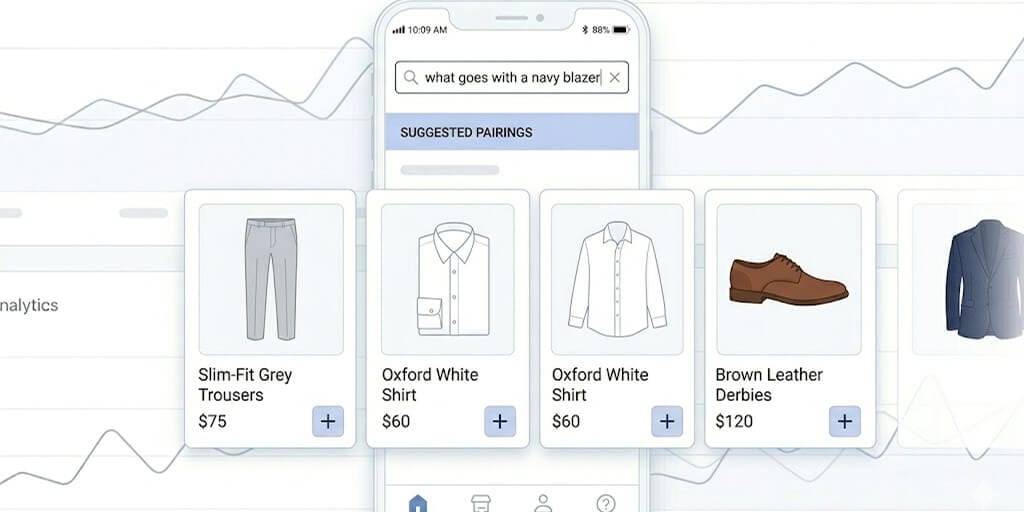
Voice makes people ask questions. Real ones. "What goes with a navy blazer?" "Which moisturizer is good for dry skin?" "Do you have anything for a beach wedding?"
These aren't product names. They're intent, phrased like you'd ask a clerk.
Most stores have no answer for this, because their search only knows how to match nouns to titles. The shopper asks a human question and gets a robotic nothing.
Search that understands meaning can map "beach wedding" to lightweight fabrics, lighter colors, and the right category, even when no product is literally tagged "beach wedding." That's semantic understanding, and it's quickly becoming the baseline, not the bonus. Our breakdown of semantic search for ecommerce walks through how the meaning-matching actually works.
Pattern 4: Speak your customers' vocabulary, accent and all
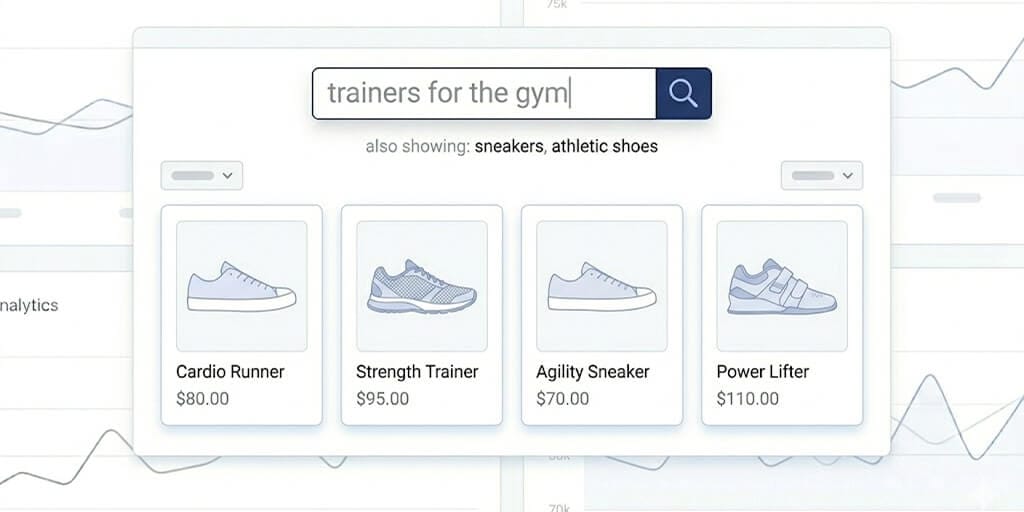
Voice surfaces every regional word your tagging forgot. Trainers, not sneakers. Jumper, not sweater. Trolley, not cart. Plus the natural mess of dictation, dropped words, run-ons, the occasional misheard term.
And this is the part that costs you money: if your search only knows your internal vocabulary, every customer who speaks differently than your product manager wrote gets a dead end.
Synonym handling and typo tolerance stop being nice-to-haves the moment queries arrive by voice. The spoken word is messier than the typed one, and your search has to be forgiving enough to keep up.
If you've read this far and you're picturing the gap between how your customers talk and what your search bar actually understands, that gap is the whole opportunity. Seeing how Sparq parses real spoken-style queries takes about ten minutes to set up, and you don't need a developer to do it.
Pattern 5: Win the off-site assistant moment with structured data
Now the off-site layer. Because some voice discovery does happen out there, on Google and the assistants, before anyone reaches your store.
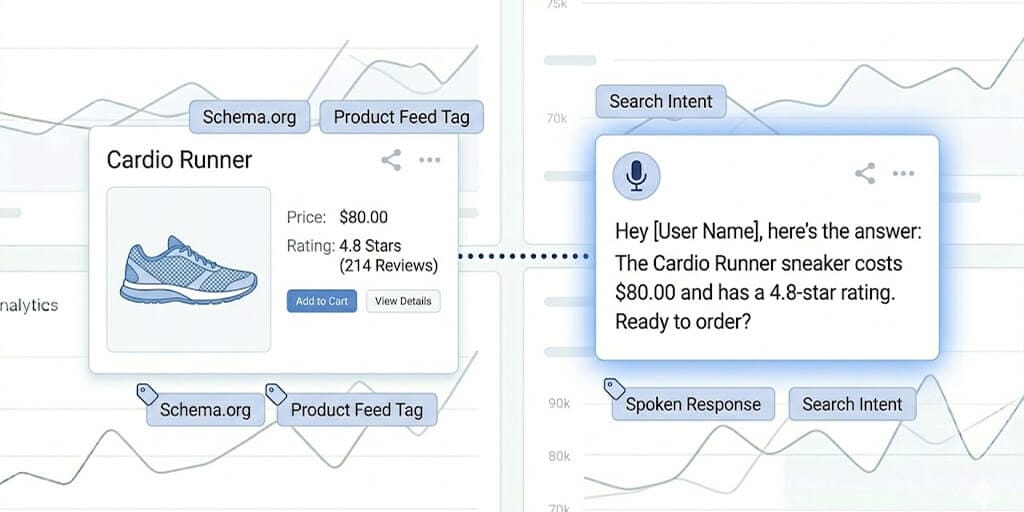
You can't make Alexa search your catalog. But you can make your products legible to the systems that voice assistants pull from. That means clean structured data on your product pages, accurate product feeds, and content that answers questions in plain language.
This is voice SEO, and it's quieter and less glamorous than people expect. It's schema markup and feed hygiene, not magic. But it's how your product becomes the answer when someone asks an assistant a buying question. For where this fits in the bigger picture, our roundup of ecommerce search trends for 2026 puts voice next to the other shifts worth watching.
Pattern 6: Nail the voice-to-screen handoff
Here's the pattern that ties it all together, and the one almost nobody designs for.
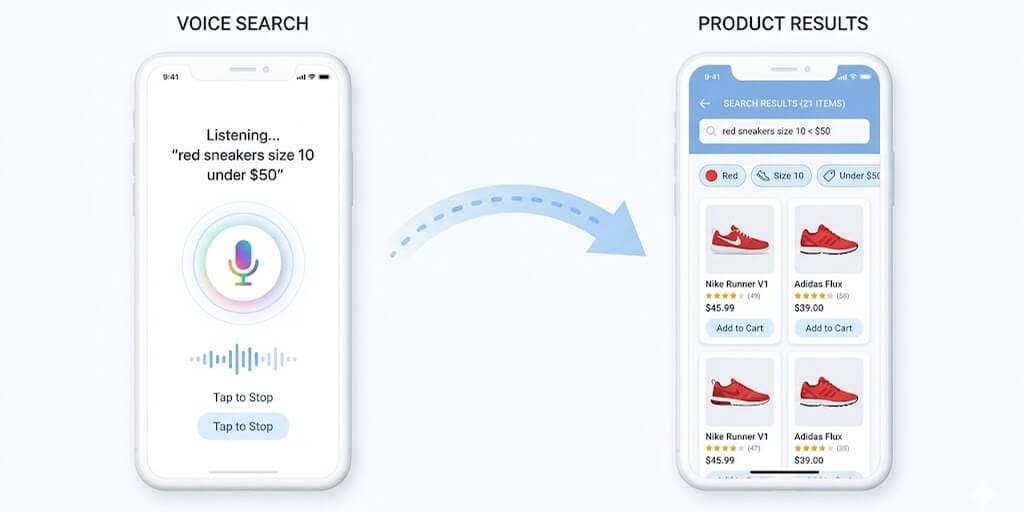
Voice shopping rarely ends in voice. The customer asks, browses, narrows by speaking, then switches to a screen to actually look and buy. Roughly one in seven voice-initiated sessions converts once it continues on screen. That handoff is the real checkout moment.
So the spoken query needs to survive the jump. When a shopper dictates "waterproof boots under a hundred" on their phone, the screen they land on should already show waterproof boots under a hundred, filters applied, ready to scan.
But then something clicks when stores get this right. The voice query stops being a novelty and becomes the fastest path to a narrowed, ready-to-buy results page. Voice did the talking. Your search did the filtering. The customer just buys.
The part that actually matters
Voice isn't going to replace people tapping and scrolling on your store. The hype crowd oversold that years ago, and the numbers never backed it up.
But voice has quietly changed the shape of what your customers ask for. Longer. More conversational. Loaded with detail. Spoken the way they'd talk to a person, then dropped into a search bar that was built to match exact words.
That mismatch is the whole thing. You don't need an Alexa skill. You need search that listens like a human would.
If you're tired of watching customers ask for exactly what they want in plain language and getting a zero-results page in return, that's the problem Sparq was built to solve. AI search that reads full sentences, filters that assemble themselves from the way people talk, and analytics that show you the spoken queries you're failing. See what your customers are really searching for. Most merchants are live in about ten minutes, and the first look at your search log tends to be eye-opening.
Frequently Asked Questions
What is voice commerce for a Shopify store?
Voice commerce is when shoppers research, reorder, or buy products by speaking instead of typing, usually through a phone or smart speaker. For most Shopify stores, the practical impact is not direct speaker purchases but the rise of long, conversational, spoken-style queries that land in your on-site search and need to be understood as intent, not exact keywords.
Can I connect my Shopify store directly to Alexa or Google Assistant?
Not natively. Voice assistants do not run searches inside your store's catalog unless you build a dedicated integration, which most small stores never do. The realistic and higher-return move is making your on-site search understand spoken-style natural language, since most voice shopping converges back to a screen anyway.
How are voice search queries different from typed searches?
Voice queries are longer, more conversational, and often phrased as full sentences or questions, like "waterproof hiking boots under 100 in size 9." Typed queries are short and clipped. Voice queries also carry multiple filter values in one breath, which only search that reads intent can break down into the right results.
Does optimizing for voice search actually increase conversions?
It can, because spoken-style queries are high-intent and detail-rich. When your search turns a sentence like "red summer dresses under 50" into an instantly filtered page, you shorten the path to purchase and avoid the zero-results pages that send ready-to-buy shoppers away. The conversion usually completes on screen, so the voice-to-screen handoff matters most.
Will a natural language search app slow down my Shopify store?
A well-built search app runs on its own infrastructure and returns results faster than Shopify's native search, so it should not slow your store down. Sparq is built specifically for Shopify and serves results instantly, which matters because slow or literal results are exactly what cause voice-style queries to fail.