Millions of products are now discoverable in ChatGPT. But the merchants who actually convert that traffic will be the ones who fix what happens after the click.
Last Tuesday, a friend who runs a skincare brand on Shopify sent me a screenshot.
A customer had asked ChatGPT: "best vitamin C serum under $40 for sensitive skin."
Her product showed up. Third result. Right there in the chat, with the product image, price, and a direct link to her store.
She was thrilled. For about twelve hours.
Then she checked her analytics. Fourteen visitors came from ChatGPT that day. Zero bought. Every single one bounced within 90 seconds.
Here's the weird part. Her product was exactly what those shoppers wanted. The AI matched it perfectly. But when they arrived on her site and tried to find the specific variant, her search returned "No results found" for "vitamin C sensitive skin."
She had the traffic. She had the product. She lost every sale because her store's search couldn't finish what ChatGPT started.
And this, right now, is the story that's going to play out across thousands of Shopify stores this month.
What Just Happened (and Why It Matters More Than You Think)
Shopify's integration with ChatGPT went live this week. And it's bigger than most merchants realize.
Through Shopify's Agentic Storefronts, your products are now discoverable across ChatGPT, Microsoft Copilot, Google AI Mode, and the Gemini app. Not as some opt-in beta. Not as a future roadmap item. It's on by default for Shopify stores.
Hundreds of millions of ChatGPT users can now ask for product recommendations and see your inventory surface in real-time. When they're ready to buy, they complete the purchase through your own storefront via an in-app browser. Your branding, your checkout, your customer relationship. All intact.
Shopify Catalog handles the backend. It takes your product data, normalizes it through their LLMs, and syndicates it across every connected AI platform. No separate integrations, no extra apps, no transaction fees beyond your standard processing.
This is not a distant future trend. This is live commerce happening in AI conversations right now. And AI agents are already reshaping how ecommerce stores operate, from product discovery to post-purchase support.
But here's the part that should worry you.
The Merchants Who Win AI Traffic Will Lose It at Their Own Front Door
Think about who this new visitor actually is.
Someone asked ChatGPT a specific, detailed question. "Find me lightweight running shoes under $120 with good arch support for flat feet." The AI scanned billions of products. It picked yours. The shopper clicked through.
This is not someone who stumbled onto your site from a random Instagram ad. This is not casual browsing.
This is the highest-intent traffic your store has ever received.
They know what they want. They've been pre-qualified by the AI. They arrived ready to buy.
Now they land on your store. They want to find the exact color. The right size. Maybe a bundle. So they do what every shopper does. They use your search bar.
And this is where most stores will blow it.
Shopify's default search is basic keyword matching. Type "running shoes arch support" and you'll likely get zero results, or a random assortment of products that happen to contain the word "running." The AI understood their intent perfectly. Your site search doesn't understand it at all.
The irony of AI commerce: the better AI gets at sending you qualified buyers, the more expensive your bad on-site search becomes.
This is the gap almost nobody is talking about. Everyone's focused on how to show up in ChatGPT. Almost nobody is asking what happens to that traffic once it arrives.
The New Conversion Stack Every Shopify Merchant Needs
Here's how we'd frame the new reality:
Layer 1: AI Discoverability (Your New SEO)
Is your product catalog structured well enough for AI to understand, surface, and recommend it?
This means specific, descriptive product titles. Not "Classic Tee" but "Heavyweight Cotton Unisex Graphic Tee, Tour 2026." Descriptions that answer real questions about materials, sizing, use cases, and compatibility. Clean metafields, meaningful tags, consistent variant data.
AI doesn't browse your site the way a human does. It reads structured data and picks the best match. Vague titles and thin descriptions make your products invisible.
If your product catalog management hasn't been updated since your store launched, this is the wake-up call.
Layer 2: On-Site Search (Where Sales Are Won or Lost)
When the AI-referred visitor arrives and starts narrowing down, can your search handle it?
Can it understand "gift for mom who loves gardening under $50"? Can it handle typos, synonyms, and natural phrasing? Can it narrow 10,000 SKUs to the 5 that actually match?
This is the chronically underinvested layer. Most merchants assumed traffic was the primary problem. With AI commerce, traffic is solved. Conversion is the bottleneck. And how your ecommerce search actually works under the hood determines whether that bottleneck stays or goes.
Layer 3: Conversion Experience (Filters, PDPs, Checkout)
Your product pages. Your checkout flow. Your filter design. You've been optimizing this for years. Keep doing it.
But notice the pattern: most brands invest heavily in Layer 3, have barely started on Layer 1, and have completely ignored Layer 2.
That needs to change. Fast.
This Is the Early-2000s SEO Moment, Happening Right Now
If you've been in ecommerce long enough, you've watched this movie before.
In the early 2000s, Google was taking over. Merchants who moved first, structured their sites properly, wrote clear product descriptions, built fast pages, showed up when customers searched. Everyone else got buried on page 4.
The gap between those two groups, in revenue, in brand recognition, became enormous. And it was almost impossible to close.
We're at that exact inflection point again. Except instead of Google crawling your site, it's AI models indexing your product catalog across multiple ecommerce search surfaces simultaneously.
The retailers who fix their AI indexing and their on-site search first will capture this wave. Everyone else will watch it pass.
And this time, it's moving faster. Because it's not just ChatGPT.
Shopify's Agentic Storefronts already connect to Microsoft Copilot, Google AI Mode in Search, and the Gemini app. The same product data, the same structured catalog, being surfaced wherever AI conversations happen.
This isn't a single integration to prepare for. It's an entire new channel category.
What to Actually Do This Week
Stop reading about this and start auditing.
Audit your product data. Open your Shopify admin. Look at your top 20 products. Are the titles specific and descriptive? Do the descriptions answer the questions a real customer would ask an AI? Are your metafields filled in, or are they empty defaults from three years ago? Every ecommerce search trend in 2026 points to structured data as the single biggest ranking factor in AI-driven discovery.
Stress-test your on-site search. Go to your own store. Search like a real customer would. Try "birthday gift for dad who golfs" instead of "golf products." Try misspelling something. Try a synonym. See what comes back.
If you're getting blank results or completely irrelevant products, you're about to lose every AI-referred visitor who does the same thing. Understanding semantic search for ecommerce isn't optional anymore. It's the conversion layer between AI traffic and actual revenue.
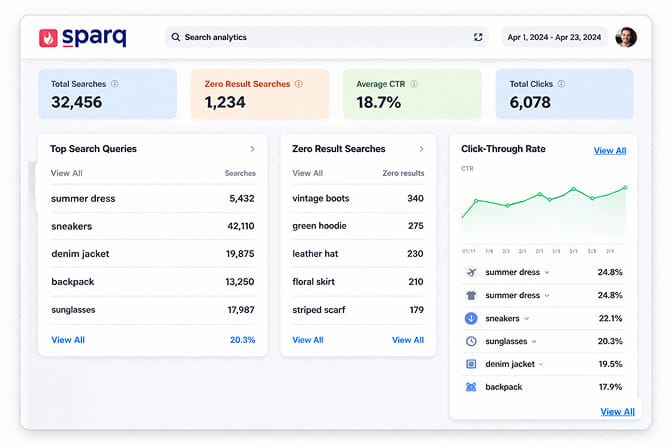
Check your search analytics. What are customers actually searching for on your store? What are the top zero-result queries? Those queries are money you're leaving on the table. If you don't know these numbers, you're flying blind at the worst possible time.
If your search analytics are sparse or nonexistent, Sparq shows you exactly what customers are searching for, which results they're clicking, and where they're dropping off. It takes about 10 minutes to set up, and the data alone is worth it before you change anything.
Fix your no-results pages. A dead-end "no results found" page is always bad. But when the visitor was pre-qualified by an AI recommendation and arrived ready to buy? That dead-end just became the most expensive page on your site.
The Window Is Open. It Won't Stay Open Long.
Here's what I keep coming back to.
Right now, most Shopify merchants don't even know this is happening. Their Agentic Storefronts activated by default. AI traffic is starting to trickle in. And their stores aren't ready for it.
That's your window.
The merchants who clean up their product data, fix their on-site search, and build a conversion experience that matches the intent of AI-referred traffic are going to capture demand that their competitors don't even realize exists yet.
Commerce is moving into AI conversations. Shopify built the infrastructure. The question isn't whether this changes everything. The question is whether you're ready for the visitors who are already on their way.
If you want to see what your on-site search is actually doing (and what it's failing to do), install Sparq from the Shopify App Store and check your search analytics. What you find will probably surprise you. And right now, that data is worth more than almost any other investment you can make.
Frequently Asked Questions
What is Shopify ChatGPT shopping and how does it work?
Shopify ChatGPT shopping lets hundreds of millions of ChatGPT users discover and buy products from Shopify merchants directly through AI conversations. Your products get surfaced via Shopify Catalog, and when a shopper is ready to buy, they complete the purchase through your own storefront in an in-app browser. You keep your branding, checkout, and customer data.
How do Shopify Agentic Storefronts differ from regular Shopify sales channels?
Agentic Storefronts connect your product catalog to AI platforms like ChatGPT, Microsoft Copilot, Google AI Mode, and Gemini. Unlike traditional sales channels, discovery happens through natural language conversations instead of keyword searches. Products are matched based on intent and structured data, not just SEO rankings. Agentic Storefronts activate by default for Shopify stores, with no extra apps or setup required.
How do I optimize my Shopify store for AI product discovery?
Start with your product data. Make titles specific and descriptive, fill in metafields with meaningful attributes (material, use case, compatibility), and write descriptions that answer questions a customer would ask. Clean, structured data is what AI models use to match your products to shopper queries. Then ensure your on-site search can handle the natural language traffic that AI sends your way.
Does fixing on-site search actually increase conversions from AI traffic?
Yes. AI-referred visitors arrive with high purchase intent because they've already been matched to your product by the AI. But if your on-site search can't handle natural language, synonyms, or typos, those visitors bounce. Merchants who invest in AI-powered on-site search typically see a 30% increase in conversion rates because they close the gap between what the shopper wants and what the store can show them.
Will Shopify ChatGPT shopping slow down my store or require developer work?
No. Agentic Storefronts activate automatically through Shopify with no separate integration, no apps to install, and no code changes. Purchases happen on your existing storefront, so your theme, checkout flow, and page speed aren't affected. The main work is on your product data and on-site search quality, both of which you can improve without a developer.