
2027 Search & Filter Roadmap: What Agentic Commerce Winners Are Building Right Now
The agents are already shopping your store. Whether you show up in their recommendations next year depends on the search and filter work you ship in the next six months. Here's the actual roadmap.
The merchant on the call had been staring at the same number for six minutes.
She'd just opened a new traffic source in her analytics. Referrer: chatgpt.com. Then below it, gemini.google.com. Then copilot.microsoft.com. The volumes were small but climbing steeply, and the bounce rates were strange. Three percent. Almost no humans bounce at three percent.
"Those aren't humans," I said. "Those are agents pre-screening your store on behalf of humans."
Here's the weird part. The agents weren't buying yet on her store. They were probing. Filtering. Comparing her catalog against three other merchants in the same conversation. And whichever store gave them cleaner data, faster filters, and clearer attributes would be the one the human ever even saw recommended.
She had about six months to ship the search and filter work that would decide whether her store made the agent shortlist by 2027. Most merchants don't yet know they're on that clock. Stay with me.
2026 was when agents arrived. 2027 is when they pick the winners.
The numbers stopped being theoretical sometime around March of this year. ChatGPT alone hit roughly 900 million weekly active users by early 2026. AI-mediated retail spending hit around $20.9 billion in 2026, roughly four times 2025. By the end of the decade, an estimated 15 to 25 percent of online retail will flow through agent channels, with $3 to $5 trillion in global spend moving through agent intermediaries by 2030.
Shopify activated Agentic Storefronts for all stores in late March 2026 via its Winter '26 Edition. Most merchants are opted in by default and don't fully realize it. The protocols (ACP, UCP, and MCP underneath both) have already settled. Discovery happens inside the agent. Checkout still happens on your store.
The merchant retains the conversion mechanics. But the agent decides whether your store ever gets surfaced in the first place. That's the new bottleneck.
This is where most store owners get it wrong. They think agentic commerce is a checkout problem. It's a search and filter problem. By the time an agent reaches checkout, it has already decided you exist. Whether you exist depends on what your search and filter layer can prove to the agent in the first 200 milliseconds.
That's the 2027 roadmap. Six concrete things winners are shipping right now.
Pattern 1: The machine-readable filter manifest
Your storefront filters look fine to a human. They're invisible to an agent.
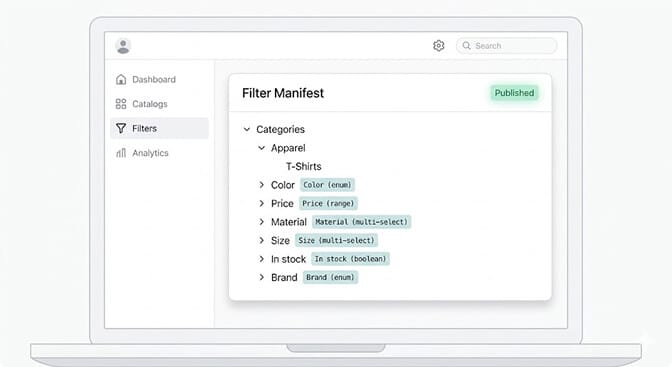
The first thing winners are publishing is a filter manifest: a structured, machine-readable description of every filter facet on the store, its data type, its enumerated values, and how to query it programmatically. Agents read the manifest once and know exactly which questions your store can answer.
Without this, the agent has to scrape your UI and guess. With it, the agent knows your "Material" filter accepts "Cotton, Linen, Wool, Polyester" before it ever sends a query. That difference is the gap between getting included in a recommendation and getting skipped silently.
If you want the broader context on how AI agents actually move through ecommerce, our piece on how agentic search is already shopping your store covers the full mechanic.
Pattern 2: The agent query endpoint
This is the part Shopify's default search cannot do, and it's where the architecture shift becomes obvious.
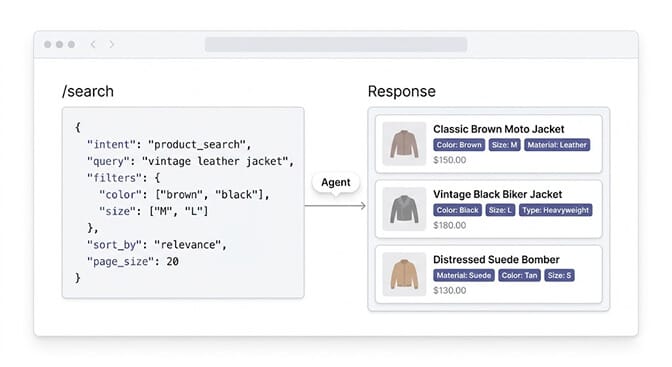
Your store needs a dedicated query endpoint built for agents (not humans) to call. It accepts a structured query, returns structured results, and exposes filter facets directly without the rendered HTML of a product listing page. Agents don't want your CSS. They want the matrix of attributes behind it.
The shape is simple. An agent posts "show me linen shirts under $80 in size medium, in stock." Your endpoint replies with the matching SKUs, attributes, prices, availability, and links. No scraping. No interpretation. No guessing.
Stores that publish this endpoint will be quoted in agent responses. Stores that don't will be summarized incorrectly, then quietly demoted from agent shortlists when the human catches the error. And this is the part that costs you money for years, not weeks.
Pattern 3: Live inventory and filter sync (no ghost results)
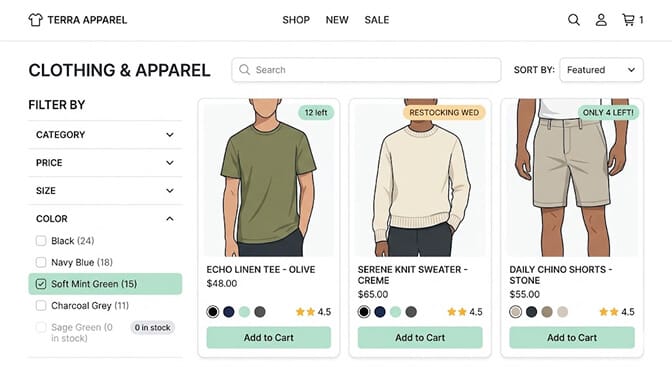
Agents are pitiless about stale data. If your filter says "12 in stock" and the actual catalog is at zero, the agent will tell the next human asking, and your store gets a quiet trust demerit on the agent's side.
The 2027 winners are shipping real-time inventory and filter sync. The facet count, the availability flag, the restock window, all sourced from the live catalog, not a nightly job. When the agent asks "is this in size eight," the answer is the truth at that exact second.
For human shoppers this is a polish item. For agents this is a survival item. They will silently route around stores that lie, even by accident.
Pattern 4: A measurable attribute catalog (specs, not adjectives)
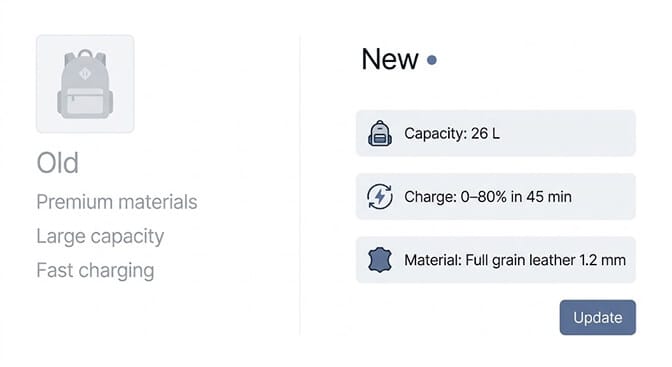
Agents do not understand "premium." They understand 1.2 millimeters of full grain leather. They do not understand "fast charging." They understand 45 minutes from 0 to 80 percent on a 65 watt USB-C connection.
Every marketing superlative on your product detail page is invisible to an agent. Every measurable specification is a filter the agent can rank you on.
Winners are auditing every product attribute and replacing adjectives with numbers. The bag isn't large, it's 26 liters and fits a 15 inch laptop. The cream isn't gentle, it's pH 5.5 and fragrance-free. Once those numbers exist as filter attributes, your store wins comparison queries the agent fires across multiple merchants in a single conversation.
This is the work most teams underestimate. It looks like a copy task and is actually a data task. The payoff lands every time an agent shortlists your store over a more expensive competitor that still writes like a 2018 brand deck.
Agents do not read your About page. They read your spec sheet. Treat your filter attributes like your real homepage.
If you want a deeper read on how AI assistants are evaluating product copy and structured data, the piece on how to get your Shopify products cited in AI answers goes line by line through what to ship.
Pattern 5: Conversational filter memory
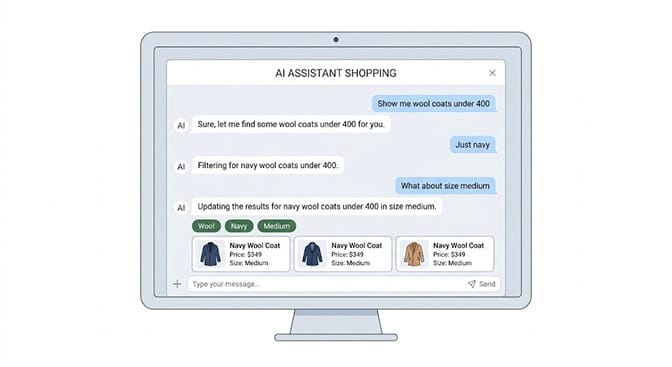
Human shoppers fire one query at a time. Agents fire conversations. By turn three the shopper has narrowed wool coats under $400 to navy in size medium, and the agent has been silently maintaining that filter state across every store it's checking.
Stores that can accept stateful, multi-turn filter queries will dominate considered-purchase categories. Stores that treat every query as a fresh start will keep losing the longer conversations, which is exactly where the highest intent shoppers live.
Stay with me here. This isn't science fiction. The shoppers using ChatGPT and Gemini to plan complex purchases are already there, and the agents are already passing accumulated filter context to whichever stores can use it. The merchants who built their search around one-shot queries are about to feel that gap fast.
Pattern 6: Filter result provenance (give the agent its receipts)
This one is the unsung superpower of 2027.
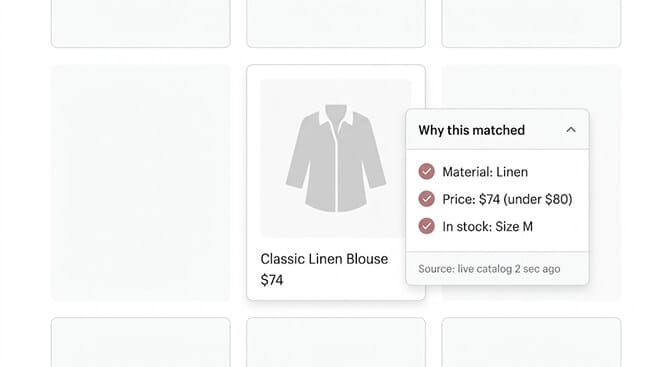
When an agent shortlists your product, the human asks one question over and over: "Why this one?" The agent has to be able to point at receipts. Which attributes matched, which filters were applied, when the inventory was last verified, and what source the data came from.
Winners are returning that provenance directly from their search endpoint. Every result carries a small audit trail of why it was included and how recently each attribute was validated. The agent passes that audit trail straight through to the human shopper as the justification for the recommendation.
The store that gives the agent its receipts wins the human's trust before the human has even arrived. It's the cheapest brand-building work you'll do this year.
If you want to see how Sparq handles structured filter responses and live inventory sync for Shopify stores, the pricing page lays out the plans and the free trial. Most merchants are live in about ten minutes, and the search analytics start populating the same day so you can see what agents (and humans) are actually asking for.
The honest constraints
Three things to keep in mind before you sprint at any of this.
You don't need to support every protocol on day one. Shopify abstracts ACP and UCP for most stores through Agentic Storefronts. Start by confirming which AI channels are enabled in your admin and verifying your product feed is clean. The protocol plumbing usually isn't your bottleneck. Your attribute data is.
You also don't need a custom AI team. The actual technical work is search-app territory: structured filter facets, machine-readable manifests, query endpoints, real-time inventory hooks. If you can choose a search app that already speaks this language, you skip a year of engineering.
And you should expect agent traffic to look strange before it looks valuable. High pageview, low conversion, three percent bounce. That's normal during the probe phase. The agents that probe you in 2026 are the ones that recommend you in 2027.
What I wish more Shopify merchants understood
The agent has no loyalty. It will not remember your founder story or admire your branding. It will choose the store whose data tells the cleanest, most provable story about what's on offer at that exact second.
That sounds cold until you realize it's also the most honest meritocracy ecommerce has ever had. The merchant with the best data wins, not the merchant with the biggest ad budget.
The 2027 winners are not the merchants with the loudest marketing. They're the ones whose search and filter layer answered every agent's question, in machine-readable detail, before the question was even asked twice.
You don't need a billion-dollar AI strategy. You need a clean filter manifest, an honest query endpoint, live inventory, measurable attributes, multi-turn memory, and receipts on every result. Six concrete patterns. Each one shippable inside a quarter.
The agents are already at your search bar. They're just waiting to see if you've left a door they can open.
Open it.
Frequently Asked Questions
What is agentic commerce search and filtering?
Agentic commerce search and filtering is a search and filter layer designed to be queried directly by AI shopping agents (like ChatGPT, Google Gemini, Microsoft Copilot, or Perplexity) on behalf of human shoppers. Instead of returning rendered HTML for a human to scroll, it returns structured data the agent can parse, compare across merchants, and use to recommend products in a conversation. The shift matters because agents now mediate a fast-growing share of high-intent retail traffic, and they only recommend stores whose data they can read.
How does agent-ready search compare to Shopify's default search for 2027?
Shopify's default search is built for humans typing into a search bar and returns a rendered product listing page. Agent-ready search exposes machine-readable filter manifests, structured query endpoints, live inventory data, and provenance on every result, all of which agents need to include your store in a multi-merchant comparison. By 2027, the gap will be visible in your analytics: stores with agent-ready search will see growing AI referrer traffic that converts, while default-search stores will see the same agents pass through and route shoppers to a competitor.
How do I make my Shopify store ready for agentic commerce in 2027?
Start with six concrete patterns: publish a machine-readable filter manifest, expose a structured search query endpoint, sync your filters to live inventory, convert subjective copy into measurable attributes, support multi-turn conversational filter state, and return provenance with every search result. You can layer these on top of Shopify's Agentic Storefronts (enabled by default since March 2026) without replatforming, usually through an AI-powered search and filtering app installed in about ten minutes.
Is investing in agentic commerce search worth it for a small Shopify store?
Yes, particularly for stores in considered-purchase categories like fashion, beauty, home goods, electronics, and accessories where shoppers are already using AI assistants to compare options. AI-mediated retail spending hit roughly $20.9 billion in 2026, roughly four times 2025, and by the end of the decade, an estimated 15 to 25 percent of online retail will flow through agent channels. Getting search and filter infrastructure ready now is cheaper than re-platforming under deadline pressure in 2027 when the channel is mature.
Will agent-ready search and filters work with my existing Shopify theme and apps?
Yes, the work mostly happens outside your storefront theme. A modern AI search and filtering app like Sparq exposes structured query endpoints and machine-readable filter facets without requiring custom theme code, and the changes that do affect the storefront (cleaner attribute fields, live inventory hooks) are theme-agnostic. For most Shopify stores, the agent readiness work is a configuration project, not a development project.