
Hybrid Search Architecture: Why the Smartest Shopify Stores Use Rules AND AI to Get Bulletproof Results
Pure keyword search misses intent. Pure AI search ignores your business rules. The stores winning product discovery in 2026 run both at once. Here's exactly how hybrid search works and why it outperforms either approach alone.
She called it her "AI problem."
She'd switched to a pure AI-powered search tool six months earlier. Semantic understanding. Natural language queries. The whole pitch. And it genuinely worked better for vague, exploratory queries than her previous keyword search.
But then she started getting complaints.
"I searched for 'summer dress' and you showed me dresses from last year's collection that we're trying to clear out. I wanted your new stuff."
"I searched for 'blue dress' and the first result was a dress you're out of stock on."
"I searched by brand and got completely unrelated items mixed in."
Her AI search was smart about understanding what customers meant. It was completely oblivious to what her business needed to do with those results.
She'd replaced a dumb search that didn't understand intent with an intelligent search that ignored her merchandising rules. Different problem. Same conversion drag.
Here's the thing about AI search that most merchants don't figure out until they're six months into a deployment: AI alone is not a complete search architecture. It's a retrieval engine. And retrieval without business logic produces results that are semantically relevant but commercially broken.
The Two Failure Modes That Hybrid Search Solves
Let's be precise about what actually goes wrong with each approach in isolation.
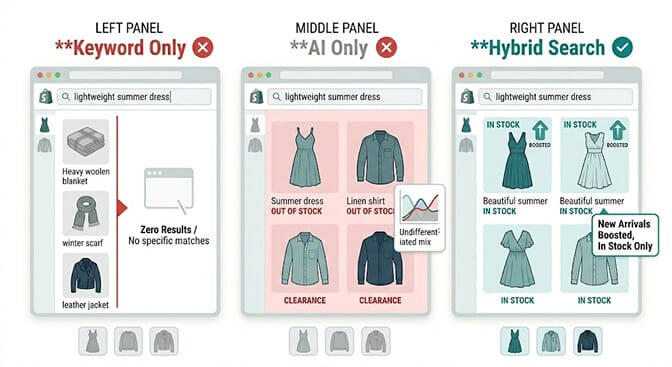
Pure keyword search fails on intent. When a customer types "something warm for winter" or "casual but work-appropriate" or "gift for my dad who runs marathons," a keyword matching engine finds nothing. It's looking for exact word matches in product titles and descriptions. The customer's words don't match your product vocabulary. Zero results, or results that are confusingly unrelated.
This is the classic semantic search problem. The customer knows what they want. They're expressing it in natural language. The search can't bridge the gap between their language and your product data. (For a deeper look at how AI-powered semantic retrieval works, see our guide to the best ecommerce search engines for Shopify.)
Pure AI search fails on business logic. A semantic AI search engine is excellent at understanding intent and finding conceptually relevant products. But it doesn't inherently know that you want to suppress out-of-stock items. It doesn't know that your highest-margin products should appear first for ambiguous queries. It doesn't know that the collection you're trying to clear before the season ends should be deprioritized in favor of current inventory.
The AI surfaces what's semantically relevant. It doesn't surface what's commercially optimal. And in a Shopify store where business rules matter, that's a real problem.
Pure keyword search fails the customer. Pure AI search fails the business. Hybrid search serves both. It's not a compromise, it's the architecture that actually works.
What Hybrid Search Actually Means
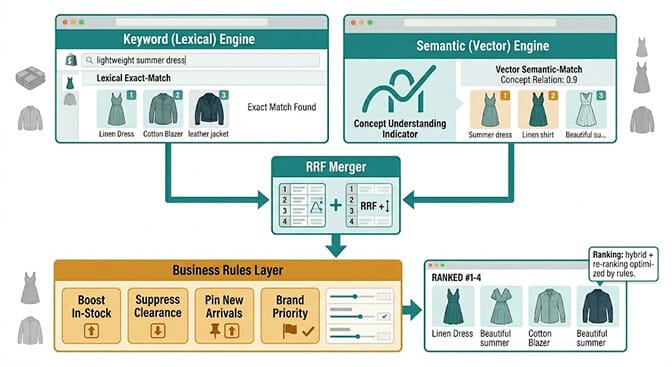
Hybrid search combines two retrieval systems: a keyword-based (lexical) engine and a semantic (vector) engine, and then applies business rules to the combined results.
The lexical engine does what keyword search has always done: matches exact or near-exact words in product titles, descriptions, and tags. It's precise for queries where the customer uses your product vocabulary.
The semantic engine does what AI search does: converts the query into a mathematical representation of meaning and finds products that match conceptually even when the vocabulary doesn't match. It handles natural language, synonyms, and vague queries. (For a primer on what's happening under the hood, see how an ecommerce search algorithm works.)
Both systems rank results independently. Then a merging algorithm, often called Reciprocal Rank Fusion (RRF), combines the two ranked lists into a single unified result set. Products that rank well in both the keyword list and the semantic list get the highest combined scores. Products that rank well in one but not the other still surface, but with less weight.
Then business rules are applied on top of the merged results. This is the layer that transforms a good technical search result into a commercially optimal one.
Companies that have implemented hybrid search report 20% improvements in product discovery relevance, 30% increases in search-influenced sales, and 91% reductions in zero-result queries. Those numbers come from the combination of all three layers working together, not from any single component.
The Four Business Rules That Make Hybrid Search Actually Work for Shopify
The AI and lexical retrieval layers handle relevance. The business rules layer handles commerce. These are the four rule types that matter most for Shopify stores.
Rule Type 1: Inventory-State Filtering
The most important business rule for almost every Shopify store.
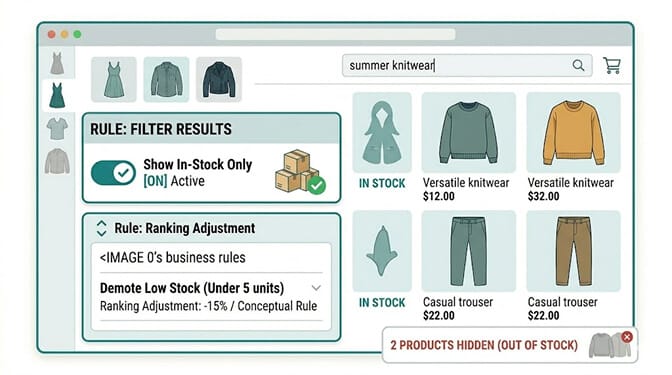
When AI retrieves semantically relevant results, it doesn't inherently check inventory. A product that perfectly matches a customer's query but has been sold out for two weeks will still surface if inventory-state filtering isn't applied as a rule layer.
This is why the merchant described at the start was getting complaints about out-of-stock results. Her AI search was doing exactly what it was designed to do: returning semantically relevant products. Nobody told it which of those products were actually available.
Inventory-state rules apply post-retrieval: after the AI and keyword engines identify relevant products, the rules layer filters, demotes, or removes items that don't meet inventory criteria. "Show only in-stock variants." "Demote items with fewer than five units remaining." "Suppress out-of-stock items from top positions but keep them accessible with an 'Notify Me' option."
These rules update dynamically with inventory changes. As products sell out or are restocked, the rule applies without manual intervention.
Rule Type 2: Merchandising Boosts and Pins
Business rules that influence how results are ranked within the relevance-ordered list that AI retrieval produces.
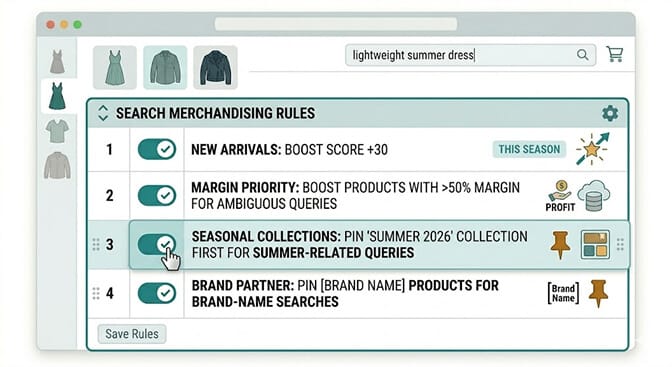
Boosting increases the ranking score of products that meet certain criteria. New arrivals boosted by a score multiplier appear higher in results for relevant queries than the AI's pure relevance ranking would place them. High-margin products boosted for ambiguous queries ensure that when a customer searches for something general (like "blue top"), the financially beneficial results surface first among the equally relevant options.
Pinning places specific products at the top of results regardless of their AI-relevance score. Seasonal hero products pinned for seasonal queries. Partner brand products pinned for brand-specific searches. New collection launches pinned for the first two weeks after release.
The key principle: boosts and pins are applied within the relevance-filtered set, not instead of relevance filtering. You're not showing irrelevant products at the top. You're choosing which of the relevant products appear most prominently. The AI retrieval ensures relevance. The merchandising rules determine business-optimal ordering within that relevant set.
This distinction matters because it prevents a failure mode common in manual merchandising: promoting products that aren't actually relevant to the query. When boosts and pins only apply within the AI-relevance-qualified set, you can merchandise confidently knowing you're not hijacking relevant queries to promote unrelated products.
Rule Type 3: Query-Intent Classification Rules
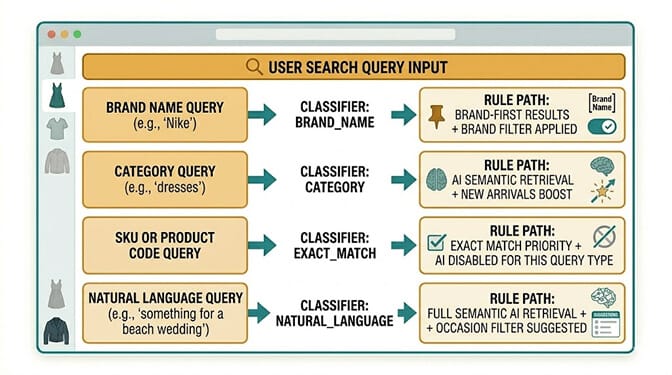
Different query types have different optimal search behaviors. Hybrid search applies different rule sets based on what type of query it's processing.
Navigational queries (brand names, SKUs, specific product names) should trigger near-exact matching with minimal AI interpretation. When a customer types "Nike Air Max 90," they want that specific product. AI semantic understanding may helpfully find related Nike products, which is not what the customer asked for. A navigational query rule applies lexical matching priority and suppresses AI reranking.
Exploratory queries (category words, vague descriptions, natural language) should trigger maximum AI semantic retrieval. When a customer types "casual shoes for spring," they're open to suggestions. The AI's ability to understand the intent and surface conceptually relevant products is at its most valuable here.
Hybrid queries (product type plus attribute, like "blue linen dress") benefit from both systems. The lexical engine handles the attribute specifics. The semantic engine handles the concept. The RRF merger combines both signals for a result that's both attribute-accurate and contextually appropriate.
The query-classification rule layer reads incoming queries and routes them to the appropriate retrieval and ranking configuration. This is what makes hybrid search genuinely adaptive: it doesn't treat all queries the same because all queries aren't the same.
Rule Type 4: Seasonal and Temporal Rules
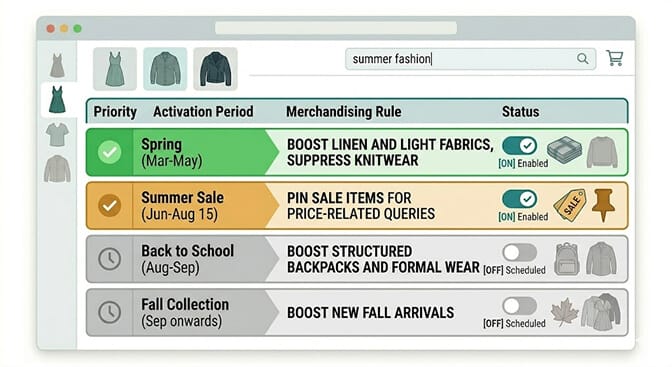
These are the rules that a purely AI-driven search system has no way of knowing on its own.
Your AI search doesn't know that your linen collection should surface first in spring and early summer but take a back seat to knitwear in autumn. It doesn't know that during your sale period, price-sensitive queries should bias toward your sale items. It doesn't know that a new collection launched last week should appear prominently for relevant queries even if it has fewer reviews and purchase signals than your established products.
Seasonal and temporal rules encode your business calendar into your search behavior. They activate and deactivate on schedules you define. They adjust which products surface prominently without requiring manual intervention every time the season changes.
This is the rule type that separates stores with intentional, business-aligned search from stores where the search happens to return relevant results but doesn't reflect what the store is actually trying to do commercially.
Putting It Together: What Hybrid Search Looks Like from the Customer Side
Here's the customer experience that all of this architecture produces.
A customer searches "lightweight dress for a beach wedding." The hybrid search system processes this:
The semantic engine recognizes this as an intent-based query. It identifies beach wedding as an occasion context, lightweight as a fabric/feel attribute, and dress as the product category. It retrieves a set of conceptually relevant products: flowy maxi dresses, lightweight midi dresses, relaxed linen styles, occasion-appropriate options.
The lexical engine matches products with title and tag elements matching "dress," "lightweight," "wedding," "beach." Some products appear in both lists with high scores.
The RRF merger combines both ranked lists, giving the highest scores to products that appeared strongly in both.
The business rules layer then applies: in-stock filter removes sold-out items, seasonal boost elevates your current summer collection, new arrival pin surfaces your just-launched beach wedding edit, and the price boost for your target margin range applies within the relevant set.
The customer sees: your most current, in-stock, commercially optimal selection of beach wedding appropriate dresses, ranked by a combination of relevance and business intent.
None of that would have happened with pure keyword search (too literal). None of it would have happened correctly with pure AI search (no business context). The hybrid produces the result that serves both the customer and your business.
If you want to see how your current search handles complex, occasion-based queries like this one right now, check your search analytics in Sparq and look at the conversion rate on natural language queries versus keyword queries. The gap tells you how much your current search architecture is leaving on the table. (For the metrics that matter most when evaluating search performance, see the search ROI KPIs every Shopify store should track.)
The Setup Reality: What Hybrid Search Requires
Here's the honest part of this conversation.
Hybrid search requires two things that pure AI or pure keyword search alone doesn't require in the same way: good product data and configured business rules.
Product data: the semantic engine is only as good as the product attributes, descriptions, and tags it indexes. If your catalog has sparse descriptions, inconsistent tagging, and missing attribute metafields, the AI retrieval will produce lower-quality results. The hybrid system amplifies good data and exposes gaps in bad data. Before implementing hybrid search, a catalog audit that fills in attribute gaps for your top products by traffic and revenue is the highest-leverage preparation. (Our guide to ecommerce search enrichment for Shopify walks through how to do this.)
Business rules configuration: the rules layer requires someone to configure and maintain it. What gets boosted and why. Which products get pinned for which queries. How seasonal rules are structured. This is an ongoing merchandising task, not a one-time setup. The payoff is significant: this rules layer is what makes your search commercially intentional rather than technically functional but commercially passive.
The good news for Shopify merchants: modern search apps handle the hybrid retrieval architecture natively. You don't need to build or maintain the RRF fusion logic. You configure the business rules in a dashboard. The complex technical layer, the vector embeddings, the RRF merger, the query classification, runs behind the interface.
Sparq's AI-powered search and filtering handles the hybrid retrieval architecture for Shopify stores, giving you the semantic understanding and keyword precision of hybrid search with a rules configuration interface that doesn't require technical expertise.
The Takeaway
The merchant with the "AI problem" didn't actually have an AI problem. She had an architecture problem.
Pure AI retrieval was giving her semantically relevant results with no commercial context. Her business rules, the things she'd learned from three years of running the store, existed nowhere in her search system.
She moved to a hybrid search approach with a rules layer. Inventory filtering. New arrival boosts. Seasonal promotions. Brand priority rules. The semantic AI continued to handle intent understanding. The rules layer brought the business logic.
Three months later: 23% improvement in search-to-purchase conversion. The complaint emails about out-of-stock results: stopped.
The intelligence came from the AI layer. The commerce came from the rules layer. Neither was enough without the other.
That's the hybrid architecture argument in two sentences. And it's why every Shopify store still running pure keyword search or freshly migrated to pure AI search is one configuration step away from better results.
Ready to see what your current search is returning and where the gaps are? Install Sparq on your Shopify store and run your most common customer queries through it. The results tell you which layer your store is missing. Prefer a walkthrough first? Book a demo or check pricing for your catalog size.
Frequently Asked Questions
What is hybrid search architecture for Shopify ecommerce?
Hybrid search architecture combines keyword-based (lexical) search and AI semantic search into a single system, then applies business rules on top. The lexical engine matches exact and near-exact keyword terms in product data. The semantic engine understands the meaning and intent behind queries using AI, finding conceptually relevant products even when the vocabulary doesn't match your product titles. The results from both systems are merged using an algorithm called Reciprocal Rank Fusion (RRF) to create a unified relevance ranking. Business rules then filter, boost, pin, and adjust that ranking based on inventory state, merchandising priorities, seasonal context, and commercial goals. The combination delivers both semantic relevance and commercial correctness that neither approach achieves alone.
Why does pure AI search fail without business rules in Shopify stores?
Pure AI semantic search is designed to find conceptually relevant products for a given query. It doesn't inherently know your inventory state, your merchandising priorities, or your commercial goals. Without a business rules layer, AI search may surface out-of-stock products in top positions, rank clearance items alongside current collections without distinction, ignore your promotion of new arrivals, and return results that are semantically relevant but commercially unoptimized for your specific business. Business rules apply post-retrieval filters and ranking adjustments that encode your commercial intent into the search output. AI retrieval provides relevance. Business rules provide commerce. Both are required.
How does Reciprocal Rank Fusion work in hybrid search for ecommerce?
Reciprocal Rank Fusion (RRF) is the algorithm that combines ranked results from your keyword search engine and your semantic search engine into a single unified list. Each product gets a score from each ranking system. RRF combines those scores using a formula that gives higher weight to products that rank well in both systems and still surfaces products that rank well in only one. This prevents either system from being ignored while preventing either from fully dominating. The result is a unified ranking that reflects both keyword precision (exact matches rank well) and semantic relevance (conceptually appropriate products that don't match exact keywords still surface). Most merchant-facing search apps handle RRF automatically in the backend.
How long does it take to configure hybrid search for a Shopify store?
The base hybrid search configuration (connecting the AI and keyword engines, applying basic inventory filtering) can typically be set up through a modern search app in a few hours without developer involvement. The business rules configuration, which is where the commercial value lives, takes longer because it requires merchandising decisions: what to boost, what to suppress, what seasonal rules to create, how to handle promotional periods. A useful approach is to launch with minimal rules (inventory filtering, new arrival boost) and add more rules over time based on your search analytics and merchandising calendar. The technical infrastructure is quick to deploy. The rules refinement is an ongoing practice.
Is hybrid search better than pure semantic AI search for all Shopify stores?
Yes, for any store where business rules matter, which includes virtually every store in practice. Pure semantic AI search without a rules layer produces results that are semantically relevant but don't account for inventory state, merchandising priorities, or commercial goals. For very small catalogs (under 50 products) where all items are always in stock and no merchandising rules are needed, pure AI search is adequate. For any store with meaningful inventory depth, seasonal collections, promotional periods, or margin considerations, the business rules layer that hybrid search provides is necessary for the search to serve both customers and the business effectively.