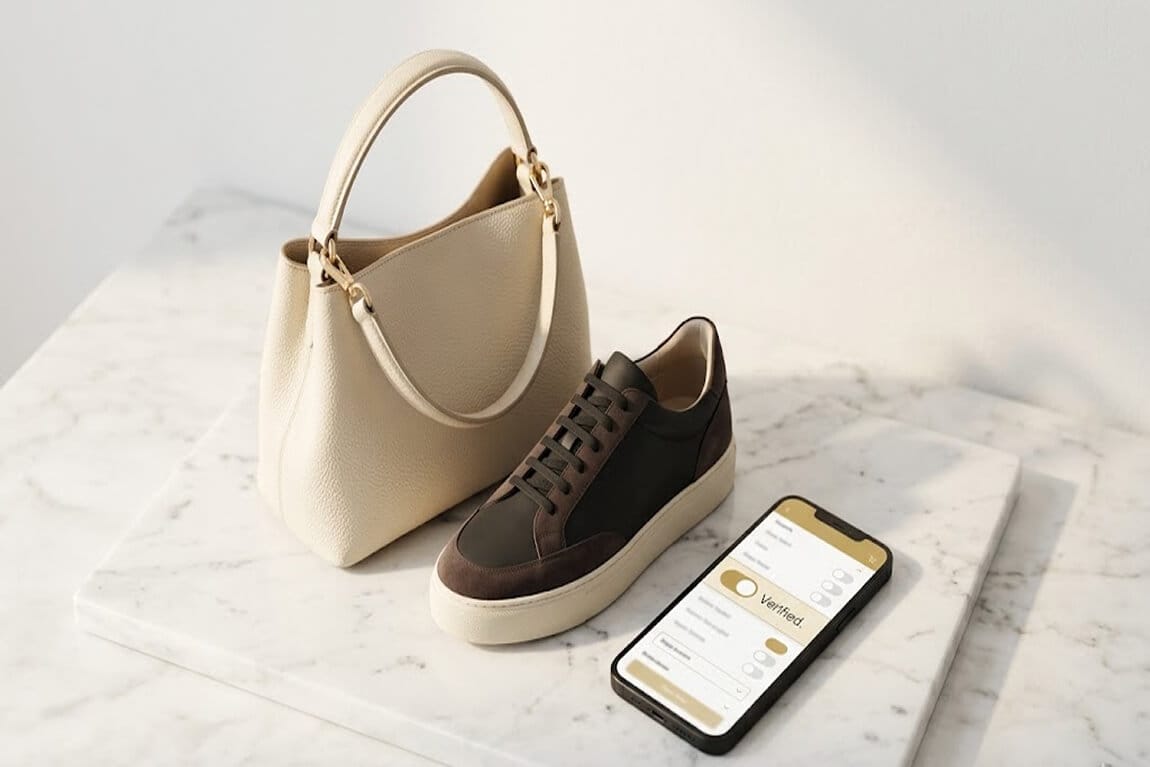
Blockchain-Backed Authenticity Filters: The Trust Layer Luxury & DTC Stores Will Compete On
The next great filter on your store isn't price or size. It's "verified real." Here's how blockchain quietly slips into your search bar, and why the brands ignoring it will lose the shopper they thought they already had.
She'd been on the product listing page for eleven minutes.
I know because I was watching the session replay. A returning customer of a small luxury accessories brand, scrolling, opening tabs, going back, scrolling again. Her cart was empty. Her hesitation was loud.
Then she dropped a question in chat. How do I know this is authentic?
The support agent typed back a perfectly polite answer about authentication cards and a serial number sticker. Three minutes later, the session ended. No purchase.
Here's the weird part. The product was genuine. The brand was genuine. The store had every reason to close that sale. What was missing wasn't authenticity. It was proof that she could see, in the moment, without leaving the page.
That's the exact gap blockchain-backed authenticity filters are about to fill. Stay with me, because this isn't a crypto pitch. It's a search and filter conversation, and it's already affecting your conversion rate.
First, the $50 billion problem nobody filters for
Counterfeit luxury goods are a roughly $50 billion annual problem on top of a $500 billion legitimate luxury market. The wider counterfeit economy across all categories is on track to push past $80 billion by 2026, and apparel sits at the top of that pile.
Now zoom in on what that does to a real shopper. About two thirds of consumers now check authenticity before they buy something premium. Listings without verifiable proof get walked away from, and resale market valuations drop by roughly 30% the moment authentication is in doubt.
Authenticity is no longer a brand promise. It's a filter parameter shoppers expect to flip on, the same way they expect to filter by size or color.
And this is the part most store owners get wrong. They think the trust signal belongs on the product page. It belongs in the filter. By the time a hesitant shopper reaches the PDP, they've already been training themselves to not trust what they see.
What a blockchain-backed authenticity filter actually is (in plain English)
Strip away the buzzwords. A blockchain-backed authenticity filter is a search and filter parameter on your store that lets shoppers narrow results to products whose authenticity has been written to a tamper-resistant digital record.
Each product gets a unique digital identity, usually tied to a QR code, an NFC chip in the tag, or an RFID label. That identity points to an immutable record showing where the item was made, by whom, with what materials, and who has owned it since.
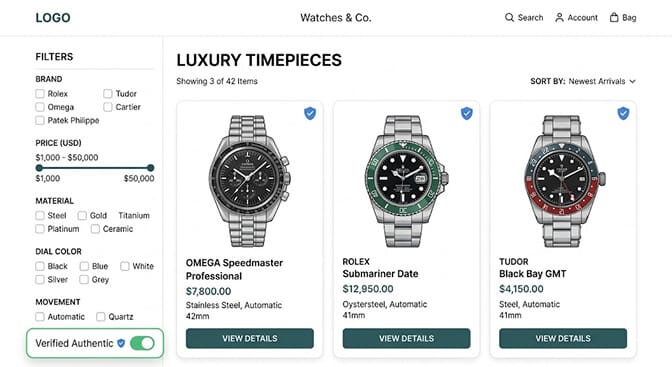
When that data is exposed as a filter, shoppers can do something that was impossible before: collapse a 400 product catalog down to only the items with a verifiable provenance trail, in one tap.
Here's why that matters for conversion. A shopper who is willing to filter for "verified" is a shopper who is willing to buy. You're not chasing them with a trust badge anymore. They're raising their own hand.
Pattern 1: The "Verified" toggle in the filter sidebar
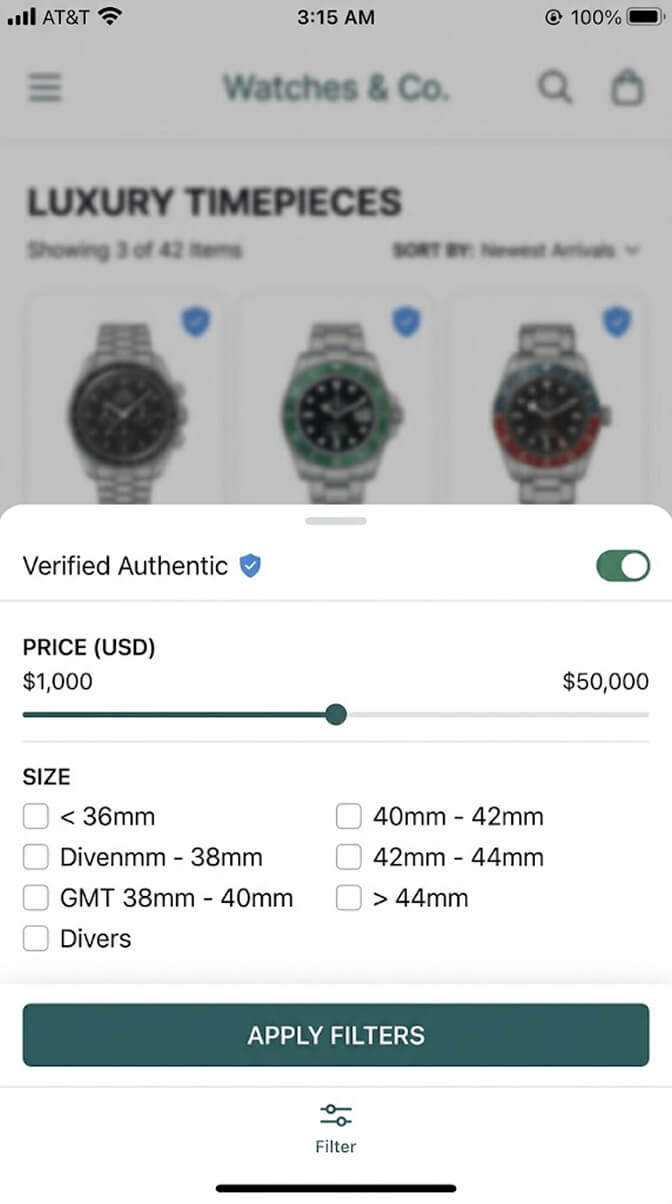
The cleanest implementation is a single binary toggle. On or off. One row in the filter sidebar, just under brand and price.
The merchant gets: an immediate self-segmentation of high-intent buyers. The shopper gets: the ability to filter out anything that doesn't carry a verifiable record, without reading a single product description.
Keep the label literal. "Verified Authentic" beats anything cleverer. Curiosity is not the goal here, certainty is.
Pattern 2: The provenance trail drill-down
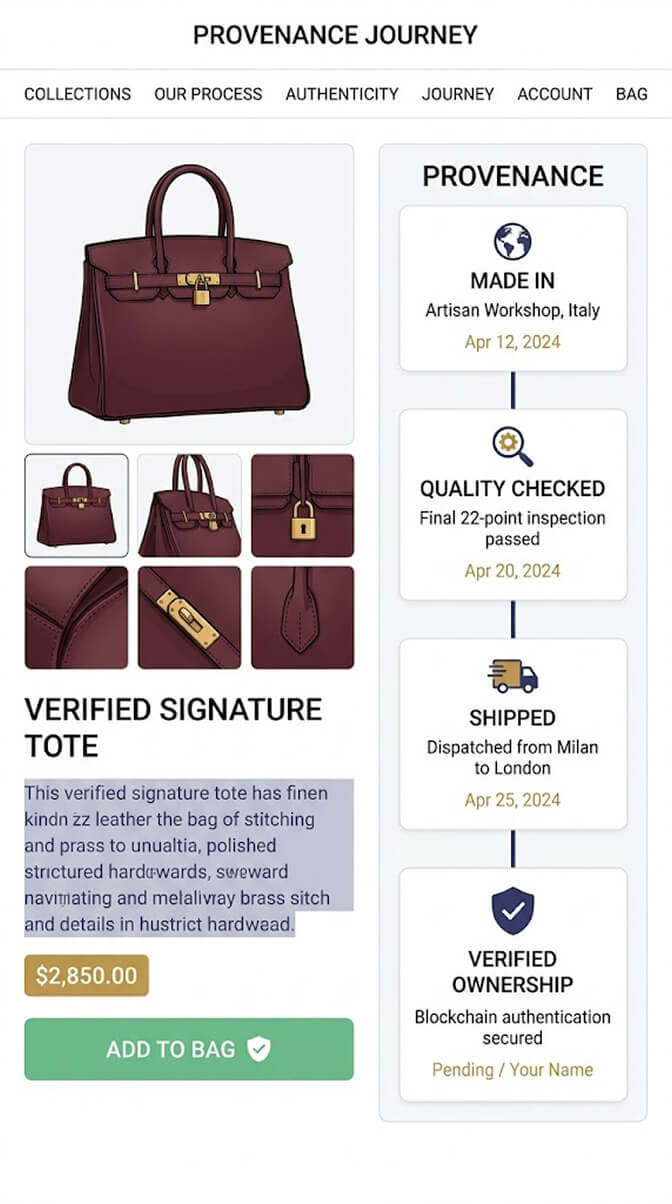
This one sits a level deeper. When the shopper opens a product card from filtered results, they see a small "Provenance" tab next to the usual description and shipping.
It doesn't dump a wall of blockchain hashes on them. It shows a clean four step trail. Where it was made. When quality was checked. When it shipped. Whether ownership has been recorded.
This is the part nobody tells you. The transparency itself sells. Shoppers do not need to understand the cryptography. They need to see that someone, somewhere, did the work to write the record. That's the entire psychological payload.
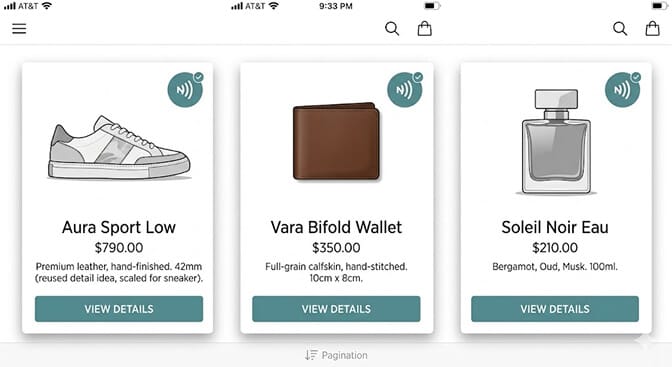
Pattern 3: The NFC tag verification badge on search cards
The badge appears on every search result card, not just inside the product page. It tells the shopper, before they even click, that this specific listing carries a physical NFC chip or QR tag they can scan after delivery to verify the item against the blockchain record.
That visual cue does two things at once. It builds trust at first glance and it sets a post-purchase expectation, which dramatically reduces return-and-refund fraud.
And this is the part that costs you money if you skip it. Stores that hide their authentication data behind product descriptions train shoppers to ignore the signal. Stores that surface it in the result grid train shoppers to look for it everywhere else.
Pattern 4: The pre-owned authentication filter
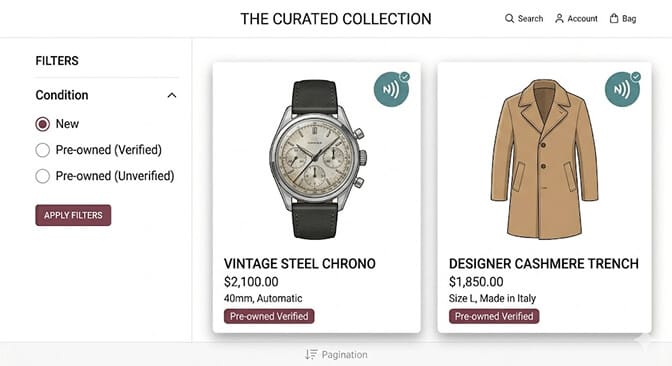
Resale is where this really earns its keep. Pre-owned items lose roughly 30% of their valuation the moment authenticity is in question. A filter that lets a shopper see only verified pre-owned items eliminates that doubt at the discovery stage.
For DTC brands experimenting with their own resale programs (and a lot of you are), this filter is the single most important UI element you can ship. Without it, your resale lane looks identical to a sketchy gray market. With it, you're suddenly competing with the well known luxury resale platforms on a level playing field.
If you want to see how dynamic, condition-aware filters can shift real conversion, our breakdown of why static filters quietly cost you sales gets into the mechanics.
Pattern 5: The Digital Product Passport compliance filter
This one isn't optional for much longer.
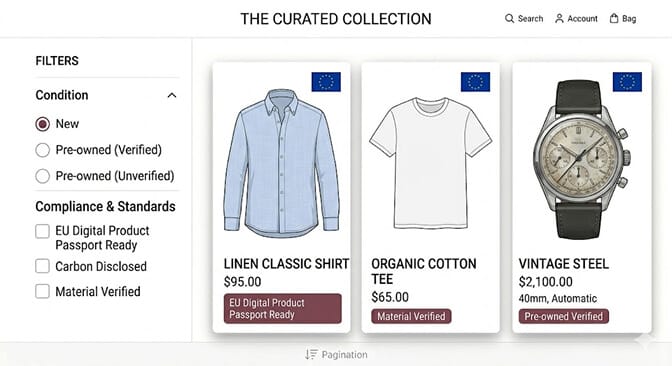
The EU's Digital Product Passport central registry goes live in July 2026. The textiles delegated act lands in late 2026 or 2027, with an 18 month compliance window after that. Battery products are already on a hard February 2027 deadline. By the time you read this, your future EU collections are already being designed under DPP rules.
What that means for your store: every product sold into the EU will eventually carry a scannable digital record. And the store that filters by DPP readiness before the deadline forces it, wins the early adopter shopper outright.
This isn't just compliance theater. It's a search and filter advantage. Our piece on how digital product passports plug into your Shopify filters goes deeper on that exact wiring.
Pattern 6: The authorized seller filter (for marketplaces and multi-vendor stores)
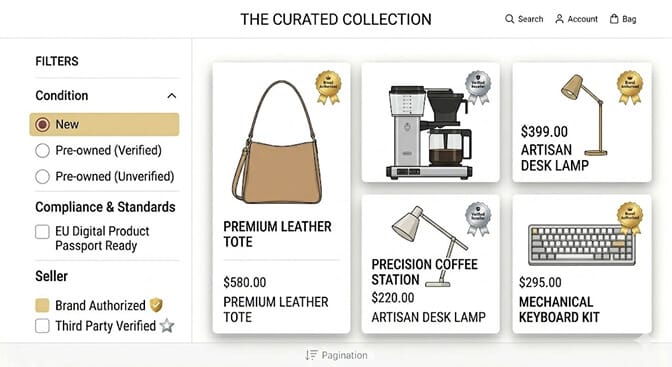
If you run a marketplace, dropship multi-brand, or operate a curated multi-vendor store, this filter is the difference between trustworthy and tolerated. Shoppers can collapse results to only the listings sold by a brand-authorized seller, with the relationship written to the same blockchain record as the product itself.
Stay with me here. This is what your platform competitors already do at the enterprise level. The reason it hasn't shown up on smaller stores yet is purely tooling. The tooling is about to catch up, fast.
If you want to see what your customers are quietly walking away from, look at the questions they ask in chat right before they leave. "Is this real?" is the single most expensive support ticket in luxury and DTC ecommerce.
If you want to surface this kind of trust filter without writing custom code, the AI filtering layer in Sparq's feature set can read any product metadata you already have, including authenticity attributes, and turn it into a working filter in about ten minutes. Free to try.
The DPP wave is the forcing function
Here's the timeline that nobody in your Shopify stack is talking about loudly enough.
July 2026, the EU DPP registry goes live. February 2027, battery passports become mandatory for products sold into the EU. Late 2027 to early 2028, the textiles delegated act finalizes. Mid-2029, full compliance for apparel. By 2033, fully circular DPPs for textiles, with lifecycle data baked in.
This is where most store owners get it wrong. They read those dates and think "I have time." You don't. Brands outside the EU still have to comply if they sell into the EU, and the supplier-side data gathering alone takes 12 to 18 months. The filter on the front of your store is the easy part. The data plumbing behind it is what eats six quarters.
Start building the filter now, even if the back end is incomplete. Shoppers reward the visible signal. Regulators reward the audit trail. You don't need both perfect on day one. You need both moving on day one.
What I'd skip (so you don't waste money)
Some honest limits, because nobody else is going to give them to you.
Don't build a custom blockchain. You'll never need it. Use existing public or consortium chains that other brands and resellers can read. Compatibility is the entire point.
Don't bury verification behind a separate microsite. If a shopper has to leave your store to verify, you've already lost most of the trust gain.
Don't put hashes or wallet addresses in your UI. Show the human-readable trail. The cryptography is the engine, not the dashboard.
And don't pretend this replaces good photography, honest copy, and clear returns. Authenticity filters amplify trust. They do not manufacture it.
What I wish more luxury and DTC merchants knew
The shopper who asked how do I know this is authentic? was not a problem customer. She was the most valuable signal in the entire session log.
She told you, in plain language, that her hesitation was solvable. Not with another discount. Not with another email. With a single visible filter that would have let her self-select into certainty.
The brands that win the next five years in luxury and DTC won't be the ones with the loudest marketing. They'll be the ones whose filters answered the trust question before the support ticket was ever opened.
You don't have to build a blockchain to do this. You just have to expose the data you (or your suppliers) already have, surface it in your filter sidebar, and let your highest intent shoppers raise their own hand.
That's the whole pitch. The shoppers who care are already there. They're just waiting for the toggle.
If you want to test what this kind of trust filter does to your conversion rate without a developer sprint, see how Sparq prices its AI search and filtering for growing Shopify stores. Most stores have it live in about ten minutes, and the search analytics alone tend to pay for the app inside the first month.
Frequently Asked Questions
What is a blockchain-backed authenticity filter?
A blockchain-backed authenticity filter is a search and filter parameter on a Shopify store that lets shoppers narrow product results to items whose origin and ownership history have been written to a tamper-resistant blockchain record. The verification is usually tied to a QR code, NFC chip, or RFID tag on the product, and the filter exposes that data as a toggle in the sidebar so shoppers can self-select for verified items in a single tap.
How does a blockchain authenticity filter compare to a regular "verified" badge on a product page?
A trust badge on a product page only helps after a shopper has already clicked into the item. A blockchain-backed filter works one level earlier, letting shoppers narrow the entire catalog to verified products before they ever open a listing. That difference matters most for high-consideration purchases in luxury and DTC, where shoppers are quietly filtering for certainty before they commit any attention to a specific item.
How do I add blockchain authenticity filters to my Shopify store?
You don't need to build a blockchain to add the filter. You need product-level metadata that points to an existing verifiable record, then a search and filtering app that can read custom metadata and turn it into a filter facet. With an AI-powered search and filtering app like Sparq, you can map any authenticity attribute you already store and expose it as a filter in roughly ten minutes, no developer required.
Is a blockchain-backed authenticity filter worth it for a small DTC brand?
Yes, even for small brands, especially in categories where counterfeits or copycats are a real problem (sneakers, fragrance, supplements, accessories, art). The filter does two things at once: it lifts conversion among high-intent shoppers by removing their last objection, and it positions a small brand alongside the larger players who already use authentication as a trust signal. The cost of adding the filter is small compared to the value of capturing the shopper who would otherwise walk.
Will blockchain authenticity filters work with Shopify's default search and the EU Digital Product Passport rules?
Shopify's default search cannot expose custom blockchain metadata as a usable filter, which is why most stores need a third-party search and filtering app to surface the data. The same plumbing that powers authenticity filters also makes EU Digital Product Passport compliance much easier, since the DPP registry going live in July 2026 expects a structured, scannable record for products sold into the EU. Brands that build the filter layer now will be ready for both.