Ecommerce search solutions in 2027: top tools, evaluation steps and measuring success
A shopper who types into your search bar has already told you what they want. When the results miss, they rarely try twice; they leave.
That happens more often than most store owners think. A Google Cloud study run by The Harris Poll found that 76% of US consumers had a retail site's search fail to show the item they wanted in the past month, and estimated that search abandonment costs US retailers over $234 billion a year (Google Cloud). Baymard Institute's 2026 benchmark found that 56% of ecommerce sites fail to adequately support users' search needs (Baymard).
Poor search is a quiet revenue leak. If you know it matters but need a clear way to choose, launch and measure the right ecommerce search solution, this guide is for you.
Here's what you'll find:
- What a good ecommerce search solution needs to do in 2027
- The top ecommerce search tools compared, with pricing, pros and cons
- Signs your store is ready for a better search tool
- A framework for evaluating vendors
- How to measure impact and ROI
We build Sparq, so read the comparison with that in mind. Competitor prices and policies come from each vendor's own pricing page, help centre or Shopify App Store listing, checked November 2026.
Why ecommerce search matters more than ever in 2027
Search users are your highest-intent visitors. They skip browsing and tell you exactly what they're looking for, so every miss is a lost sale and every good result is a shortcut to checkout.
Shoppers now search the way they talk to AI
Adobe found that traffic from AI assistants to US retail sites grew 393% year over year in Q1 2026, and 39% of consumers it surveyed had used AI assistants for online shopping (Adobe).
People who ask ChatGPT for "a carry-on suitcase that fits under a plane seat" expect your search bar to understand the same sentence. Keyword matching alone can't.
Your product data now has two audiences
Your catalog is read by shoppers using your search bar and by AI assistants recommending products on their behalf. Adobe reported that in March 2026, visits from AI sources converted 42% better than visits from other channels such as paid search and email (Adobe).
Shopify has also added a store-level knowledge base for AI shopping agents, readable through its Storefront MCP (Search Engine Journal). The clean, structured product data that powers good site search is the same data these agents quote.
What to look for in ecommerce search solutions
The best tool for you depends on your catalog, your team and your budget. But in 2027, a good ecommerce search solution should deliver on five fronts.
Search relevance and AI capabilities
- Typo tolerance: "jaket" and "sandels" should still return jackets and sandals.
- Synonyms: shoppers who type "couch" should find your "sofas".
- Semantic search: full sentences like "black dress for a winter wedding" should return relevant products, not every black item.
- Attribute understanding: "running shoes under $80" should respect the price.
- Exact matches first: a SKU or exact product name should put that product at the top.
Speed and reliability
- Instant results as shoppers type, on mobile as well as desktop.
- Fresh data: price, stock and new products should show up in search quickly.
- Handles traffic peaks such as Black Friday without slowing down.
- Light storefront footprint: search code shouldn't slow your pages or leave code behind when removed.
Merchandising and business control
- Pin, boost and bury: push bestsellers or high-margin products up and out-of-stock items down.
- Synonyms, redirects and banners: send "returns" or "size guide" straight to the right page.
- No-code controls: the person who runs search day to day shouldn't need a developer.
Filters and navigation
- Filters built from your own product data, such as size, color, material and fit.
- Filters on collection pages, not only on search results.
- No tight caps: check whether filter counts or filter menus are limited by plan.
Analytics and insights
- Top searches and how they convert.
- Zero-result searches, so you can add synonyms, redirects or products.
- Revenue from search, so you can prove the tool pays for itself.
Top ecommerce search solutions for 2027
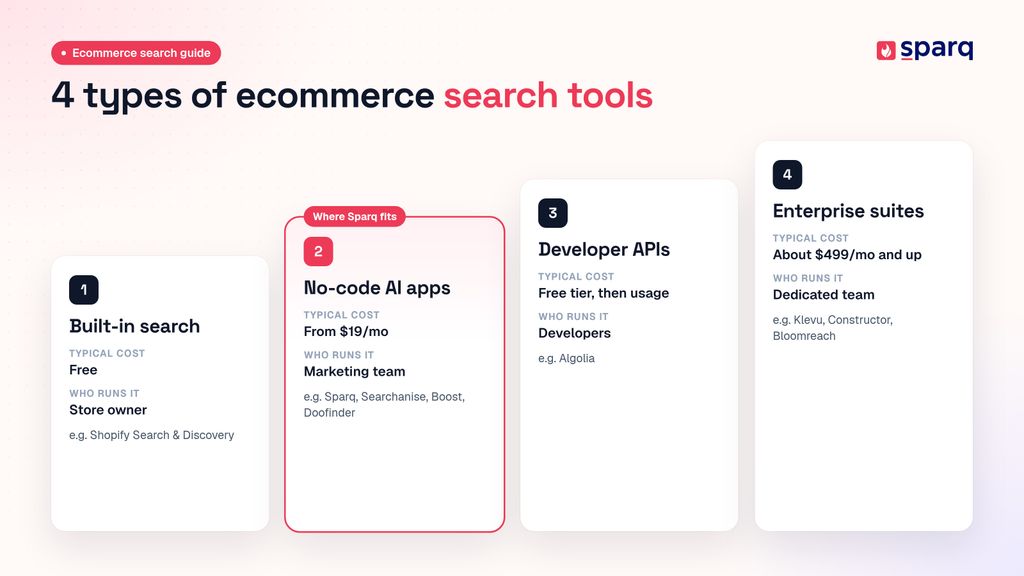
There are many search tools out there, but they fall into four groups: built-in platform search, no-code AI search apps, developer search APIs and enterprise suites.
Here's how the leading tools compare.
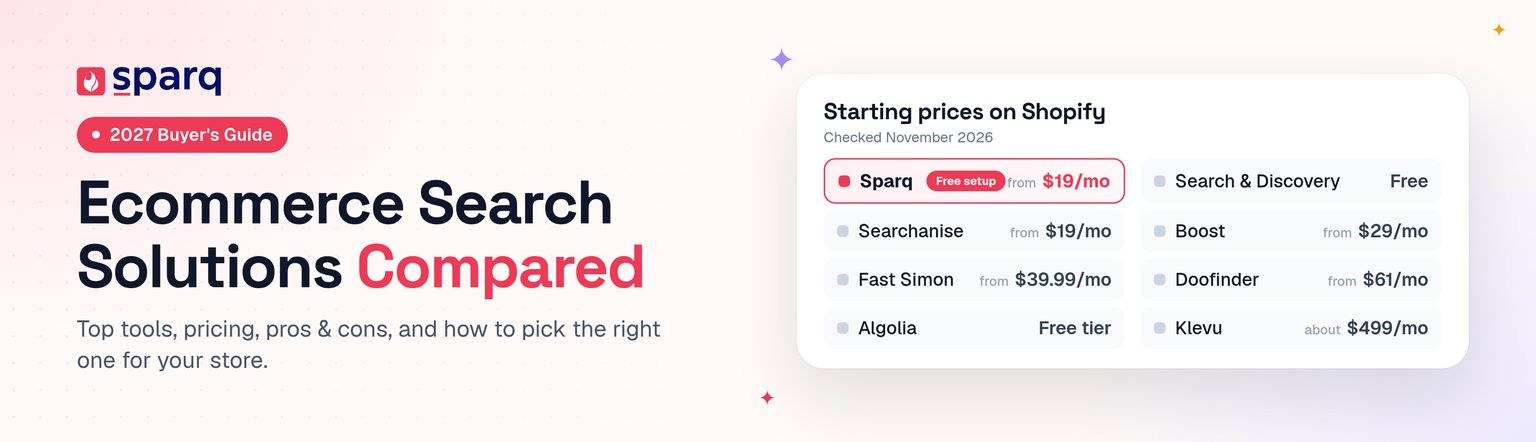
| Tool | Type | Starts at | Priced by | Setup |
|---|---|---|---|---|
| Sparq | No-code AI app | $19/mo | Products + impressions | Done for you, free |
| Search & Discovery | Built-in | Free | — | Self-serve |
| Searchanise | No-code app | $19/mo | Product count | Self-serve |
| Boost | No-code app | $29/mo | Store sales (GMV) | Self-serve |
| Doofinder | No-code app | $61/mo | Server requests | Self-install |
| Fast Simon | No-code app | $39.99/mo | Site sessions | Self-serve |
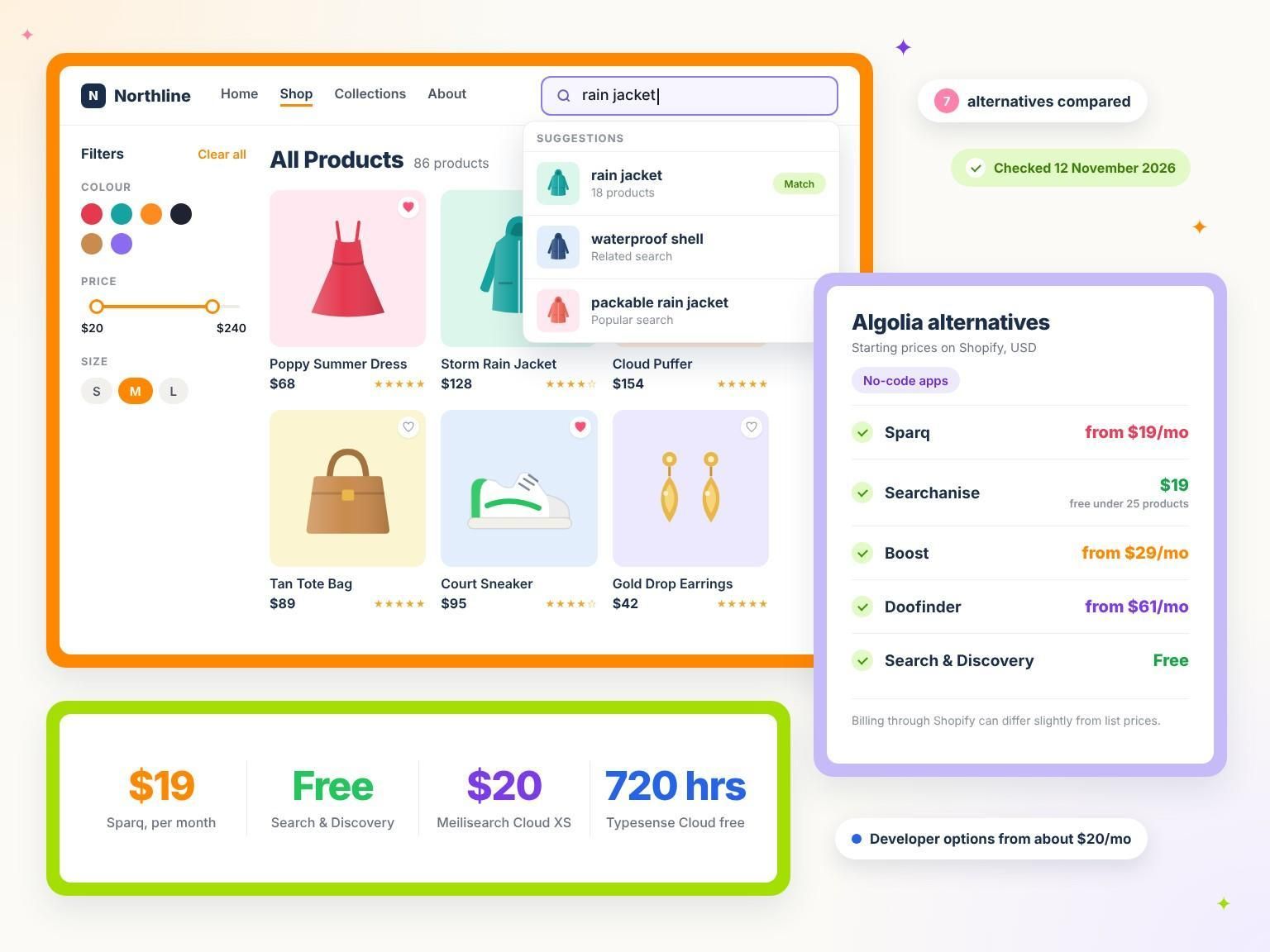
| Algolia | Developer API | Free tier | Search requests | Developer |
| Klevu (Athos Commerce) | Enterprise | About $499/mo | Contract | Vendor-led |
Shopify starting prices, checked November 2026. Prices change, so confirm with each vendor before you buy.
Sparq
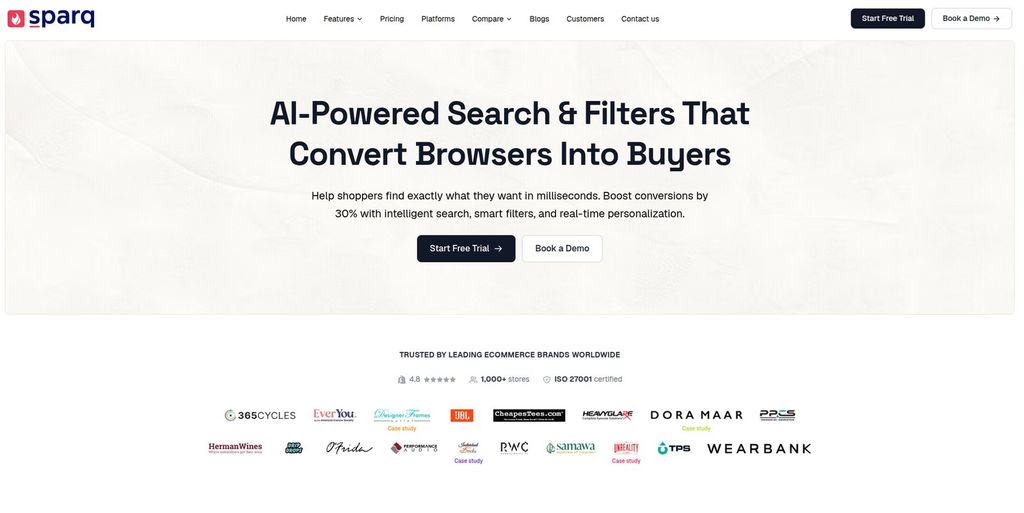
Overview: Sparq is an AI search and product discovery app built for Shopify, with versions for WooCommerce, BigCommerce, PrestaShop, Magento and headless stores. It gives growing stores AI semantic search, unlimited filters, no-code merchandising, product recommendations and search analytics, and the Sparq team sets it up for you at no extra cost.
Pros:
- AI semantic search understands typos, synonyms and full-sentence queries out of the box
- Unlimited filters on every plan, with a filter menu for every collection
- Free setup and migration by the Sparq team, with no theme code edits
- 24/7 live chat support, plus published response targets (24h, 12h and 4h by plan)
- Zero-result reports and search analytics in the dashboard
- Search keeps running if a busy month goes over your plan
- Built for Shopify and rated 4.8 on the Shopify App Store
Cons:
- No free plan; the lowest plan is $19/month
- Rule-based merchandising is listed as Coming Soon
- A no-code app, not a developer search API
Best for: Shopify stores with 500 to 50,000 products that want AI search and filters without hiring a developer.
Pricing:
- Standard: $19/month (2,500 products, 30,000 impressions)
- Premium: $59/month (7,500 products, 100,000 impressions)
- Enterprise: $299/month (50,000 products, 500,000 impressions)
- 14-day free trial. An impression is a shopper interaction with Sparq search or filters; extra usage is a one-time charge. See Sparq pricing.
Shopify Search & Discovery
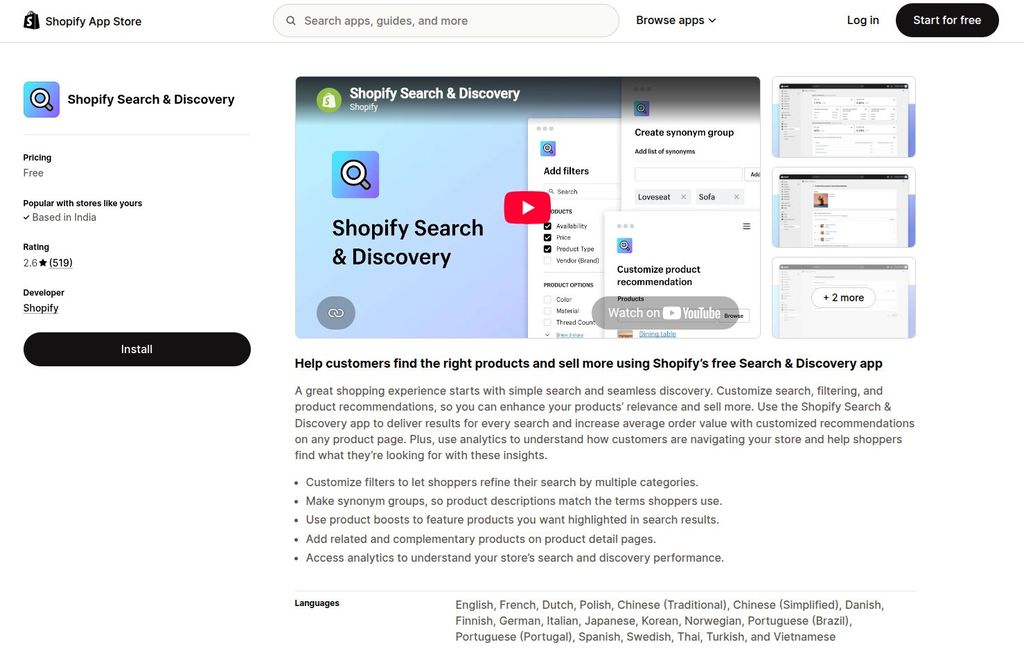
Overview: Shopify's free app adds filters, synonyms, product boosts and basic recommendations to native Shopify search (Shopify).
Pros:
- Free and built into Shopify admin
- Nothing extra to load on the storefront
Cons:
- Capped at 25 filters per store
- No filters on collections with more than 5,000 products
- Can't set a different filter menu per collection
- Support runs through Shopify's general support queue
Best for: New stores with small, simple catalogs, and as the baseline to beat when you trial a paid tool.
Pricing: Free. See Sparq vs Shopify Search & Discovery.
Searchanise
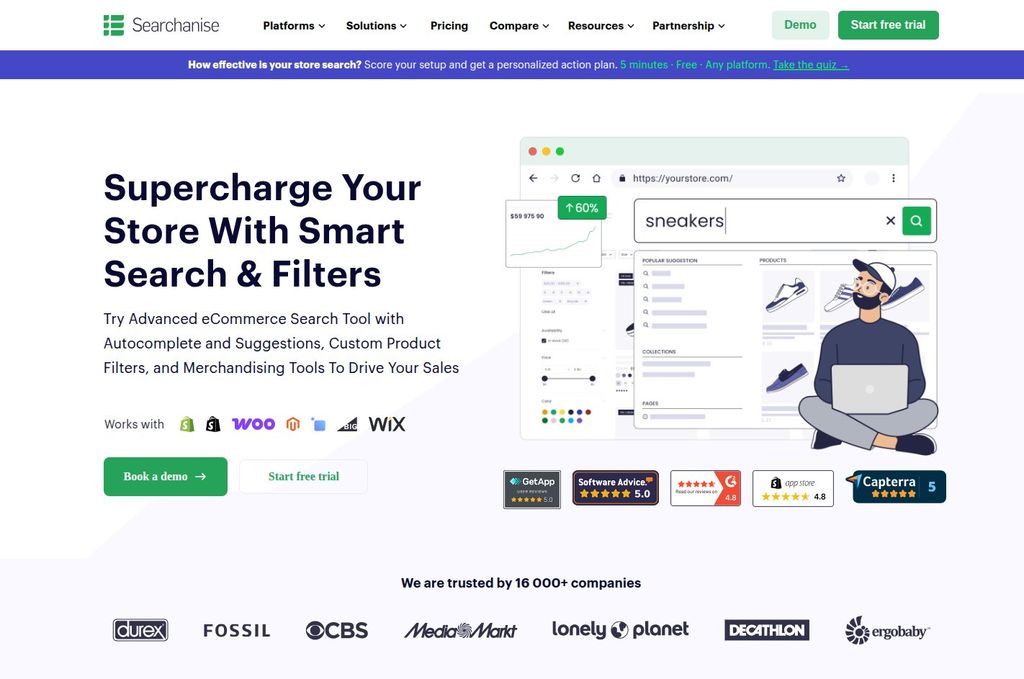
Overview: A long-running search and filter app with low entry pricing based on catalog size (Shopify App Store).
Pros:
- Free plan for stores under 25 products
- Low entry price for small catalogs
Cons:
- The $19 plan covers only 1,500 products
- Price rises with every product-count tier
Best for: Small catalogs where price per product matters most.
Pricing:
- From $19/month for up to 1,500 products
- $39/month for 7,500 products, up to $349/month for 300,000
- Free under 25 products
See Sparq vs Searchanise.
Boost AI Search & Filter
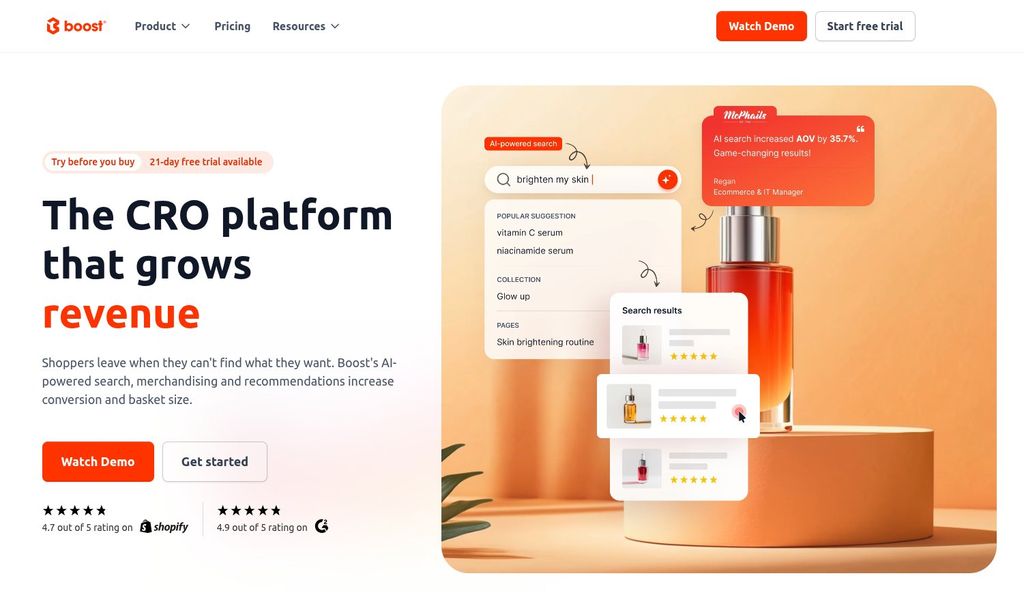
Overview: A Shopify search and filter app focused on collection filtering and filter trees.
Pros:
- Wide range of filter options
- 21-day free trial
Cons:
- New installs since October 2025 are priced by store sales (GMV), so the bill rises as revenue grows
- Adds $2 per $1,000 of sales over the plan cap
- Filter trees and metafield filter slots are limited by plan
- Complex customization is quoted separately; no published support response time
Best for: Stores where filtering is the main problem to solve.
Pricing: From $29/month, set by average monthly sales over three months. See Sparq vs Boost.
Doofinder
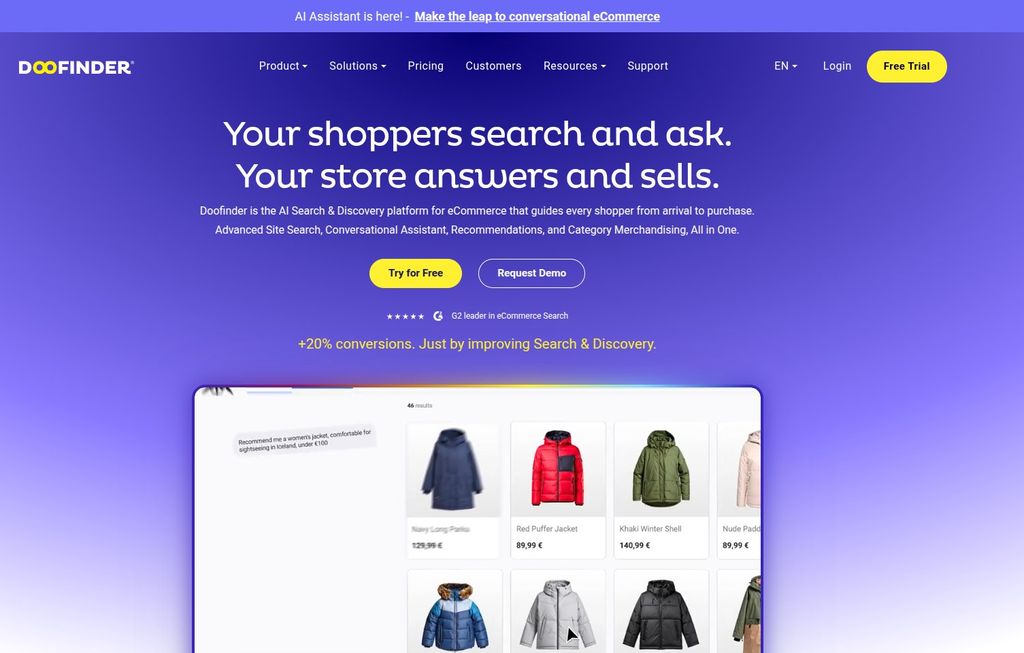
Overview: A search and discovery tool popular with European stores and brands that sell on several platforms (Capterra).
Pros:
- Supports many ecommerce platforms
- 15-day free trial
Cons:
- Shopify plans start higher than most no-code apps
- Metered by server requests, so search, filters, pagination and recommendations all add usage
- Self-install; support starts with an AI assistant, with human agents Monday to Friday
Best for: Brands running more than one storefront platform.
Pricing: Shopify plans at $61, $186 and $436/month; Enterprise is custom. See Sparq vs Doofinder.
Fast Simon
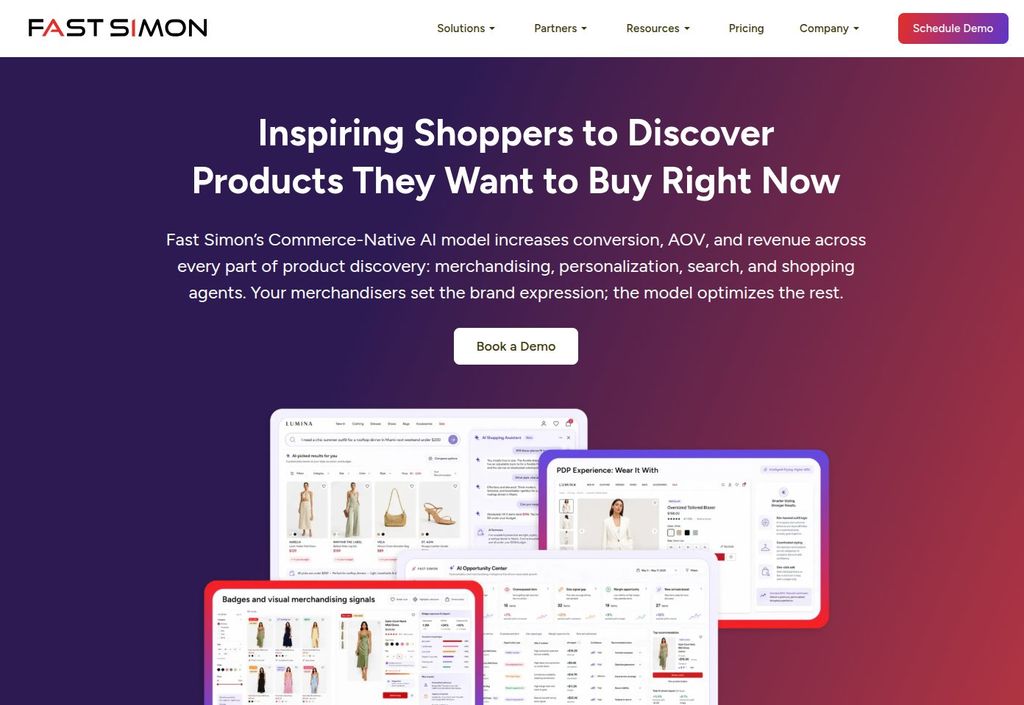
Overview: A Shopify search and discovery app with visual search and merchandising features, priced by monthly site sessions.
Pros:
- Visual search and merchandising tools
- Free plan for very small stores (100 sessions a month)
Cons:
- Plans are capped by site sessions, not searches, so all traffic counts
- Collection filters start on the Essential plan
- Its help centre says service can be blocked for shoppers if usage consistently exceeds the plan
Best for: Stores that want visual search and can predict their traffic.
Pricing:
- Starter: $39.99/month (2,000 sessions)
- Essential: $114.99/month (10,000 sessions)
- Top Pro: $299.99/month (30,000 sessions); larger plans by request
See Sparq vs Fast Simon.
Algolia
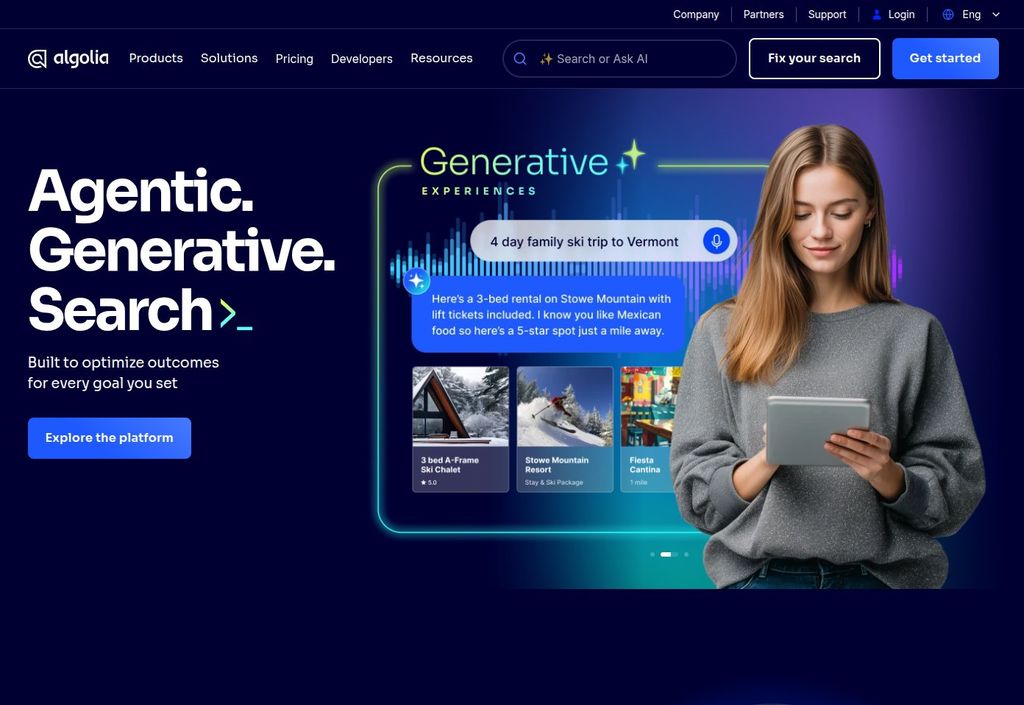
Overview: A developer search API with a Shopify app, priced per search request (Algolia).
Pros:
- Free tier for testing and low-traffic stores
- Flexible API that suits headless and custom front ends
Cons:
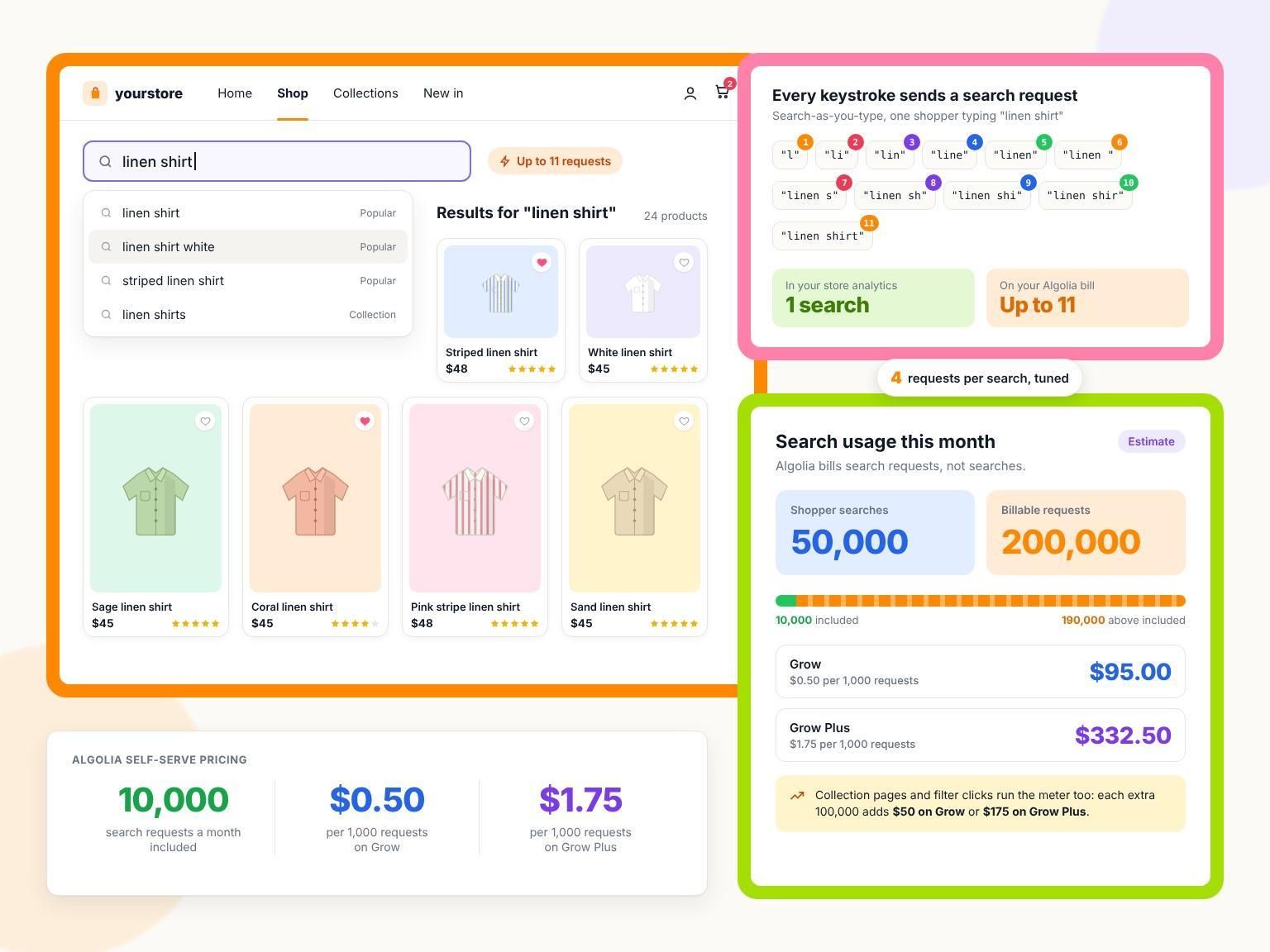
- Autocomplete sends a billable request on every keystroke, so bills rise with traffic
- AI ranking and the merchandising studio need the higher Grow Plus rate
- Setup and tuning usually need a developer
- Shopify plans include self-service support only, and Algolia bills separately from Shopify
Best for: Custom or headless storefronts with an engineering team.
Pricing:
- Free: 10,000 search requests and 50,000 records a month
- Grow: $0.50 per extra 1,000 requests
- Grow Plus: $1.75 per extra 1,000 requests
- Elevate: annual contract, by quote
See our breakdown of Algolia pricing for ecommerce and Sparq vs Algolia.
Klevu (now Athos Commerce)
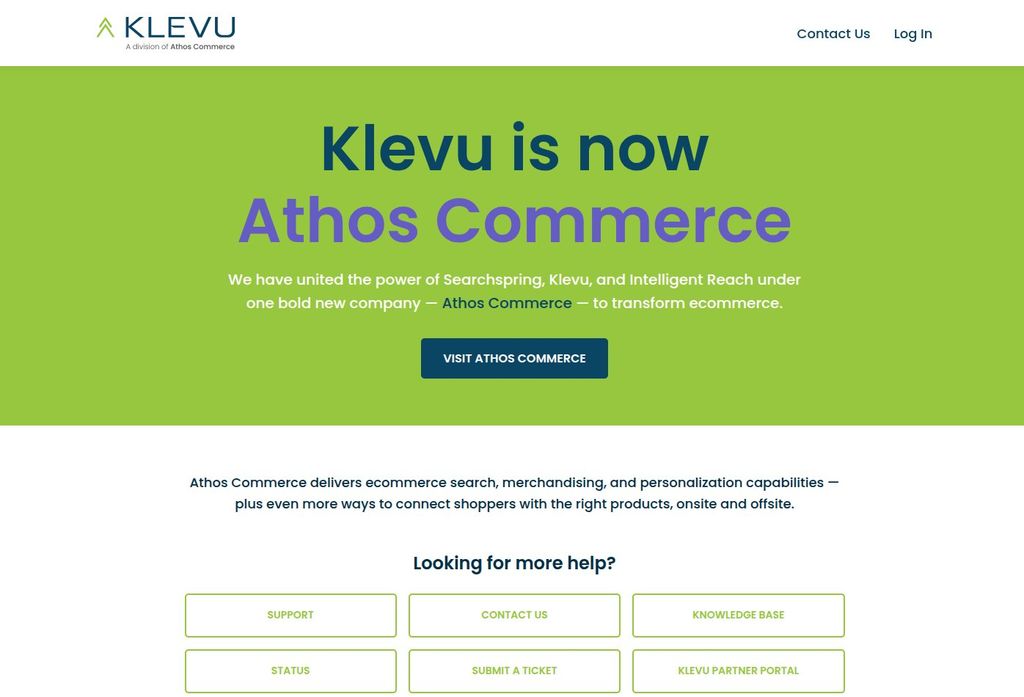
Overview: Klevu is an AI search and discovery platform for mid-market and enterprise retailers. Its website now says Klevu has joined Searchspring and Intelligent Reach under one company, Athos Commerce, which sells search, merchandising and personalization.
Pros:
- AI search with merchandising and recommendation modules
- Now part of a larger suite that also includes Searchspring
Cons:
- Entry price is well above no-code apps
- Pricing is not self-serve; plans go through sales
- Products and plans may change as the brands merge into Athos Commerce
Best for: Larger retailers with budget for a dedicated discovery platform.
Pricing: Klevu's paid plans have been listed from around $499/month on Capterra (Capterra); check current pricing with Athos Commerce.
Signs your store is ready for a better search tool
Before you switch, check whether your current search is actually holding you back. Here are the most common signals.
Performance signals
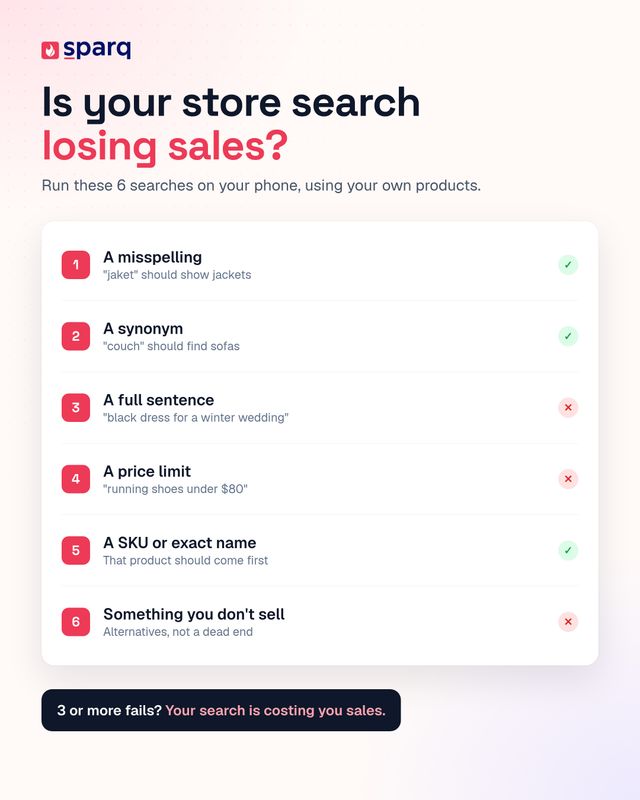
- Failed searches: on your phone, search for a misspelling, a synonym, a full sentence, a product with a price limit, a SKU and something you don't sell. If three or more fail, search is costing you sales.
- High zero-result rate: open your search report (in Shopify, Analytics > Reports) and note every search that returned nothing.
- Shoppers search twice: lots of reworded searches mean the first results missed.
- Search converts no better than browsing: search users have stated intent, so they should convert higher.
Growth signals
- Your catalog is growing past a few hundred products, and browsing alone no longer works.
- You sell on more than one platform or in more than one market.
- You need merchandising control, such as pinning products or running campaigns from search.
Platform signals
- You've hit a plan limit, such as filter caps or collection size limits.
- Your team relies on workarounds, like hidden tags or hand-built synonym lists.
- You have no developer, so any tool you pick has to be run by marketing or ecommerce staff.
AI-readiness signals
- Product titles use internal codes, not the words shoppers use.
- Attributes are missing, so size, material and fit can't power filters or AI answers.
- Zero-result searches go unread, when each one is a phrase to add to a product page, a synonym or a new collection.
Evaluation criteria for selecting ecommerce search tools
Use these criteria with the comparison above to find the right fit.
Business needs
- Catalog size: most tools price by products, so check which tier your catalog lands in.
- Traffic and peaks: request-, session- and sales-based pricing all rise during Black Friday and holiday sales.
- Team: decide who will run search day to day, and whether they need a developer.
- Platforms and markets: check support for every storefront and language you sell in.
- Budget and total cost: include setup, support plans and developer time, not just the monthly fee.
Technical considerations
- Speed: results should feel instant, on mobile too.
- Index freshness: how fast price, stock and new products appear in search.
- Reliability: what shoppers see if the service goes down.
- Storefront impact: whether the code touches cart or checkout, and whether uninstalling restores your theme.
Vendor evaluation checklist
- Trial on your own catalog: test with your real top searches and zero-result queries, not a demo store.
- Setup: who sets it up, and is it included in your plan?
- Support: published response times, channels and hours.
- Pricing transparency: what exactly you're billed on, and what happens if you go over.
- Contract: monthly or annual, and how cancellation and renewal work.
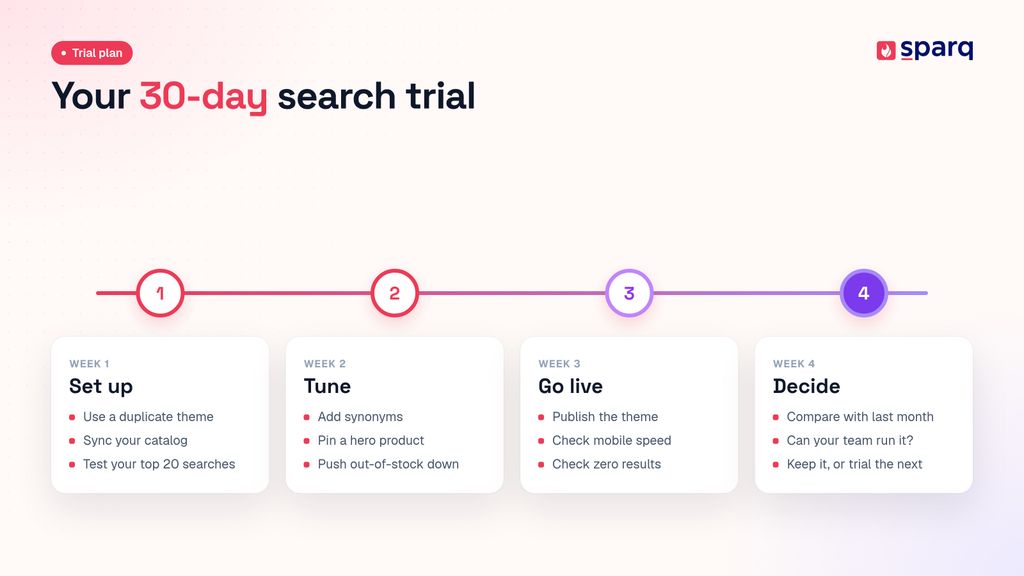
A simple trial plan: set up on a duplicate theme in week 1, tune synonyms and rankings in week 2, go live in week 3, and compare search numbers with the previous month in week 4.
Measuring ROI and success
A search tool only makes sense if it moves your numbers. Here's how to track it.
Key performance indicators
Search quality metrics:
- Search click-through rate: how often a search leads to a product click.
- Zero-result rate: the share of searches that return nothing.
- Search refinement rate: how often shoppers reword a search.
Business impact metrics:
- Search conversion rate: the share of search sessions that end in an order.
- Average order value from search: whether searchers spend more.
- Revenue from search: search sessions' share of total revenue.
ROI calculation framework
Start with break-even: how many extra orders a month cover the subscription?
Extra orders needed per month = Monthly tool cost ÷ (Average order value × Gross margin)
Illustrative example (not customer data): on a $59/month plan, with a $60 average order and a 40% margin, each order earns $24 in gross profit. You need about 2.5, so three extra orders a month to break even. Plug in your own numbers with the Sparq ROI calculator.
When to expect results
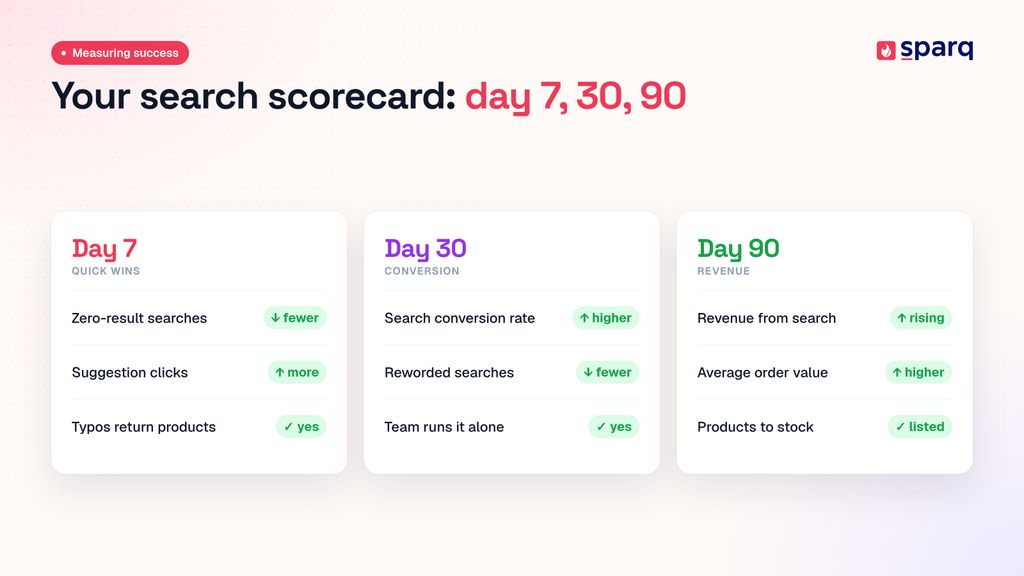
- Day 7: fewer zero-result searches, and more clicks on search suggestions.
- Day 30: higher conversion from search sessions and fewer reworded searches.
- Day 90: a rising share of revenue from search and higher average order value, as merchandising and recommendations kick in.
Success stories
- Designer Frames Outlet: the eyewear retailer improved its conversion rate by 28% and cut bounce rate by 15% after moving to Sparq's predictive search.
- Dora Maar: the jewelry store saw a 23% increase in conversion rate from Sparq users, with faster filter page loads.
- Canadian street fashion brand: the fashion and footwear retailer grew its average order value by 18% with Sparq search and merchandising.
Better ecommerce search, better business results
Search is where shoppers tell you exactly what they want. The tool you pick decides whether they find it, and in 2027 the same product data also decides whether AI assistants recommend you.
What's next:
- Check your current search against the signals above.
- Define your needs using the evaluation criteria.
- Shortlist two or three tools from the comparison that fit your catalog, team and budget.
- Trial on your own catalog and judge the results at day 7, 30 and 90.
Sparq gives growing stores AI semantic search, unlimited filters, no-code merchandising and search analytics, set up for you at no extra cost. Try Sparq free for 14 days or book a free demo and site search audit.
Frequently Asked Questions
What is the best ecommerce search solution?
It depends on your store. Shopify Search & Discovery suits new stores with small catalogs, no-code AI apps like Sparq suit most growing Shopify stores without developers, Algolia suits custom builds with an engineering team, and enterprise suites like Klevu (now Athos Commerce) suit large retailers.
How much does ecommerce search cost?
Built-in search is free. No-code apps start from about $19 to $61 a month on Shopify and scale by products, sessions, sales or requests. Developer APIs like Algolia have a free tier and then charge per search request. Enterprise suites start around $499 a month or more.
Is Shopify's free search good enough?
For a small catalog, often yes. Search & Discovery is capped at 25 filters and shows no filters on collections over 5,000 products, so growing stores that need more filters, ranking control or analytics usually move to a dedicated app.
How long does it take to switch search tools?
No-code apps usually go live within a day on a duplicate theme, and some, like Sparq, are set up for you. Developer APIs and enterprise suites take weeks because the front end has to be built or customized.
Will changing my search tool affect SEO?
Site search results pages are usually not indexed, so the direct SEO effect is small. Watch page speed, and make sure any app you remove cleans up its code.
Sources
- Google Cloud and The Harris Poll: search abandonment research (2023)
- Adobe: AI traffic to US retail sites, Q1 2026
- Baymard Institute: Ecommerce Search UX 2026
- Search Engine Journal: Shopify knowledge base for AI agents
- Shopify Search & Discovery
- Sparq pricing
- Searchanise on the Shopify App Store
- Doofinder on Capterra
- Klevu on Capterra
- Algolia pricing explained