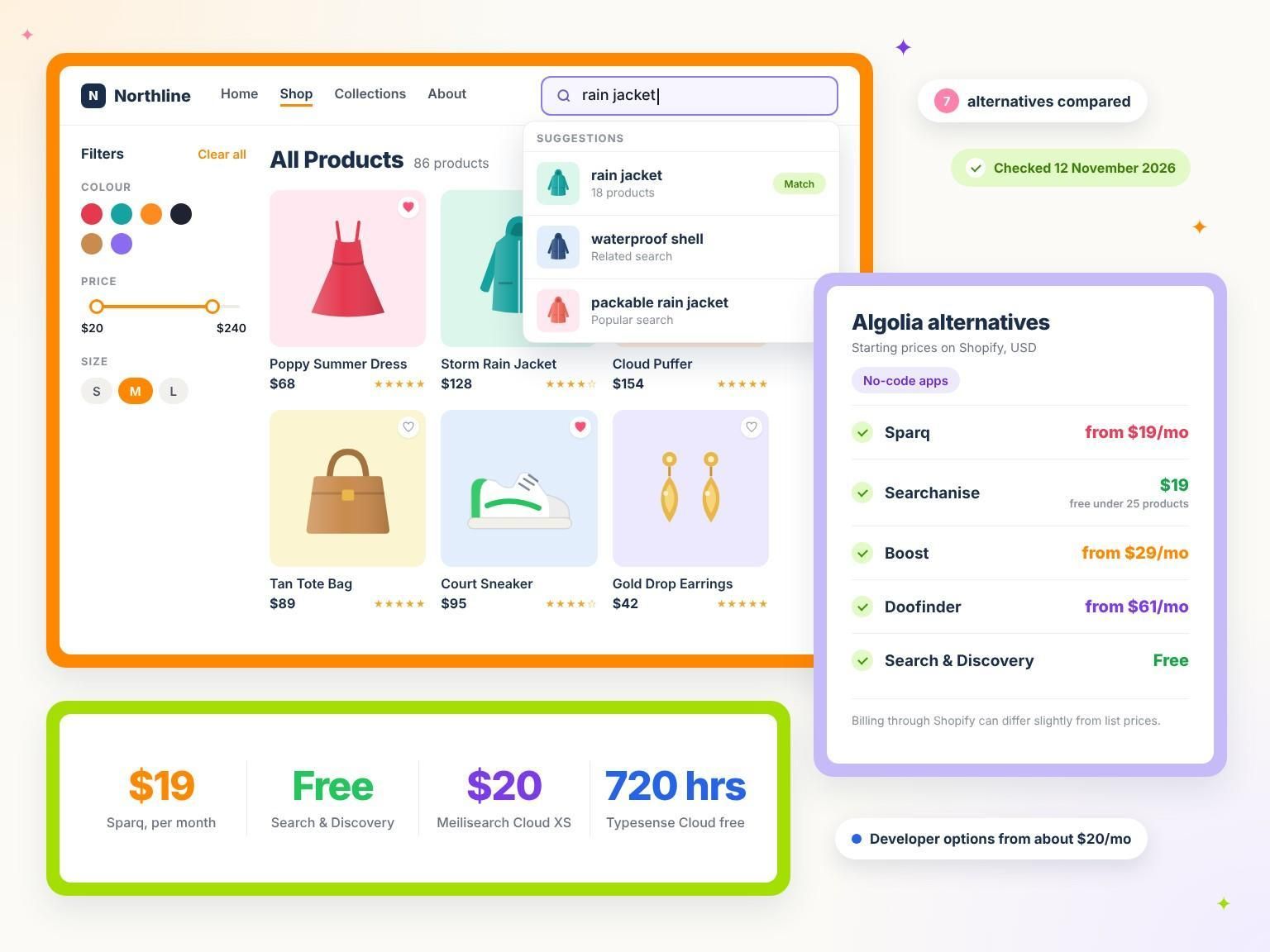
Algolia Pricing in 2026: What Algolia Costs an Ecommerce Store
Algolia pricing starts with a Free plan (10,000 search requests and 50,000 records a month). Past that, Grow costs $0.50 and Grow Plus $1.75 per extra 1,000 search requests, plus $0.40 per extra 1,000 records. Elevate is a quoted annual contract, and a store with 50,000 searches a month can expect roughly $20 to $680 in search charges.
Picture this: you switch on Algolia in November, the search bar feels fast, and the first invoice lands in December. It's several times what you budgeted, and nothing about the plan you picked looks wrong.
Here's the catch. Algolia bills for search requests, not searches, and on a typical Shopify setup those are very different numbers.
We build Sparq, a Shopify search and filter app that competes with Algolia, so read this with that in mind. Every Algolia number below comes from Algolia's own pricing page, FAQ, support articles and docs, checked 12 November 2026, and we say plainly where Algolia is the better buy.
If you're still choosing between apps, our comparison of the best ecommerce search engines for Shopify covers the wider field. This post does one job: it shows what the Algolia cost will be for your store, and why.
Algolia pricing at a glance: the four plans
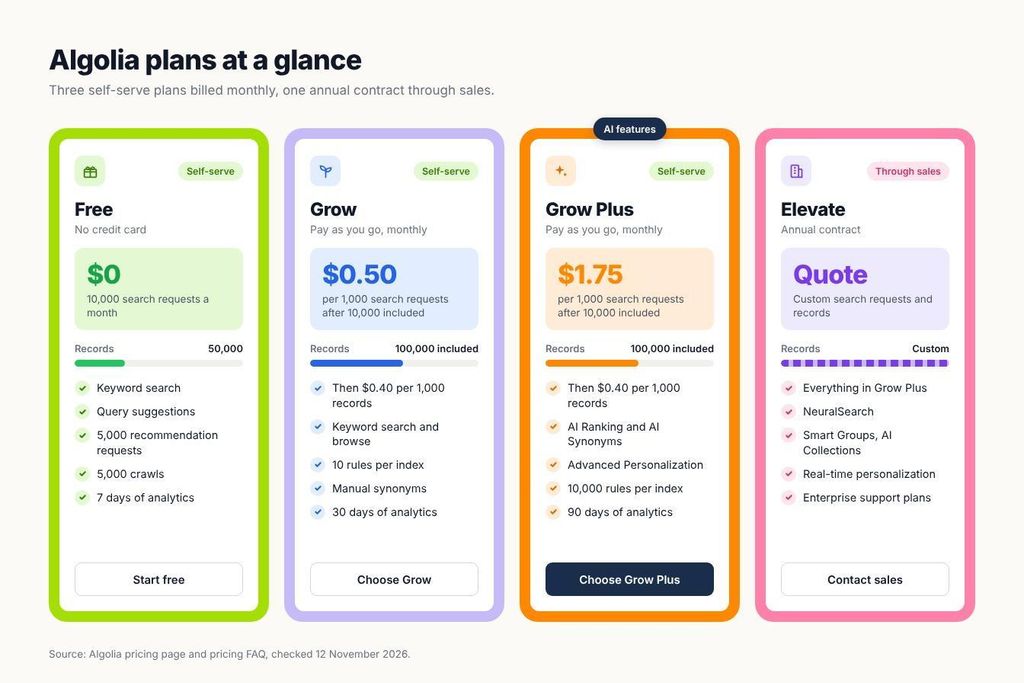
Algolia sells four plans. Free, Grow and Grow Plus are self-serve, while Elevate goes through sales.
| Plan | Billing | Search requests | Records | Main features |
|---|---|---|---|---|
| Free | Free, no credit card | 10,000 a month | 50,000 | Keyword search, query suggestions, 5,000 recommendation requests, 5,000 crawls, 7 days of analytics |
| Grow | Pay as you go, monthly | 10,000 included, then $0.50 per 1,000 | 100,000 included, then $0.40 per 1,000 | Keyword search and browse, 10 rules per index, manual synonyms, 30 days of analytics |
| Grow Plus | Pay as you go, monthly | 10,000 included, then $1.75 per 1,000 | 100,000 included, then $0.40 per 1,000 | Everything in Grow, plus AI Ranking, AI Synonyms, Advanced Personalization, Collections, 10,000 rules per index, 90 days of analytics |
| Elevate | Annual contract, priced by quote | Custom | Custom | Everything in Grow Plus, plus NeuralSearch, Smart Groups, AI Collections, real-time personalization, enterprise support plans |
Source: Algolia's pricing page and pricing FAQ, checked 12 November 2026.
According to Algolia's FAQ, Grow and Grow Plus have no contract. Elevate requires an annual contract, and volume discounts only come with one.
What about the Shopify app? Algolia AI Search & Discovery is free to install on the Shopify App Store and lists the same plans. Its listing says Algolia may bill you separately from your Shopify invoice, and that support is self-service unless you contact sales.
So the sticker prices are clear. What's less clear is how fast your store runs the meter.
What counts as a "search request" on Algolia
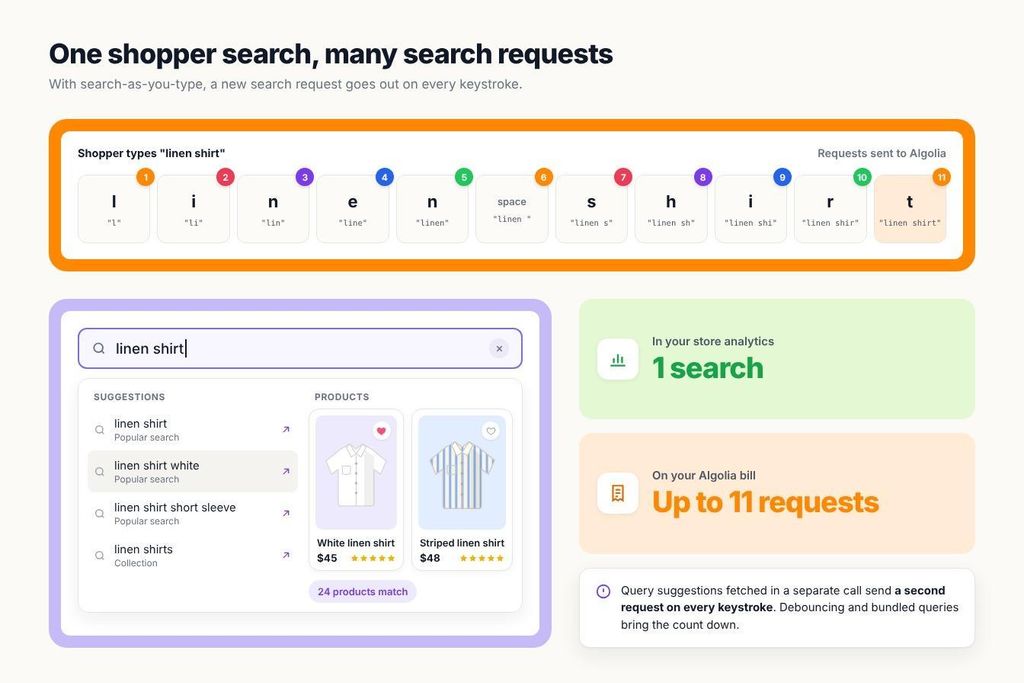
Algolia's FAQ defines a search request as a group of one or more search operations sent in a single exchange. The next line is the one that matters for a store: in autocomplete and search-as-you-type setups, a new request goes out on every keystroke.
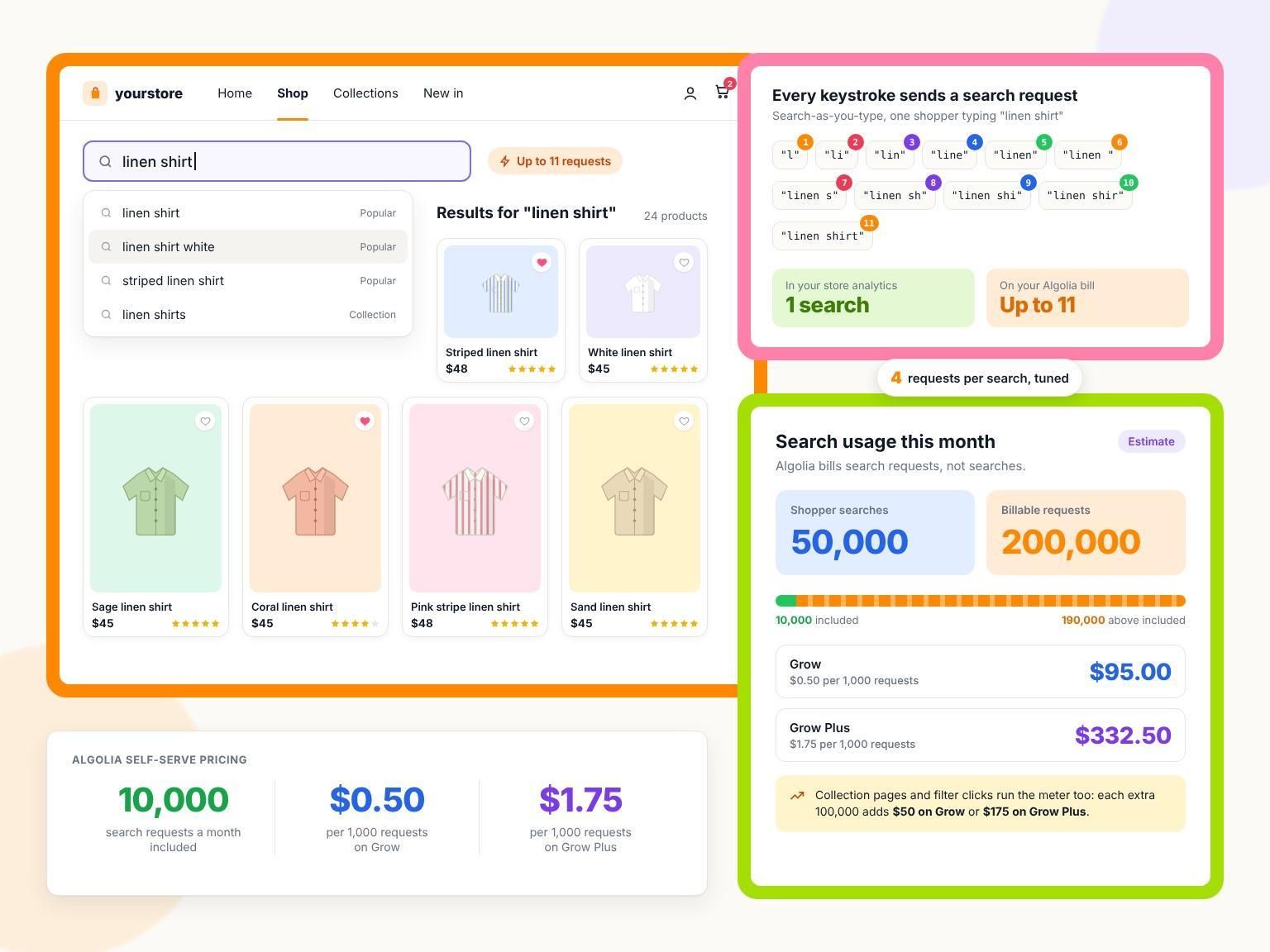
A shopper typing "linen shirt" letter by letter can send up to 11 requests before they reach the results they wanted. That's one search in your analytics and up to 11 on your bill.
Here's how Algolia's docs and support articles count the things a Shopify store does every day.
| What happens on your store | How Algolia counts it |
|---|---|
| Each keystroke in search-as-you-type | One search request |
| Several indices queried in one bundled call (products, collections, suggestions) | One search request (older plans counted one per index) |
| Query suggestions fetched in their own separate call | A second request on every keystroke |
| A collection page that loads results from Algolia, even with an empty query | One search request |
| A shopper typing inside a filter list, such as a long brand list | One search request per call |
| Applying a filter on the results page | One request (Algolia says more than one means a setup problem) |
| The browse endpoint used to export records | An indexing operation, not a search request |
Sources: Algolia pricing FAQ; Algolia support articles "How does Algolia count search requests, operations and records" and "Do Query Suggestions increase the number of billable requests"; Algolia InstantSearch.js docs on optimizing search requests. All checked 12 November 2026.
Two things follow from that table.
First, setup decides your bill as much as traffic does. Algolia's own optimization guide tells developers to debounce keystrokes and bundle queries, because a search bar that skips both can pay twice per letter.
Second, Algolia isn't only metering your search bar. If it powers your collection pages, every page load and filter change is a request, and Algolia's docs even warn that search engine bots crawling your site can push the count up.
Search-as-you-type is still worth having, and our guide to ecommerce search autocomplete explains why. You just need to know it's metered.
Algolia pricing in practice: a bill for 50,000 searches a month
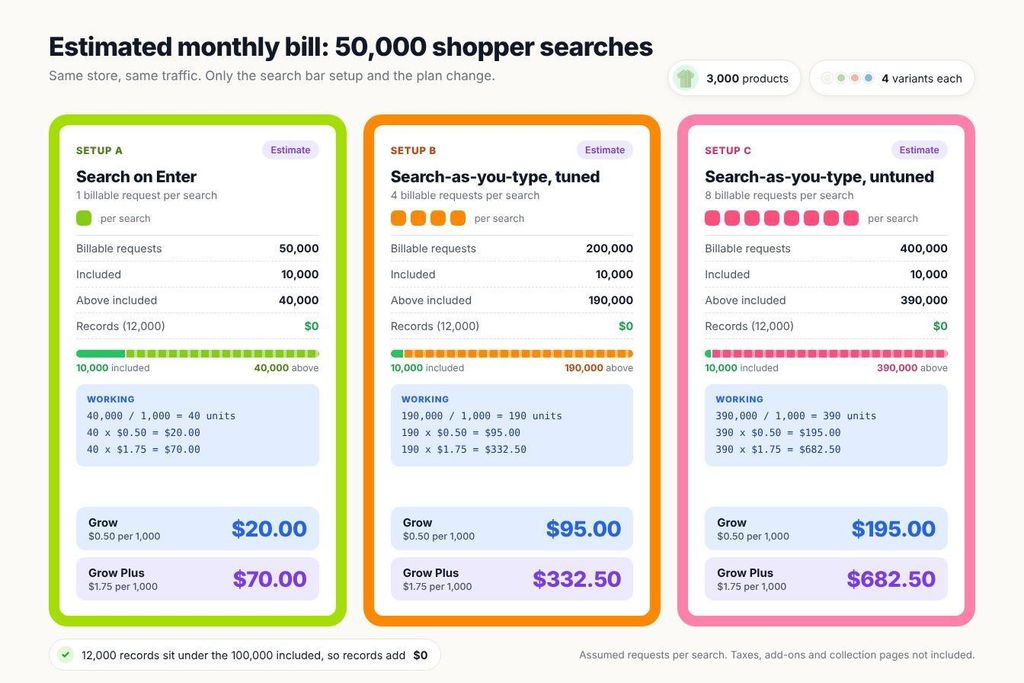
Let's put numbers on it. Imagine a Shopify store with 3,000 products, an average of 4 variants each, and 50,000 shopper searches a month.
This is an estimate, not a quote. It uses Algolia's published rates and three assumptions about how the search bar is built.
| Setup A: search on Enter | Setup B: search-as-you-type, tuned | Setup C: search-as-you-type, untuned | |
|---|---|---|---|
| Shopper searches a month | 50,000 | 50,000 | 50,000 |
| Billable requests per search (assumed) | 1 | 4 | 8 |
| Billable requests a month | 50,000 | 200,000 | 400,000 |
| Requests above the 10,000 included | 40,000 | 190,000 | 390,000 |
| Grow at $0.50 per 1,000 | $20.00 | $95.00 | $195.00 |
| Grow Plus at $1.75 per 1,000 | $70.00 | $332.50 | $682.50 |
| Records: 3,000 products x 4 variants = 12,000 | $0 (under 100,000) | $0 | $0 |
Working: requests above 10,000, divided by 1,000, multiplied by the plan's rate. Setup B assumes debounced typing and one bundled call per keystroke. Setup C assumes no debouncing and suggestions sent in a separate call. Taxes, add-ons and collection page traffic are not included.
So what does that mean for you? The same 50,000 searches can cost $20 or $682.50, and the gap comes from the plan you need and how your search bar was built.
Collection pages move the number too. If Algolia powers them, every extra 100,000 page loads and filter clicks adds $50 on Grow or $175 on Grow Plus.
Stores that want AI relevance need Grow Plus, because Algolia's feature grid reserves AI Ranking, AI Synonyms, the Merchandising Studio and the visual rules editor for it. That higher $1.75 rate then applies to every request, including plain keyword lookups.
Before you price any search tool, it helps to know what search is worth to your store. Our search ROI calculator gives you a rough figure in about a minute.
Our example store sits inside the 100,000 included records. Bigger catalogs don't, and that's where the next costs start.
The Algolia costs that aren't next to the plan prices
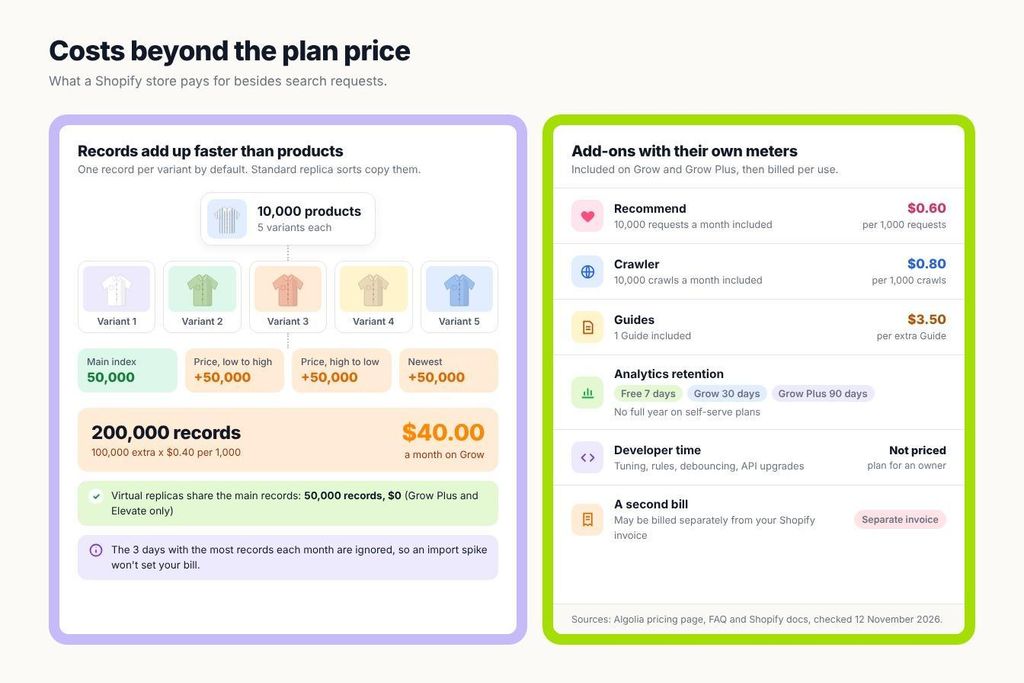
Some of these live on Algolia's pricing page, just in the feature grid or the FAQ rather than beside the plan prices. Others only appear in the Shopify integration docs.
Records add up faster than products
Algolia's Shopify app creates one record per variant by default, according to its product-level indexing docs. A catalog of 10,000 products with 5 variants each is 50,000 records, not 10,000.
Sorting adds more. In the Shopify app, each sort order (price low to high, newest and so on) is backed by a replica index, and the default standard replica copies your records into your quota.
| Catalog setup | Records counted | Monthly record charge on Grow |
|---|---|---|
| 10,000 products x 5 variants, relevance sort only | 50,000 | $0 |
| Same catalog plus 3 standard replica sorts | 200,000 | $40.00 (100,000 extra x $0.40 per 1,000) |
| Same catalog on Grow Plus using virtual replicas | 50,000 | $0 |
Virtual replicas share the main index's records, but Algolia's feature grid lists them on Grow Plus and Elevate only. A product-level mode (one record per product) also cuts the count, though Algolia labels it beta and notes it changes how filters combine across variants.
One helpful detail: Algolia ignores the three days with the most records each month, so a short spike during a big import won't set your bill.
Add-ons with their own meters
| Add-on | Included on Grow and Grow Plus | After that |
|---|---|---|
| Recommend (product recommendations) | 10,000 requests a month | $0.60 per 1,000 requests |
| Crawler | 10,000 crawls a month | $0.80 per 1,000 crawls |
| Guides | 1 Guide | $3.50 per Guide |
| Support plans | Website support only | Add-on listed for Elevate |
| Professional services | Not listed | Optional on Elevate |
Sources: Algolia's pricing page feature grid and FAQ, and Algolia's support article on how Guides are priced, checked 12 November 2026.
Analytics retention
Free keeps 7 days of analytics, Grow 30 days and Grow Plus 90 days. If you want to compare this holiday season with last year's inside Algolia, neither self-serve plan keeps a full year.
Developer time
The Shopify app gets you started with Autocomplete and InstantSearch blocks for your theme. Tuning relevance, writing rules, debouncing, bundling queries and maintaining any custom storefront code is developer work.
It isn't a one-time job either. Algolia's Shopify docs note the app blocks moved to version 5 of its API client, with version 4 support ending on 14 August 2026, so stores with custom JavaScript had an upgrade to do.
We won't guess an hourly rate. Just plan for someone technical to own search, the way you'd plan for a theme developer. If that's the cost you'd rather avoid, Sparq is built to go live in minutes with no developer and no code.
A second bill
The Algolia Shopify listing says charges may be billed by Algolia separately from your Shopify invoice. That's one more invoice to reconcile each month.
Want to see what your own catalog would cost on a flat plan while you weigh this up? You can compare Sparq's plans in a couple of minutes, and the 14-day trial needs no credit card.
Where Sparq costs less than Algolia (and where it doesn't)
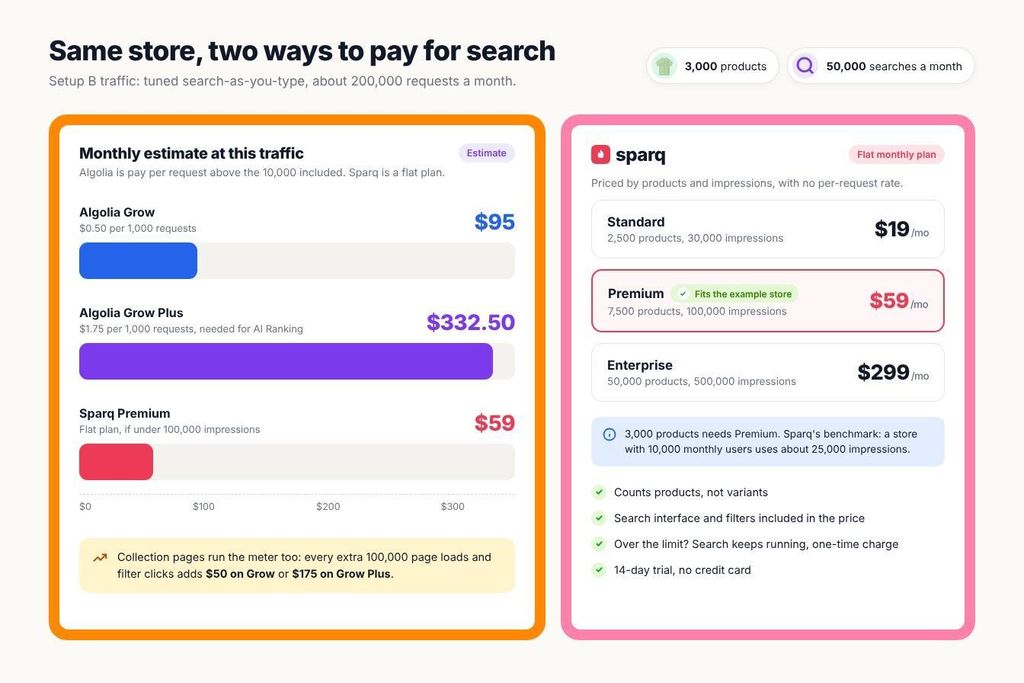
Sparq prices differently. You pay a flat monthly plan sized by products and impressions, and Sparq counts an impression whenever someone interacts with Sparq search and filters on your store.
| Sparq plan | Price | Products | Impressions a month |
|---|---|---|---|
| Standard | $19 a month | 2,500 | 30,000 |
| Premium | $59 a month | 7,500 | 100,000 |
| Enterprise | $299 a month | 50,000 | 500,000 |
Source: Sparq's pricing page, checked 12 November 2026.
Sparq counts products, not variants: each active product published to your online store counts once. Our example store has 3,000 products, so it needs Premium for the product count alone.
How many impressions will your traffic use? Sparq's pricing page puts a typical store with 10,000 monthly users at about 25,000 impressions. By that ratio, Premium's 100,000 impressions fits a store of roughly 40,000 monthly users.
If a busy month goes past your plan, your search keeps running and Sparq adds a one-time charge for the extra usage. Sparq doesn't publish a per-unit rate for that charge, so stores that run hot every month should look at Enterprise instead.
Here's the same example store side by side, using Setup B from the bill above.
| Option | Monthly estimate | What's included | Limits to know |
|---|---|---|---|
| Algolia Grow | $95 | Keyword search, 10 rules per index, 30 days of analytics | No AI Ranking or Merchandising Studio; developer setup |
| Algolia Grow Plus | $332.50 | AI Ranking and Synonyms, Merchandising Studio, 90 days of analytics | Cost rises with every request |
| Sparq Premium | $59 if under 100,000 impressions | 7,500 products, 1,000 synonyms, banners and redirects, no-result reports, email and chat support (12 hour response), 90 days of conversion history | One-time charge above limits; rule-based merchandising is Coming Soon |
| Sparq Enterprise | $299 | 50,000 products, 500,000 impressions, 10,000 synonyms, phone support (4 hour response), 1 year of history | Shopify-first app, not a developer search API |
For a store like this, Sparq Premium comes in below both Algolia plans on our assumptions, and it includes the search interface and filters in the monthly price.
Where Algolia is the better fit
We'd rather you pick the right tool than the cheaper one, and our roundup of Algolia alternatives for Shopify compares the other options at this price point. Algolia itself wins in these cases:
- Low traffic or no search-as-you-type. Setup A on Grow is $20 a month, and under 10,000 requests the Free plan costs nothing. Sparq has no free plan, and its lowest plan is $19.
- You have developers and want an API. Custom ranking, search across content beyond your catalog and full control of the front end are Algolia's home turf.
- Headless or multi-storefront builds. Algolia's API-first design suits these well, and a headless build usually has a developer on hand anyway.
- Enterprise scale on an annual contract. Elevate adds NeuralSearch, 99.99% availability, SSO and volume discounts.
If none of those describe you, you may be paying for engine room capacity you won't use. A flat plan with the interface, filters and support included is usually the better deal for a store run by a small team.
Know your search bill before the month starts
Algolia is a strong engine with a meter attached, and the meter runs on keystrokes, sort orders and variants. If you'd rather know your bill up front, Sparq plans start at $19 a month, priced by products and impressions with no per-request rate.
Run the 14-day free trial on your real catalog and traffic, with no credit card, and compare the numbers yourself. See Sparq pricing and start your free trial.
Frequently Asked Questions
Is Algolia free for Shopify stores?
Yes, up to a point. Algolia's Free plan includes 10,000 search requests, 50,000 records, 5,000 recommendation requests and 5,000 crawls a month with no credit card, and the Shopify app is free to install. With search-as-you-type, 10,000 requests can mean only a few thousand searches, so busy stores outgrow it quickly.
How much does Algolia cost per 1,000 searches?
Algolia charges per 1,000 search requests, not per 1,000 searches. Grow costs $0.50 and Grow Plus $1.75 per 1,000 requests after the first 10,000 each month. With search-as-you-type, one shopper search can trigger several requests, so your real cost per 1,000 searches is often a multiple of the listed rate.
Does Algolia count every keystroke as a search request?
Yes, in autocomplete and search-as-you-type setups. Algolia's pricing FAQ says a new search request is performed on every keystroke. Bundling several indices into one call counts once, and debouncing cuts how many keystrokes reach Algolia, so a well-built search bar costs noticeably less than a careless one.
Does Algolia require an annual contract?
Not for Grow or Grow Plus. Algolia's FAQ says both are billed monthly with no contract required. Elevate, which adds NeuralSearch, Smart Groups, enterprise support plans and volume discounts, requires an annual contract and is priced by quote through Algolia's sales team, so check current pricing with them directly.
How does Algolia count Shopify products and variants as records?
By default, Algolia's Shopify app creates one record per variant, so 2,000 products with 5 variants each makes 10,000 records. Standard replica sort orders copy those records again. A beta product-level mode stores one record per product, and virtual replicas on Grow Plus and Elevate avoid the duplicate records.