Algolia Alternatives for Shopify Stores (2026): Prices Compared
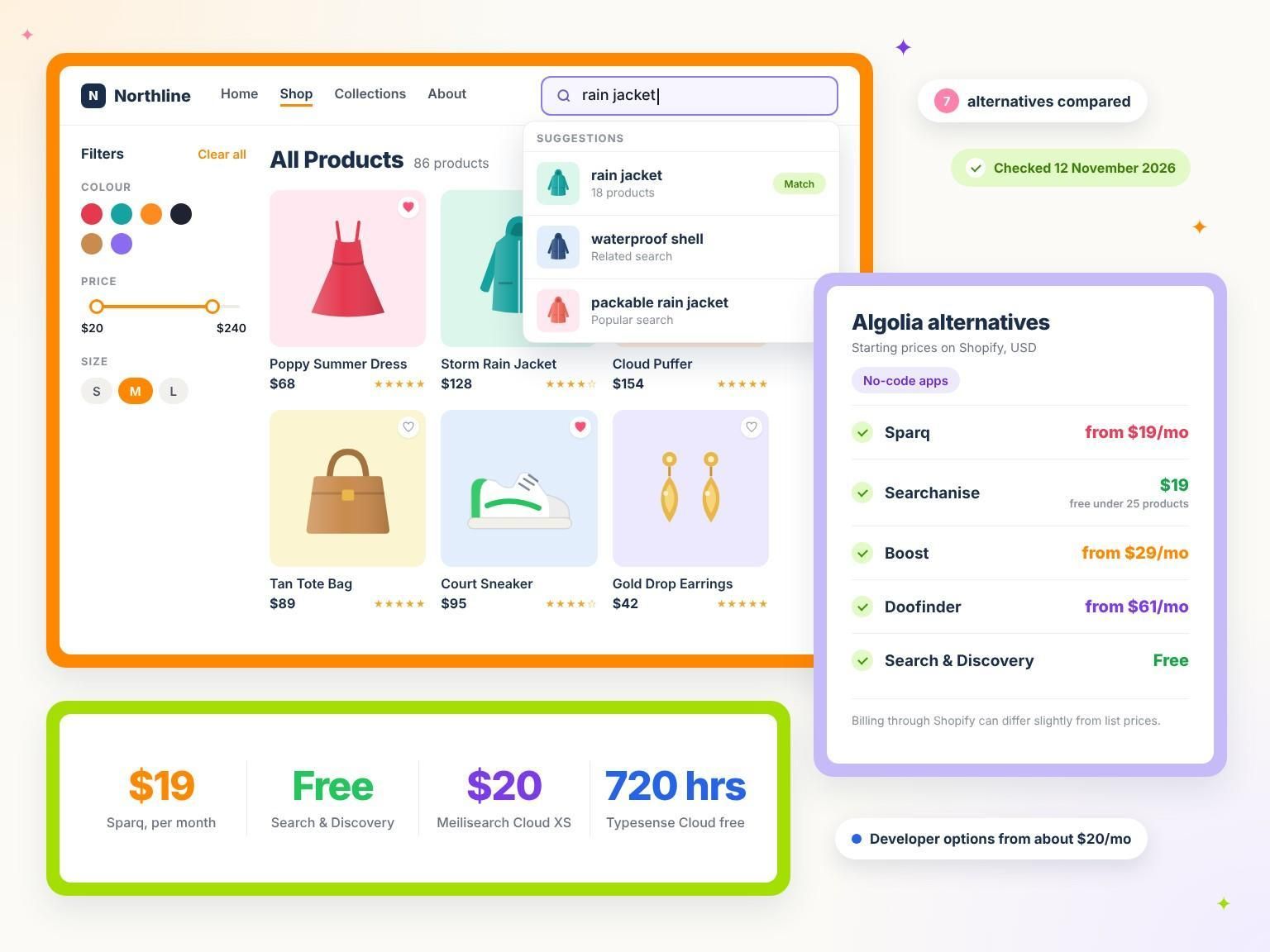
The best Algolia alternatives for Shopify stores are Sparq (from $19 a month), Searchanise (free up to 25 products, paid from $19), Boost (from $29), Doofinder (from $61 on Shopify) and Shopify's free Search & Discovery app. If you have developers, Typesense and Meilisearch give you Algolia-style search from about $20 a month.
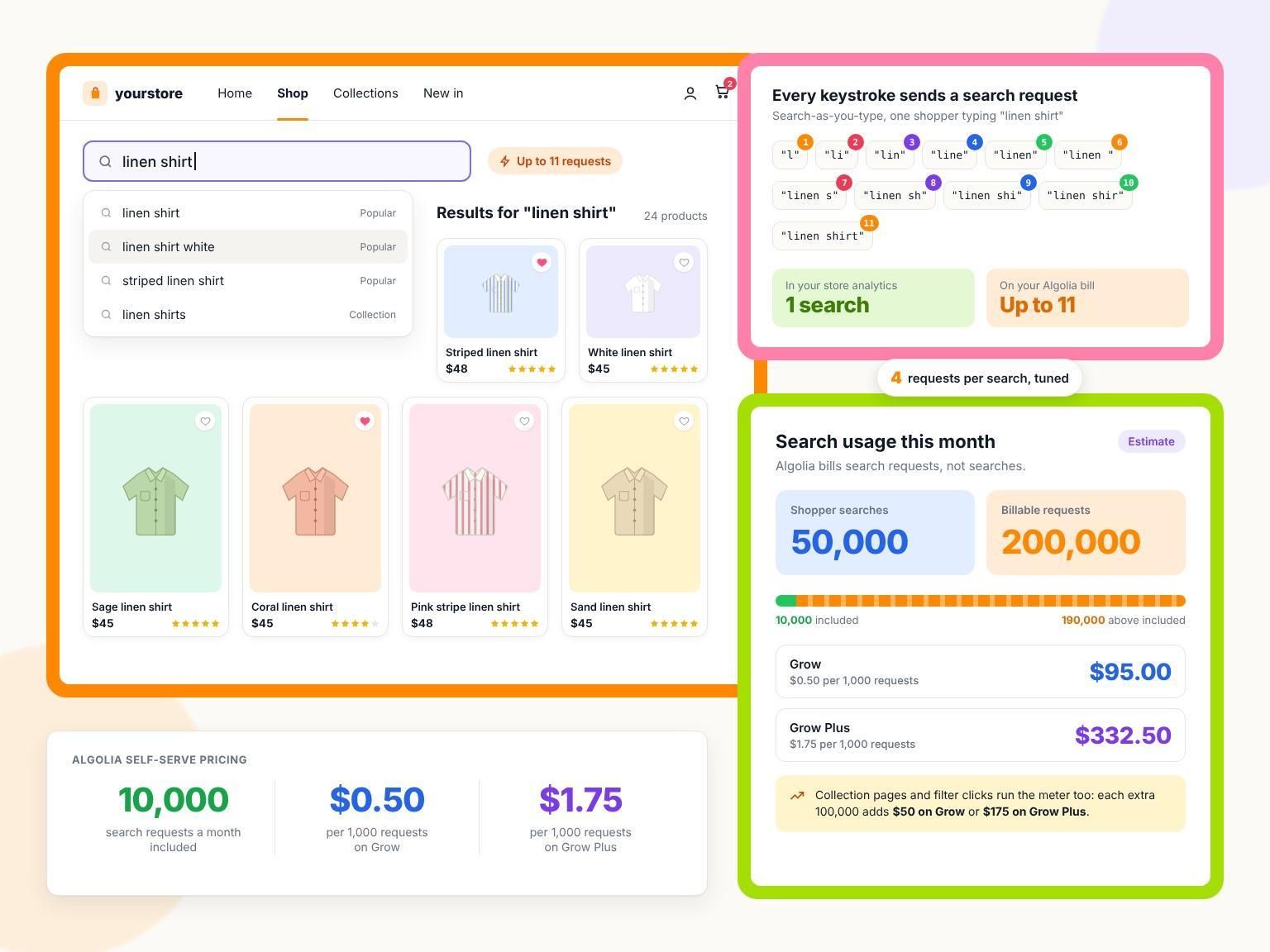
Picture this: your sale goes live on a Saturday morning, and every letter a shopper types into your search box counts toward next month's Algolia bill. You like the results. You're less sure about the invoice, or about who will tune the ranking now that your freelance developer has moved on.
That store is made up, but the reason is real. Algolia is excellent search built for engineering teams, and it bills by usage.
So we checked every option below on its own pricing page and its Shopify App Store listing on 12 November 2026. We make Sparq, so read our section with that in mind; we've put its limits in plain sight too. If you want the cost side of Algolia first, our Algolia pricing breakdown works through an example bill.
Algolia alternatives compared: price, scaling and setup
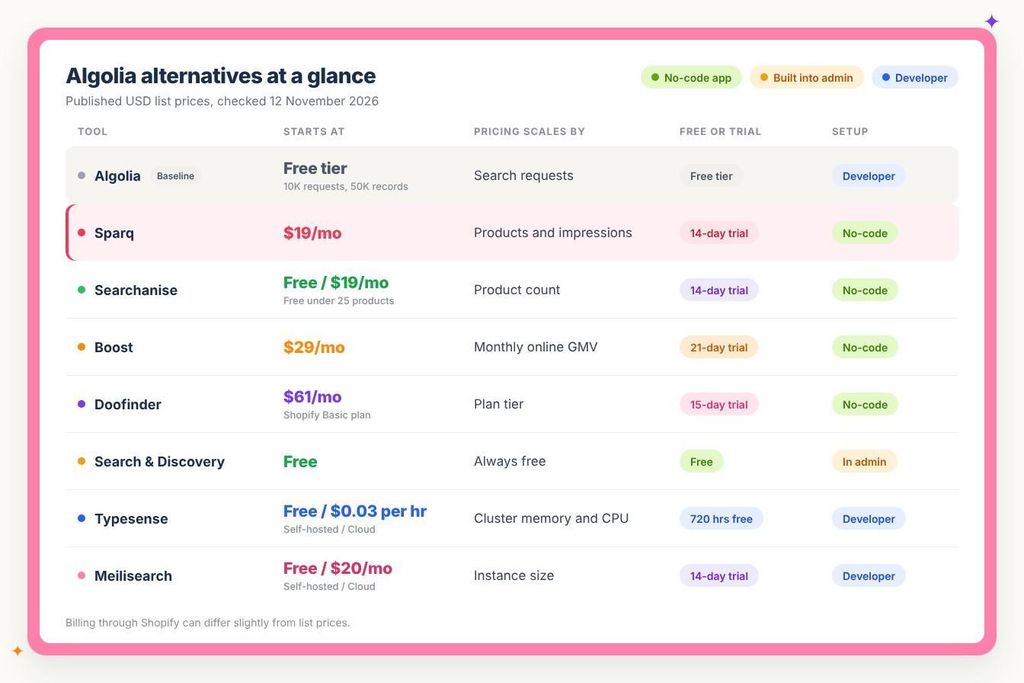
Here's every option side by side, with Algolia as the baseline. Prices are published USD list prices, and billing through Shopify can differ slightly.
| Tool | Starting price | How pricing scales | Free plan or trial | Setup | Best for |
|---|---|---|---|---|---|
| Algolia (baseline) | Free tier: 10K search requests and 50K records a month | Grow: $0.50 per extra 1K search requests; Grow Plus: $1.75 per extra 1K; records $0.40 per extra 1K over 100K; Elevate by quote | Free tier, no credit card | Developer led; Shopify app offers self-service support only | Stores with an engineering team |
| Sparq | $19/mo (2,500 products, 30K impressions) | By products and impressions: $59 (7,500 / 100K), $299 (50,000 / 500K); one-time charge for overage | No free plan; 14-day trial, no credit card | No-code app | Shopify stores without a developer that want AI search and filters |
| Searchanise | Free under 25 products; $19/mo up to 1,500 products | By product count: $39 (7,500) up to $349 (300,000); Shopify Plus plans from $49 | Free plan (under 25 products), 14-day trial | No-code app | Small catalogs where price per product matters most |
| Boost AI Search & Filter | $29/mo (Launch) | By monthly online GMV: Launch up to $159 under $50K GMV; Convert from $299; Accelerate from $699 | 21-day trial | No-code app | Stores where filters drive sales |
| Doofinder | $61/mo on Shopify (Basic) | Shopify plans $61, $186, $436; Enterprise custom; other platforms by search requests | 15-day trial | No-code app | Brands selling on several platforms |
| Shopify Search & Discovery | Free | Free | Free | Built into Shopify admin | Small, simple catalogs |
| Typesense | Free to self-host; Cloud from $0.03/hr (about $21.60/mo) | By cluster memory and CPU, plus bandwidth; no limits on records or operations | Cloud: first 720 hours free on the smallest cluster | Developer | Engineers who want no per-request fees |
| Meilisearch | Free to self-host; Cloud from $20/mo | Fixed price per instance size, plus disk and bandwidth | Cloud: 14-day trial, no credit card | Developer | Engineers who want a fixed monthly cost |
One thing jumps out. Algolia bills by usage, the Shopify apps mostly bill by catalog size, traffic or sales, and the developer engines bill for the server.
Sparq: AI search and filters for Shopify, no developer needed
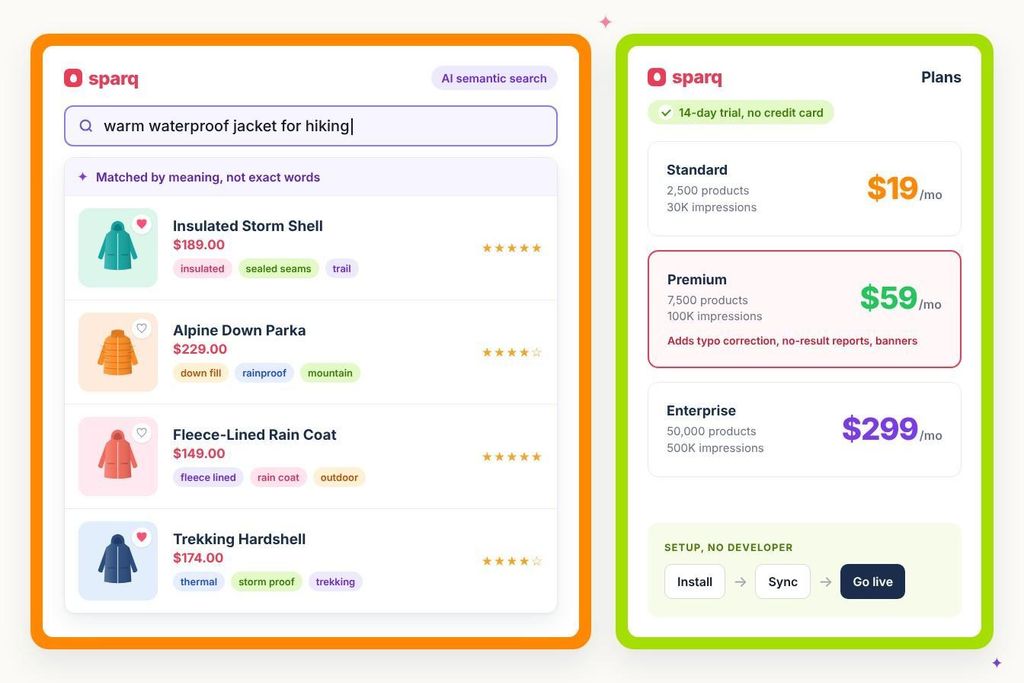
Sparq is our AI search and filter app. It's built Shopify-first, carries the Built for Shopify badge on its App Store listing, and also runs on WooCommerce, BigCommerce, Magento and OpenCart.
What it costs: Standard is $19 a month for 2,500 products and 30,000 impressions, Premium is $59 for 7,500 products and 100,000 impressions, and Enterprise is $299 for 50,000 products and 500,000 impressions. An impression is any shopper interaction with Sparq search or filters, and our pricing page puts a typical store with 10,000 monthly users at about 25,000 impressions.
Sparq has no free plan for live stores; the free Development plan covers test stores, stores on a Shopify trial and paused stores. You get a 14-day trial of the premium features with no credit card.
Where it shines: semantic search that matches meaning, so "warm waterproof jacket for hiking" can find products that never use those exact words. Setup is install, sync and go, with personalised onboarding on Premium. Here's how our AI semantic search handles natural language queries.
Where it falls short: Sparq is an app, not a developer search API, so there's no index you query from your own code. On Standard you get search as you type, filters and 100 synonyms, but typo correction, no-result reports and banners start on Premium at $59.
Rule-based merchandising is still listed as coming soon on Standard and Premium. Go over your plan and nothing switches off; we add a one-time charge for the extra usage, and we don't publish a per-unit rate for it.
Who it suits: Shopify stores from a few hundred to 50,000 products that want AI search and filters without hiring anyone.
Searchanise: the budget pick for smaller catalogs
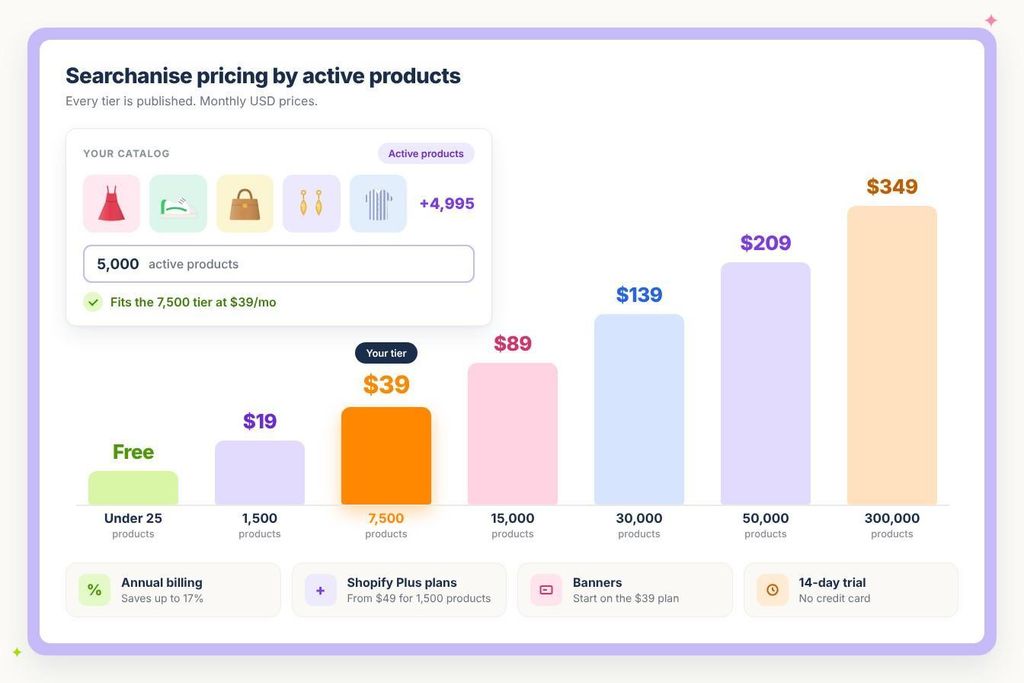
Searchanise is a long-running search and filter app with a 4.7 rating from 1,267 reviews on the Shopify App Store. It prices by the number of active products and publishes every tier.
What it costs: free for development stores and stores under 25 products. Paid plans run $19 a month for 1,500 products, $39 for 7,500, $89 for 15,000, $139 for 30,000, $209 for 50,000 and $349 for 300,000, with annual billing saving up to 17%. Shopify Plus stores have their own plans, starting at $49 for 1,500 products.
Where it shines: clear pricing, a 14-day trial with no credit card, and a long feature list covering analytics, merchandising, product labels and variants. Its listing also stresses real human support, and we put it next to Sparq feature by feature in Sparq vs Searchanise.
Where it falls short: the $19 plan stops at 1,500 products, and banners start on the $39 plan. Custom visual changes are capped by time, at 30 minutes a month on Basic and an hour on Essential.
Who it suits: small and mid-size catalogs that want the lowest price per product.
Boost AI Search & Filter: strongest when filters are the job
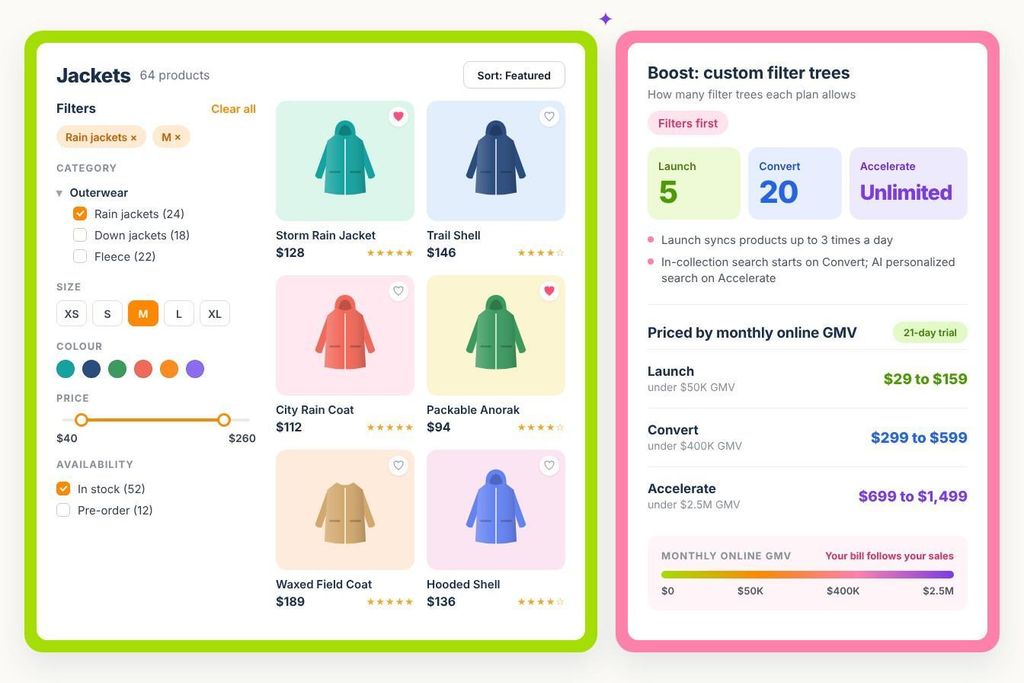
Boost Commerce makes Boost AI Search & Filter, rated 4.7 from 1,627 reviews. It bundles AI search, filter trees, merchandising, recommendations, bundles and even pre-order and back-in-stock tools.
What it costs: Launch starts at $29 a month and goes up to $159 for stores under $50K monthly online GMV. Convert starts at $299 (up to $599 under $400K GMV) and Accelerate at $699 (up to $1,499 under $2.5M GMV), each with a 21-day trial.
Where it shines: custom filter trees (5 on Launch, 20 on Convert, unlimited on Accelerate) and merchandising campaigns. Recent reviews praise the support team, though one says setup was tricky on a heavily custom theme.
Where it falls short: the bill follows your sales, not your catalog, so a great year raises your search cost. Launch syncs products up to 3 times a day, in-collection search starts on Convert, and AI personalized search arrives only on Accelerate.
Who it suits: growing stores where collection page filtering drives most of the revenue. Our guide to ecommerce filter design shows what good filters do.
Doofinder: one search tool across several platforms
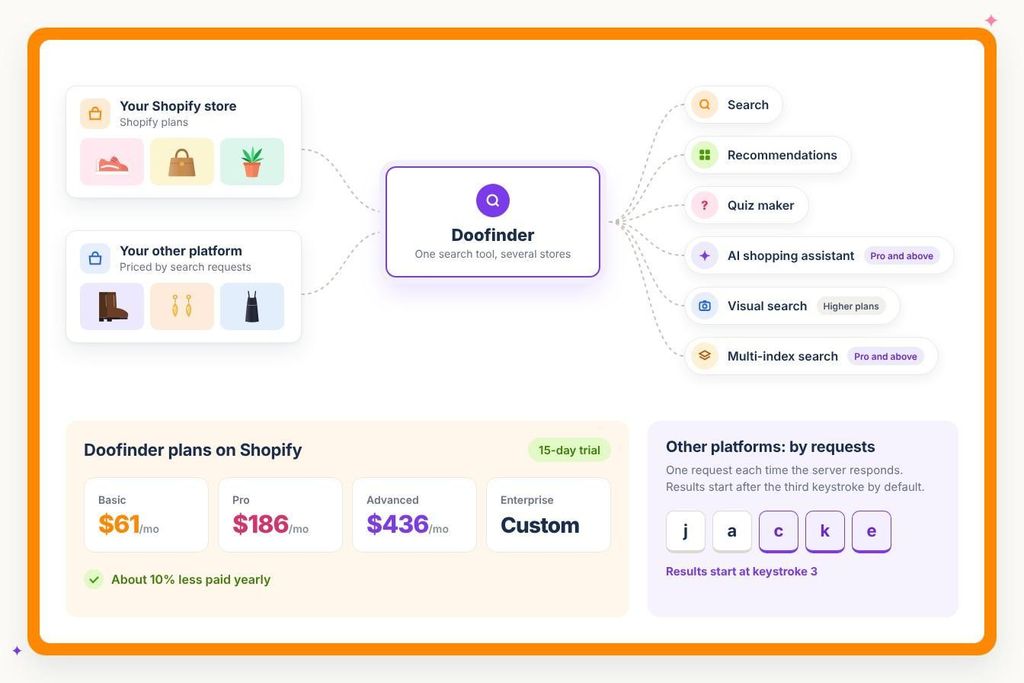
Doofinder is an AI search and discovery platform rated 4.7 from 758 reviews on Shopify. It covers search, recommendations and a quiz maker, with an AI shopping assistant and visual search on higher plans.
What it costs on Shopify: Basic is $61 a month, Pro $186 and Advanced $436, or about 10% less paid yearly, each with a 15-day trial. Enterprise is custom.
On other platforms, Doofinder's own pricing page lists $49, $149 and $349 plans with 10,000, 150,000 and 400,000 requests a month, and says Shopify has its own plans. Here's the catch: its FAQ counts a request each time its server responds, with results starting after the third keystroke by default.
Where it shines: one tool if you sell on more than one platform, plus multi-index search across products and content from Pro.
Where it falls short: it has the highest entry price of the Shopify apps here. The AI Assistant sits on Pro and above, with details and pricing by enquiry.
Who it suits: brands running stores on several platforms, or teams that want visual search and an assistant without code.
Shopify Search & Discovery: free, and fine for small stores
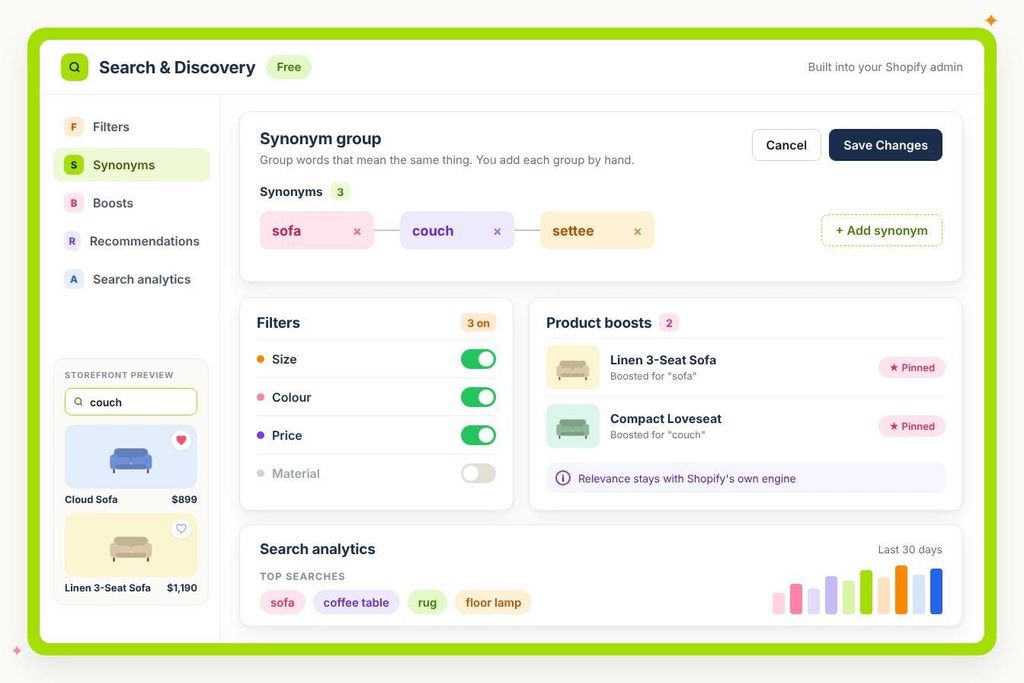
Shopify's own Search & Discovery app is free and lives inside your admin. It adds custom filters, synonym groups, product boosts, related and complementary product recommendations, and search analytics.
Where it shines: it costs nothing, Shopify makes it, and it's the right first step for a new store.
Where it falls short: you build synonym groups and boosts by hand, and relevance stays with Shopify's engine, so no vendor tunes it for your catalog. Its App Store rating is 2.6 from 514 reviews, so read the complaints and see whether they match your store.
Who it suits: stores with small catalogs and simple product names. If you've outgrown it and don't have a developer, that's the gap Sparq fills, and you can compare Sparq plans by catalog size before you start a trial.
For developers: Typesense and Meilisearch, the open-source Algolia alternatives
Let's be plain: these two are for stores with developers. Neither is a plug-in Shopify app, so someone has to sync products from Shopify, build the search box and results page, and keep it all running.
In return, you stop paying per search.
Typesense
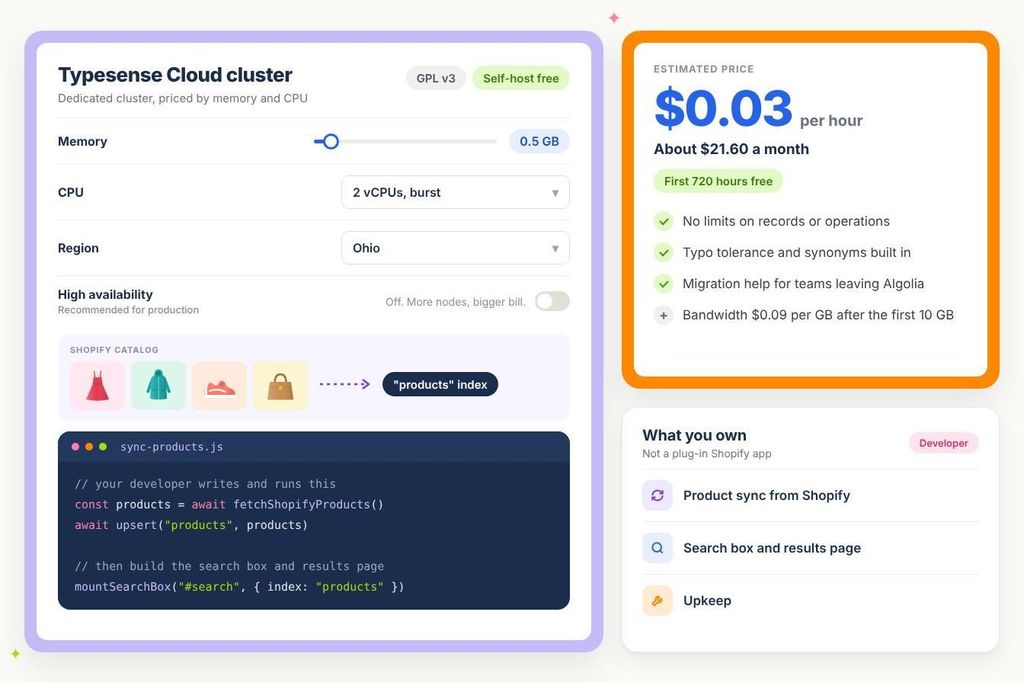
Typesense is an open-source search engine under the GPL v3 license, and it pitches itself as an open-source alternative to Algolia. Self-hosting is free apart from your server.
Typesense Cloud charges for a dedicated cluster by memory and CPU, with no limits on records or operations. The smallest setup in its calculator (0.5 GB of RAM, 2 burst vCPUs, Ohio region) was $0.03 an hour, about $21.60 a month, with the first 720 hours free and bandwidth at $0.09 per GB after the first 10 GB.
Where it shines: typo tolerance and synonyms built in, server-based pricing, and migration help for teams leaving Algolia. Where it falls short: you own the sync, the storefront UI and the upkeep, and Typesense itself recommends high availability for production, which means more nodes and a bigger bill.
Meilisearch
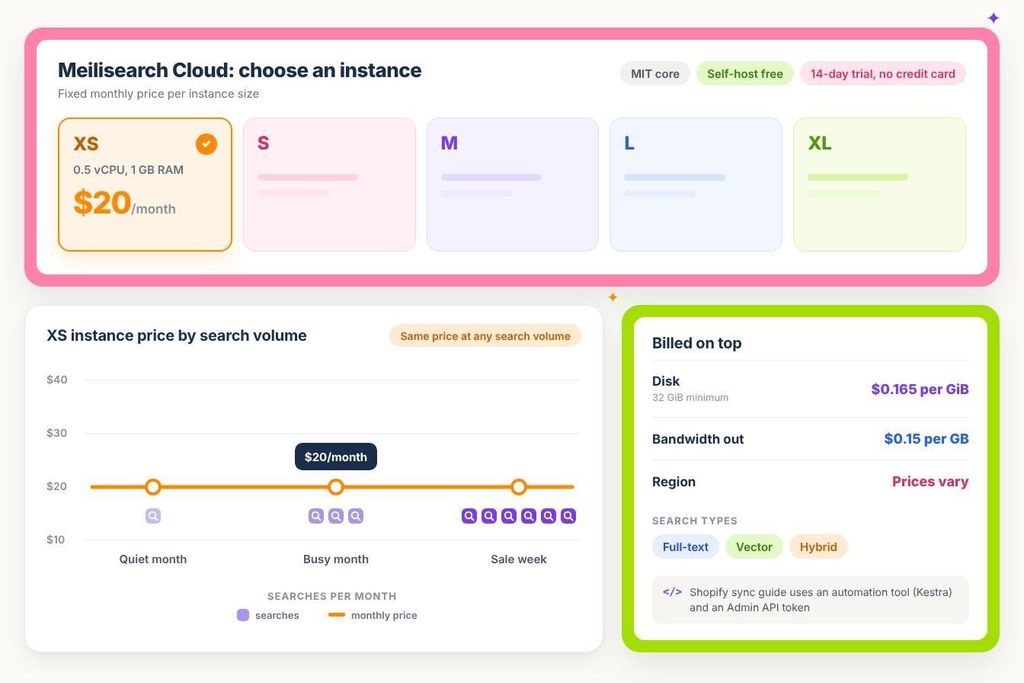
Meilisearch is an open-source engine whose core is MIT licensed, and self-hosting is free with no usage limits. Meilisearch Cloud starts at $20 a month for an XS instance (0.5 vCPU, 1 GB RAM), a fixed price whatever your search volume.
Disk and outbound bandwidth are billed on top, at $0.165 per GiB of disk (32 GiB minimum) and $0.15 per GB out, and prices vary by region. The Cloud trial runs 14 days with no credit card.
Where it shines: full-text, vector and hybrid search at a predictable monthly cost. Where it falls short: its own Shopify guide syncs the catalog through Kestra, an automation tool, using a Shopify Admin API token, which tells you who it's written for.
How to choose the right Algolia alternative for your store
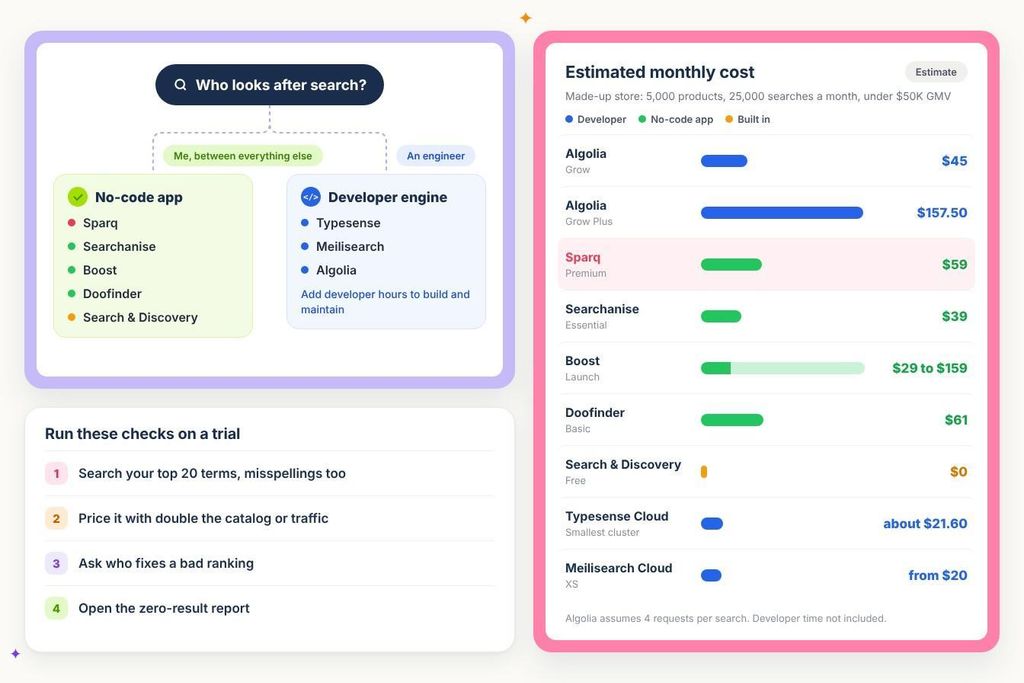
Start with one question: who will look after search? If the answer is "me, between everything else," pick a no-code app; if it's an engineer, the developer engines come into play. Our best ecommerce search engine for Shopify comparison has hands-on test notes on the main apps.
Then put a price on your own store. Here's an estimate for a made-up Shopify store with 5,000 products (about 3 variants each), 20,000 monthly visitors, 25,000 shopper searches a month and under $50K in monthly online GMV.
| Tool | Plan that fits | Working (estimate) | Est. monthly cost |
|---|---|---|---|
| Algolia Grow | Grow | 25,000 searches x 4 requests (one per keystroke) = 100,000; minus 10,000 included = 90,000; 90 x $0.50. Records: 15,000 variant records, under 100,000 included | $45 |
| Algolia Grow Plus | Grow Plus | Same 90,000 extra requests; 90 x $1.75 | $157.50 |
| Sparq | Premium | 5,000 products needs the 7,500 tier; about 50,000 impressions using our 10,000 users = 25,000 benchmark, under 100,000 | $59 |
| Searchanise | Essential | 5,000 products fits the 7,500 tier | $39 |
| Boost | Launch | Under $50K GMV: between $29 and $159 depending on GMV | $29 to $159 |
| Doofinder | Basic (Shopify) | Entry plan; check request limits for your traffic | $61 |
| Shopify Search & Discovery | Free | No charge | $0 |
| Typesense Cloud | Smallest cluster | Assumes the catalog fits 0.5 GB; high availability costs more; developer time extra | About $21.60 |
| Meilisearch Cloud | XS | Instance price; disk and bandwidth extra; developer time extra | From $20 |
Estimate. Assumptions: 4 requests per search on Algolia (one per keystroke on a tuned setup), one Algolia record per variant, and impressions scaled from Sparq's pricing page example. Taxes and add-ons not included.
So what does that mean for you? On price alone, Searchanise and the developer engines come out cheapest for this store, Sparq sits in the middle at $59, and Algolia moves with every letter your shoppers type.
Then weigh the work. Typesense and Meilisearch look cheap until you price the developer hours to build and maintain them.
Before you commit to anything, run these checks on a trial:
- Search your top 20 terms, including misspellings, and see what comes back.
- Work out the price if your catalog or traffic doubles.
- Ask who fixes a bad ranking: you, the vendor or a developer.
- Open the zero-result report, because that's where lost sales hide.
Try Sparq on your own catalog
If you run Shopify without a developer and want AI search and filters working on day one, try Sparq. Plans start at $19 a month, priced by products and impressions, and the 14-day trial needs no credit card.
Sparq has no free plan, so you'll pick the plan that fits your catalog when the trial ends. Your settings and filter data carry over when you upgrade.
See Sparq plans and start your 14-day trial
Frequently Asked Questions
What is the best Algolia alternative for Shopify?
For most Shopify stores without a developer, a no-code app is the best Algolia alternative. Sparq (from $19 a month) suits stores that want AI search and filters, Searchanise is cheapest per product, and Boost is strongest on filters. Stores with engineers can look at Typesense or Meilisearch instead.
Is there a free alternative to Algolia?
Yes. Shopify Search & Discovery is free with filters, synonyms, boosts and recommendations, and Searchanise is free for stores under 25 products. Typesense and Meilisearch are free to self-host, but you pay for the server and need a developer to build the sync and the search interface.
Why does Algolia get expensive for ecommerce stores?
Algolia bills per search request, and its docs say each keystroke sent to an index counts as one request in search-as-you-type. A shopper typing a short query can create several requests. Past the 10,000 included each month, Grow charges $0.50 and Grow Plus $1.75 per extra 1,000 requests.
Can I use Typesense or Meilisearch with Shopify?
Yes, but only with developer work. Neither ships as a plug-in Shopify app, so someone syncs products from Shopify, builds the search box and results page, and maintains them. Meilisearch's own Shopify guide uses an automation tool and an Admin API token, and both offer managed cloud hosting from about $20 a month.
Is Sparq cheaper than Algolia?
It depends on your traffic. Sparq charges a flat monthly plan by products and impressions, from $19, while Algolia charges by search request after a free tier. In our 5,000-product estimate, Sparq Premium was $59, Algolia Grow about $45 and Grow Plus about $157.50, before any developer time.