How to Find a Profitable Ecommerce Niche (That Customers Can Actually Shop)
The real reason most niche stores fail isn't the niche itself-it's what happens after someone lands on your site.
I was on a call with a store owner last month. Let's call him Marcus.
Marcus had done everything right. He'd spent weeks researching trending niches. Read every "Top 10 Ecommerce Niches for 2025" article on the internet. Analyzed Google Trends. Found a gap in the market for premium dog accessories for apartment dwellers.
Perfect, he thought. Urban pet owners with disposable income. Underserved. Growing fast.
Six months later, his store was bleeding money.
Not because the niche was wrong. The niche was great.
The problem? When customers searched "small space dog bed" on his site, they got zero results. When they tried to filter by apartment-friendly sizes, the options made no sense. His catalog had 200 products-and customers couldn't find a single one that matched what they actually wanted.
He picked the right niche. But he built a store nobody could shop.
Here's the thing nobody tells you about finding a profitable ecommerce niche: the niche is only half the equation. The other half is whether your store can actually deliver on the promise of that niche.
That's what we're going to fix today.
Why Most "Find Your Niche" Advice Misses the Point
Go read any guide on how to find an ecommerce niche. I'll wait.
They all say the same things:
Follow your passion. Check Google Trends. Look for low competition. Find a gap in the market.
And look-that advice isn't wrong. It's just incomplete.
Because here's what happens in the real world. You pick a niche. You source products. You build a Shopify store. You drive traffic. Customers land on your site.
And then they search for something.
The moment a customer types a query into your search bar is the moment your niche either works or doesn't.
If they search "wireless earbuds for running" and your store shows them over-ear headphones? They bounce.
If they try to filter by "waterproof" and that option doesn't exist? They leave.
If your niche is "sustainable home goods" but your search doesn't understand that "eco-friendly" and "green" and "sustainable" mean the same thing? You've lost the sale.
This is the gap nobody talks about. Your niche isn't just a category-it's a vocabulary. A set of attributes. A way customers think about products.
And if your store can't speak that language, you're dead in the water.
The Real Framework for Finding a Profitable Niche
Forget the generic advice. Here's how to actually evaluate a niche-from someone who's watched hundreds of Shopify stores succeed and fail based on how well they serve their customers.
Step 1: Start With Problems, Not Products
Every profitable niche is built on a problem people desperately want solved.
Not a product category. A problem.
"Dog accessories" isn't a niche. "Keeping your dog comfortable in a 600-square-foot apartment" is a niche.
"Kitchen gadgets" isn't a niche. "Cooking healthy meals in under 20 minutes for busy parents" is a niche.
The difference matters because problems dictate how people search.
When someone has a problem, they search in problem language. "Best small dog bed for apartments." "Quick healthy dinner tools." "Workout earbuds that don't fall out."
When you understand the problem, you understand how your customers will try to find solutions in your store. And that tells you exactly how to structure your products, filters, and search.
Action step: Write down the core problem your niche solves in one sentence. If you can't, your niche is too broad.
Step 2: Map the Customer's Mental Model
Here's where most store owners get lazy.
They pick a niche, source 100 products, throw them into Shopify, and call it a day.
But your customers don't think about products the way you do.
If you're selling sustainable fashion, your customers might search by:
- Material (organic cotton, recycled polyester, bamboo)
- Certification (GOTS certified, Fair Trade, B Corp)
- Use case (workwear, casual, activewear)
- Values (vegan, zero-waste, carbon neutral)
If your store only lets them filter by "size" and "color"? You've completely missed how they shop.
A profitable niche is one where you deeply understand the attributes your customers care about-and build your entire store around them.
This is where most niche research falls short. People analyze demand. They analyze competition. But they never analyze how customers in this niche actually discover products.
Action step: List 10 ways a customer might search for or filter products in your niche. Not product names-attributes, use cases, and problems.
Step 3: Validate Demand (But Not the Way You Think)
Yes, you should check Google Trends. Yes, you should look at search volume.
But here's a better signal: what are customers already searching for on existing stores?
If you can find a competitor with public reviews, read them. What words do customers use? What do they praise? What do they complain about?
Even better-if you already have a store with any traffic at all, look at your search analytics. The queries customers type into your search bar are pure gold. They tell you exactly what people want, in their own words.
I've seen store owners discover entirely new product opportunities just by reading their search logs. One home goods store noticed dozens of searches for "non-toxic cleaning" products-a category they didn't even carry. They added it. It became their second-best seller within three months.
Action step: Before committing to a niche, find 3-5 sources of real customer language. Reviews, forums, Reddit threads, competitor search boxes (type a query and see what autocompletes). Build a list of the exact phrases your future customers use.
The Part Nobody Tells You: Your Niche Has to Be Searchable
Stay with me here. This is the part that separates stores that scale from stores that stall.
Let's say you've found a profitable niche market. Demand is there. Competition is manageable. You've got great products.
Now ask yourself: can customers actually find what they want in your store?
This isn't a hypothetical. It's the #1 reason niche stores underperform.
Here's what I mean.
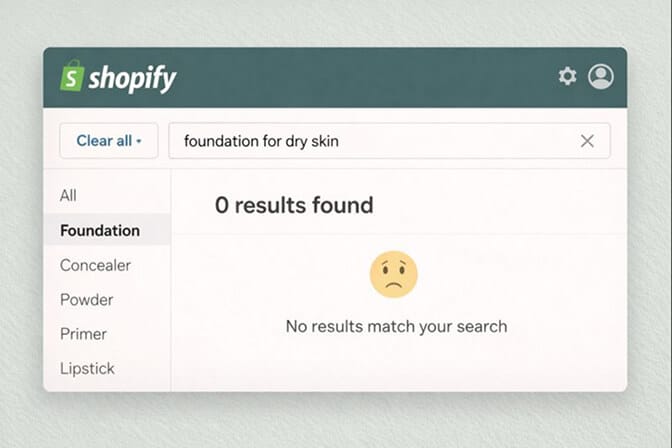
Shopify's default search is keyword-based. It matches exact words. If a customer searches "running headphones" and your product is titled "Sport Wireless Earbuds," you might not show up.
For broad stores like Amazon, this is annoying but survivable. For a niche store? It's fatal.
Because the whole point of a niche store is that you're supposed to be the expert. You're supposed to have exactly what they need. When your search fails, it feels like a betrayal.
In a niche store, every failed search is a broken promise.
This is why, when you're evaluating niche ecommerce business ideas, you need to think about searchability from day one.
Can your products be described in multiple ways? (Synonyms matter.) Do customers use jargon or slang? (Your search needs to understand it.) Are there common misspellings? (Typo tolerance is essential.) Do people search by problem or by product? (Natural language understanding helps.)
If the answer to any of these is "yes," you need smarter search than what Shopify gives you out of the box. That's why we built Sparq.ai-but more on that later.
How to Choose an Ecommerce Niche: The 5-Point Checklist
Let me give you the exact framework I'd use if I were starting a niche store tomorrow.
✅ 1. Problem Clarity
Can you articulate the core problem in one sentence?
✅ 2. Language Density
Does this niche have rich, specific vocabulary? (More synonyms and attributes = more search complexity, but also more opportunity for stores that get search right.)
✅ 3. Attribute Depth
Can products be meaningfully filtered by 5+ attributes beyond size and color?
✅ 4. Passion Signals
Are there communities (subreddits, Facebook groups, forums) where people obsess over this topic?
✅ 5. Discovery Gap
Can you offer a better shopping experience than existing competitors? (This is your moat.)
If you can check all five boxes, you've found more than a niche. You've found an opportunity.
The Niches I'm Watching Right Now
I'm not going to give you a generic list of "best ecommerce niches 2025." You can find those anywhere.
Instead, here are three types of niches that I think are underserved-specifically because most stores in these spaces have terrible search and filtering.
1. Complex Customization Niches
Think personalized jewelry, custom pet portraits, made-to-order furniture. These stores have tons of options, but customers struggle to narrow down what they want. The stores that win here will be the ones that let customers search and filter by highly specific criteria.
2. Technical Specification Niches
Camera gear. PC components. Cycling parts. Customers in these niches know exactly what they want-but they use jargon, model numbers, and specs. If your search can't handle "Canon EF-S 18-55mm compatible" or "Shimano 105 groupset," you've lost them.
3. Values-Based Niches
Sustainable goods. Vegan products. Fair-trade fashion. Customers here filter by certifications, materials, and ethics-not just price and size. The stores that dominate these niches will be the ones that make those values searchable.
A Quick Word on Shopify Niche Ideas vs. Reality
If you're reading this, you're probably building on Shopify. Good choice-it's where most of the smart niche operators are.
But here's the reality check.
Shopify gives you beautiful themes, great checkout, solid apps. What it doesn't give you is a search engine that understands your niche.
Out of the box, Shopify search is basic. Keyword matching. Limited filters. No understanding of synonyms or natural language.
For a general store, that might be fine. For a niche store where customers expect you to get them? It's a problem.
This is exactly why we built Sparq. AI-powered search that actually understands what your customers mean-not just what they type. Smart filters that adapt to your catalog. Analytics that show you what people are searching for and not finding.
If you're serious about building a niche store that converts, it's worth 10 minutes to try it.
The Bottom Line on Finding Your Niche
Here's what I want you to take away from this.
Finding a profitable ecommerce niche isn't just about spotting trends or analyzing competition. It's about understanding how your specific customers think, search, and shop.
The stores that win aren't the ones that pick the "right" niche. They're the ones that build an experience perfectly matched to how their niche shops.
Marcus-the dog accessories guy from the beginning-eventually figured this out. He didn't change his niche. He changed how his store worked. Better search. Better filters. Products tagged with the attributes his customers actually cared about.
Last month, his revenue was up 40%.
Same niche. Same products. Completely different experience.
That's the real secret to a profitable niche: it's not what you sell. It's how well customers can find it.
Frequently Asked Questions
1. What is an ecommerce niche?
An ecommerce niche is a focused segment of a larger market, defined by specific customer needs, problems, or interests. Rather than selling "clothing" broadly, a niche store might focus on "sustainable activewear for yoga practitioners." The more specific your niche, the better you can tailor your products, marketing, and store experience to your target audience.
2. How do I find a profitable niche with low competition?
Look for niches where demand is growing but existing stores deliver poor customer experiences. Check forums and reviews to find underserved customer pain points. The best low competition ecommerce niches often aren't "undiscovered"-they're poorly served. If you can offer better product discovery, smarter search, and more relevant filtering than competitors, you can win even in crowded markets.
3. How long does it take to validate an ecommerce niche?
You can do basic validation in 1-2 weeks using Google Trends, keyword research, and competitor analysis. But real validation comes from launching and watching customer behavior. Pay attention to what visitors search for on your site, which filters they use, and where they drop off. That data will tell you whether your niche is working faster than any pre-launch research.
4. Does niche selection actually affect conversion rates?
Absolutely. Niche stores typically convert 2-3x better than general stores because they speak directly to a specific audience. But here's the catch: that only works if your store experience matches the niche. If customers can't search, filter, and find products using the language of your niche, you'll lose the conversion advantage.
5. Is it better to start with a broad or narrow niche?
Start narrow, then expand. A focused niche lets you build authority, create targeted marketing, and deliver a superior customer experience with limited resources. Once you've dominated a narrow niche, you can gradually expand into adjacent categories. The biggest mistake new store owners make is going too broad too fast.